


Timeliness of rotavirus vaccination at sentinel sites in four early-adopter African countries
- PMID: 31455587
- PMCID: PMC9153147
- DOI: 10.1016/j.vaccine.2019.08.008
Timeliness of rotavirus vaccination at sentinel sites in four early-adopter African countries
Abstract
Background: The majority of countries with the highest rotavirus-associated death rates are in sub-Saharan Africa. In 2009, the World Health Organization (WHO) recommended routine vaccination against rotavirus worldwide, with unique age recommendations to administer the first dose before 15 weeks of age and last dose by 32 weeks of age. These age restrictions were relaxed in January 2013, but they may still lead to lower rotavirus vaccine coverage.
Methods: Children age-eligible to have received rotavirus vaccine that were enrolled in Ghana, Zimbabwe, Rwanda or Burkina Faso's active rotavirus surveillance platforms from 2013 to 2017 and had a stool specimen that tested rotavirus-negative were included in the analysis. Proportion vaccinated and timeliness of rotavirus vaccine versus DTPw-HepB-Hib (pentavalent) first dose and last dose were compared at weeks 15 and 32, respectively, using Chi-square analyses. Odds ratios were calculated using logistic regression.
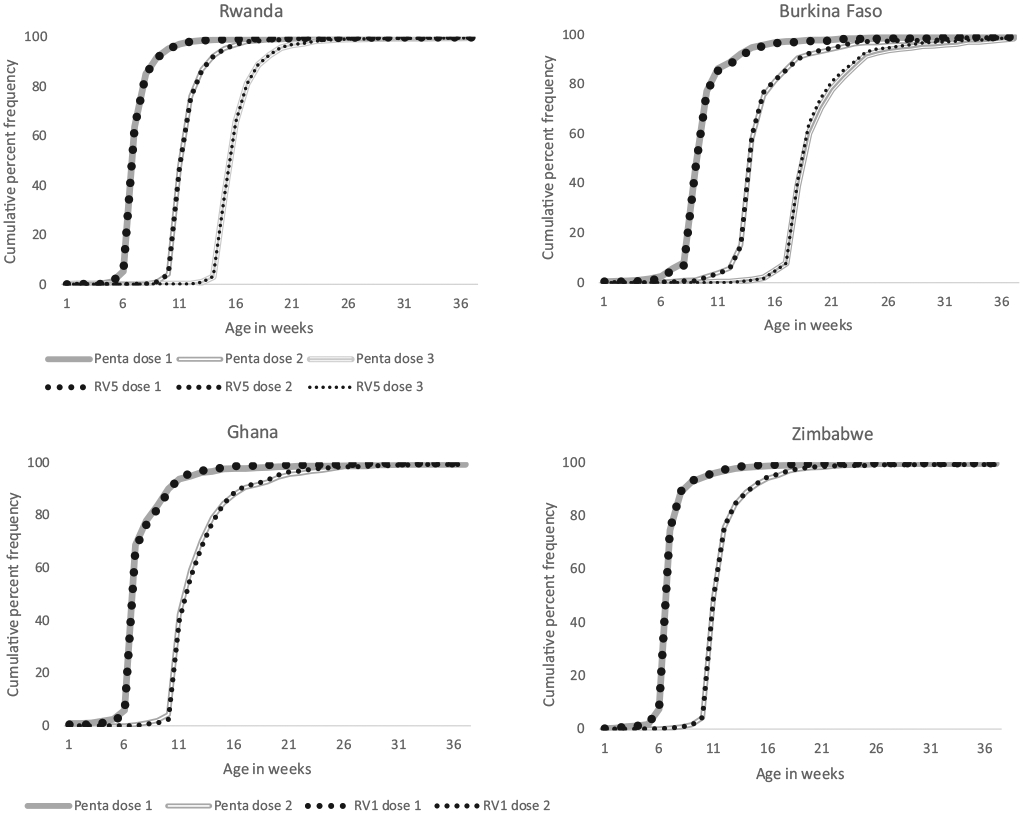
Results: Among children who received rotavirus vaccine dose 1, 96-99% received this dose by 15 weeks of age and among children who received the last dose, 98-99% received it by 32 weeks of age. In all four countries, there was no significant difference in the proportion of children who received first dose rotavirus versus pentavalent vaccine by week 15, or last dose rotavirus versus concordant pentavalent vaccine by week 32. Delayed administration of first dose pentavalent vaccine was significantly associated with missing first dose of rotavirus vaccine in 3 of the 4 countries studied, although delays in administration were rare (1-4%).
Conclusions: Rotavirus vaccination was timely among sentinel sites in these four early rotavirus vaccine-introducing countries in Africa. Late presentation for vaccination may have resulted in some children with access to care missing first dose of rotavirus vaccine; however, vaccination delays were infrequent and therefore the potential impact of the age restrictions on overall proportion vaccinated was minimal.
Keywords: Acute gastroenteritis; Methods; Surveillance; Validation.
Published by Elsevier Ltd.
Figures
References
-
- WHO. Rotavirus vaccines: an update. Week Epidemiolog Rec 2009;84:533–40. - PubMed
-
- WHO. Rotavirus vaccines WHO Position paper–january 2013. Week Epidemiolog Rec 2013;88(5):49–64. - PubMed
-
- World Health Organization; Generic protocols for (i) hospital-based surveillance to estimate the burden of rotavirus gastroenteritis in children and (ii) a community-based survey on utilization of health care services for gastroenteritis in children: field test version; Geneva; Switzerland: WHO; 2002; Available from: http://www.vaccineresources.org/files/Generic_protocol_for_surveillance_...; accessed on 3 July 2018.
Publication types
MeSH terms
Substances
Grants and funding
LinkOut - more resources
Full Text Sources
Medical
