. 2019 Sep 10;116(37):18655-18663.
doi: 10.1073/pnas.1907833116. Epub 2019 Aug 27.

A promising bioconjugate vaccine against hypervirulent Klebsiella pneumoniae

Affiliations

A promising bioconjugate vaccine against hypervirulent Klebsiella pneumoniae

Mario F Feldman et al. Proc Natl Acad Sci U S A. .

Abstract

Hypervirulent Klebsiella pneumoniae (hvKp) is globally disseminating as a community-acquired pathogen causing life-threatening infections in healthy individuals. The fact that a dose as little as 50 bacteria is lethal to mice illustrates the dramatic increase of virulence associated with hvKp strains compared with classical K. pneumoniae (cKp) strains, which require lethal doses greater than 107 bacteria. Until recently, these virulent strains were mostly antibiotic-susceptible. However, multidrug-resistant (MDR) hvKp strains have been emerging, spawning a new generation of hypervirulent "superbugs." The mechanisms of hypervirulence are not fully defined, but overproduction of capsular polysaccharide significantly impedes host clearance, resulting in increased pathogenicity of hvKp strains. While there are more than 80 serotypes of K. pneumoniae, the K1 and K2 serotypes cause the vast majority of hypervirulent infections. Therefore, a glycoconjugate vaccine targeting these 2 serotypes could significantly reduce hvKp infection. Conventionally, glycoconjugate vaccines are manufactured using intricate chemical methodologies to covalently attach purified polysaccharides to carrier proteins, which is widely considered to be technically challenging. Here we report on the recombinant production and analytical characterization of bioconjugate vaccines, enzymatically produced in glycoengineered Escherichia coli cells, against the 2 predominant hypervirulent K. pneumoniae serotypes, K1 and K2. The K. pneumoniae bioconjugates are immunogenic and efficacious, protecting mice against lethal infection from 2 hvKp strains, NTUH K-2044 and ATCC 43816. This preclinical study constitutes a key step toward preventing further global dissemination of hypervirulent MDR hvKp strains.

Keywords: bioconjugation; glycoconjugate; hypervirulent Klebsiella pneumoniae; vaccine.


Conflict of interest statement

Conflict of interest statement: M.F.F. and C.M.H. have a financial stake in VaxNewMo, a for-profit entity developing bioconjugate vaccines against Streptococcus pneumoniae and Klebsiella pneumoniae using patented technology derived from the data presented in this and other published manuscripts.

Figures
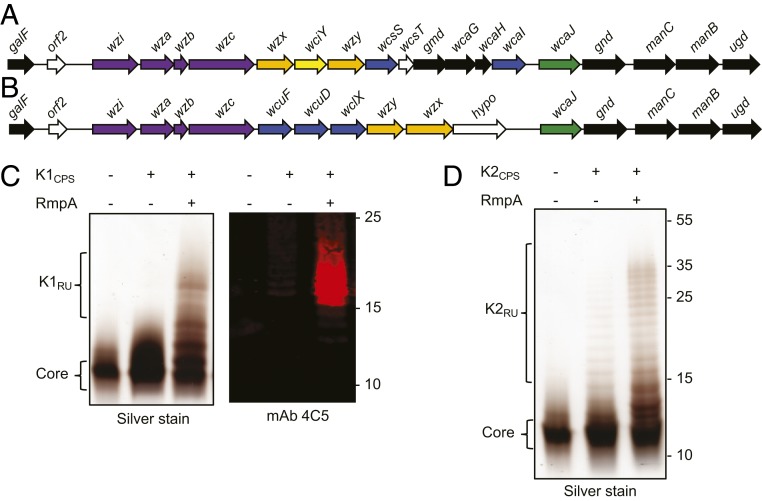
Fig. 1.
Fig. 1.
RmpA enhances expression of the K1 and K2 glycans in E. coli CLM37. (A) The K. pneumoniae K1 CPS gene map and (B) the K. pneumoniae K2 CPS gene map. Black arrows indicate UDP-sugar biosynthesis genes, purple arrows indicate CPS regulatory/surface export genes, orange arrows indicate transport/polymerase genes, blue arrows indicate glycosyltransferase genes, and green arrows indicate initiating glycosyltransferase genes. (C) Silver staining and Western blot analysis of LPS extracted from CLM37, CLM37 expressing the K1 locus, or CLM37 coexpressing the K1 locus and RmpA. (D) Silver staining of LPS extracted from CLM37, CLM37 expressing the K2 locus, or CLM37 coexpressing the K locus and RmpA.
Fig. 2.
Fig. 2.
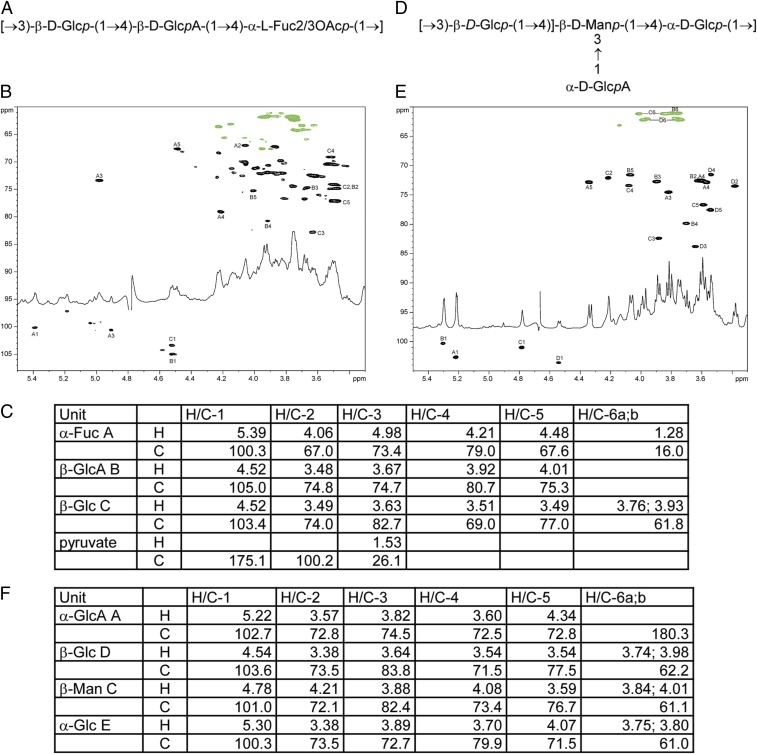
Two-dimensional NMR analysis of K1- and K2-containing LPS extracted from CLM37. (A) The core structure of the K1 repeat unit. (B) The 1H-13C HSQC spectrum of K. pneumoniae K1 polysaccharide produced in E. coli. Signals of the 2 variable O-acetylated fucoses are not shown because of low signal intensity. (C) NMR data for the K. pneumoniae K1 polysaccharide and the E. coli core (D2O, 25 °C, 600 MHz). Data for the main structure with O-acetylation (OAc) at Fucose A O-3. OAc 2.08/21.6 ppm. (D) The core structure of the K2 repeat unit. (E) The 1H-13C HSQC spectrum of K. pneumoniae K2 polysaccharide produced in E. coli (D2O, 35 °C, 600 MHz). (F) NMR data for the K. pneumoniae K2 polysaccharide and the E. coli core (D2O, 35 °C, 600 MHz).
Fig. 3.
Fig. 3.
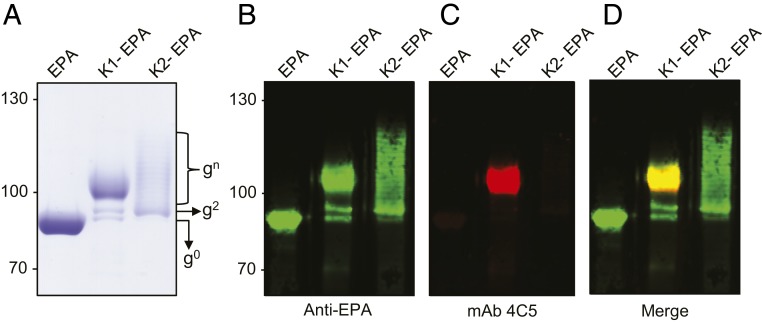
K1-EPA and K2-EPA bioconjugate vaccines. (A) Coomassie-stained image of purified EPA, K1-EPA, and K2-EPA. Each lane was loaded with ∼5 µg of glycoconjugate based on total protein. The unglycosylated EPA exists a single band. The K1-EPA exists as multiple glycoforms migrating in smear-like pattern. The K2-EPA bioconjugate migrates with a modal, ladder distribution. Each lane was loaded with ∼0.5 µg of glycoconjugate based on total protein. (BD) Western blot analysis probing for EPA and the K1 glycan. (B) Anti-EPA Western blot, (C) anti-K1 Western blot, and (D) merge image.
Fig. 4.
Fig. 4.
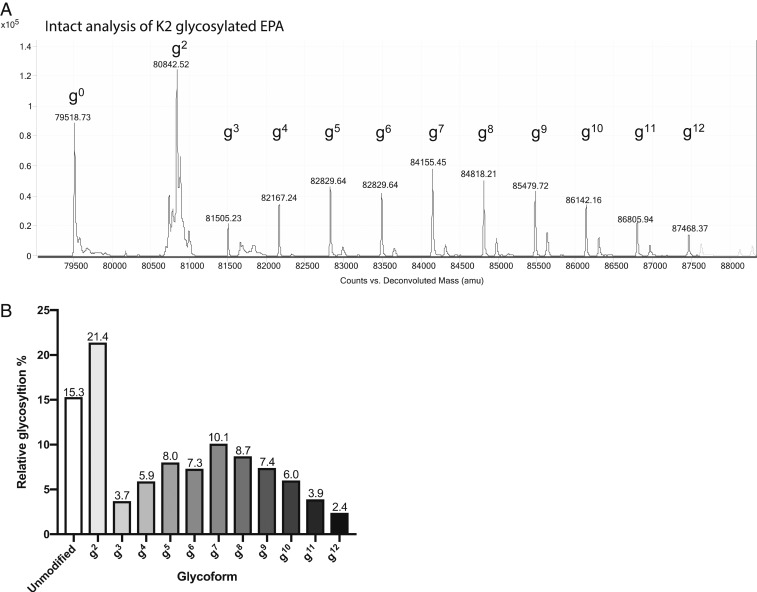
Mass spectrometry analysis of K2-EPA. (A) Intact protein mass spectrometry analysis showing the MS1 mass spectra for K2-EPA. The EPA fusion protein has a theoretical mass of 79,526.15 Da and can be observed as the peak at 79,518.73 Da. The EPA fusion protein was also observed in multiple states of increasing mass corresponding to the K2 repeat unit, which has a mass of 662 Da. Varying glycoforms of K2-EPA were observed and are denoted by “gnumeric”, where “g” stands for glycoform and the “numeric” corresponds to the number of repeating CPS8 subunits. (B) Quantification of the relative abundance of each K2 glycoform.
Fig. 5.
Fig. 5.
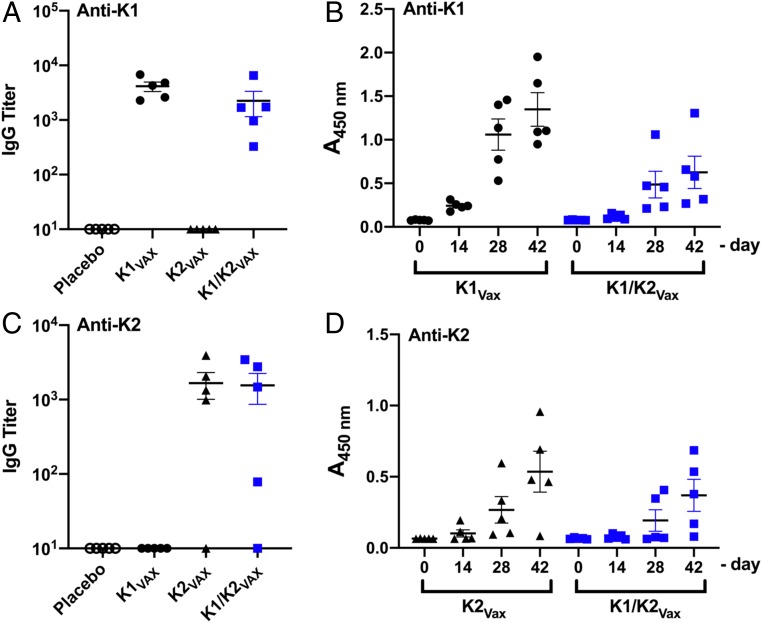
IgG responses to K1 and K2 bioconjugate vaccines. (A) Titers of K1-specific IgG antibodies in mice immunized with EPA, K1-EPA, K2-EPA, or a bivalent K-/K2-EPA. (B) K1-specific IgG kinetics over the course of the immunization as measured by ELISA and quantified by absorbance at 450 nm. (C) Titers of K2-specific IgG antibodies in mice immunized with EPA, K1-EPA, K2-EPA, or a bivalent K-/K2-EPA. (D) K2-specific IgG kinetics over the course of the immunization as measured by ELISA and quantified by absorbance at 450 nm.
Fig. 6.
Fig. 6.
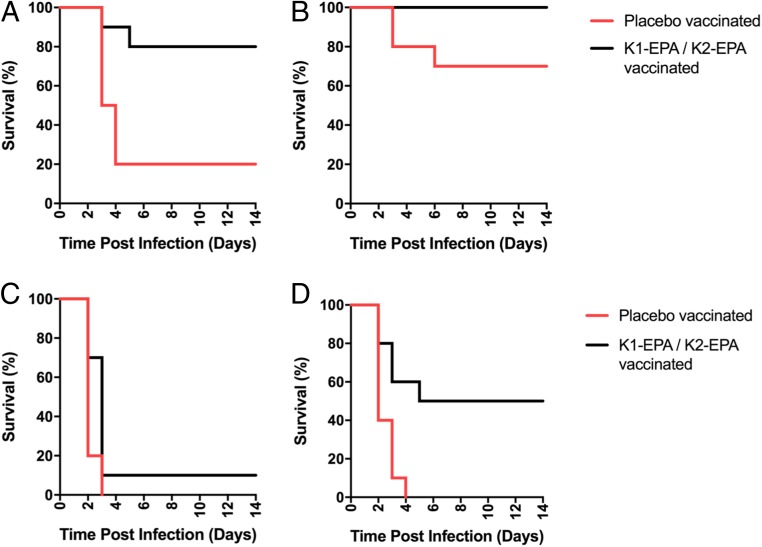
Survival of placebo- and bivalent bioconjugate-vaccinated mice after lethal challenge with hvKp. Groups of mice were vaccinated with either the placebo or the bivalent K1-/K2-EPA bioconjugate on days 0, 14, and 28. Anesthetized mice were aspirated with either the K. pneumoniae NTUH K-2044 or ATCC 43816 and monitored for survival for 14 d. For low-dose challenge studies, mice were infected with (A) 50 CFU of NTUH K-2044 or (B) 250 CFU of ATCC 43816. For high-dose challenge studies, mice were infected with (C) 4,700 CFU of NTUH K-2044 or (D) 4,300 CFU of ATCC 43816. Each graph represents data from a single experiment with n = 10 mice per group. Statistical analysis was performed via log-rank (Mantel–Cox) tests.

References

    1. Magill S. S., et al. ; Emerging Infections Program Healthcare-Associated Infections and Antimicrobial Use Prevalence Survey Team , Multistate point-prevalence survey of health care-associated infections. N. Engl. J. Med. 370, 1198–1208 (2014). - PMC - PubMed
    1. Division of Healthcare Quality Promotion, National Center for Emerging and Zoonotic Infectious Diseases, Centers for Disease Control and Prevention , Antibiotic Resistance Threats in the United States (Centers for Disease Control and Prevention, Atlanta, GA, 2013).
    1. Shon A. S., Bajwa R. P., Russo T. A., Hypervirulent (hypermucoviscous) Klebsiella pneumoniae: A new and dangerous breed. Virulence 4, 107–118 (2013). - PMC - PubMed
    1. Cheng D. L., Liu Y. C., Yen M. Y., Liu C. Y., Wang R. S., Septic metastatic lesions of pyogenic liver abscess. Their association with Klebsiella pneumoniae bacteremia in diabetic patients. Arch. Intern. Med. 151, 1557–1559 (1991). - PubMed
    1. Liu Y. C., Cheng D. L., Lin C. L., Klebsiella pneumoniae liver abscess associated with septic endophthalmitis. Arch. Intern. Med. 146, 1913–1916 (1986). - PubMed

Publication types

MeSH terms

LinkOut - more resources