. 2019 Aug 27;9(1):12394.
doi: 10.1038/s41598-019-48855-1.

Pharmacologically reversible, loss of function mutations in the TM2 and TM4 inner pore helices of TREK-1 K2P channels

Affiliations

Pharmacologically reversible, loss of function mutations in the TM2 and TM4 inner pore helices of TREK-1 K2P channels

Ehab Al-Moubarak et al. Sci Rep. .

Abstract

A better understanding of the gating of TREK two pore domain potassium (K2P) channels and their activation by compounds such as the negatively charged activator, flufenamic acid (FFA) is critical in the search for more potent and selective activators of these channels. Currents through wild-type and mutated human K2P channels expressed in tsA201 cells were measured using whole-cell patch-clamp recordings in the presence and absence of FFA. Mutation of the TM2.6 residue of TREK-1 to a phenylalanine (G171F) and a similar mutation of TM4.6 (A286F) substantially reduced current through TREK-1 channels. In complementary experiments, replacing the natural F residues at the equivalent position in TRESK channels, significantly enhanced current. Known, gain of function mutations of TREK-1 (G137I, Y284A) recovered current through these mutated channels. This reduction in current could be also be reversed pharmacologically, by FFA. However, an appropriate length MTS (MethaneThioSulfonate) cross-linking reagent (MTS14) restricted the activation of TREK-1_A286C channels by repeated application of FFA. This suggests that the cross-linker stabilises the channel in a conformation which blunts FFA activation. Pharmacologically reversible mutations of TREK channels will help to clarify the importance of these channels in pathophysiological conditions such as pain and depression.


Conflict of interest statement

The authors declare no competing interests.

Figures
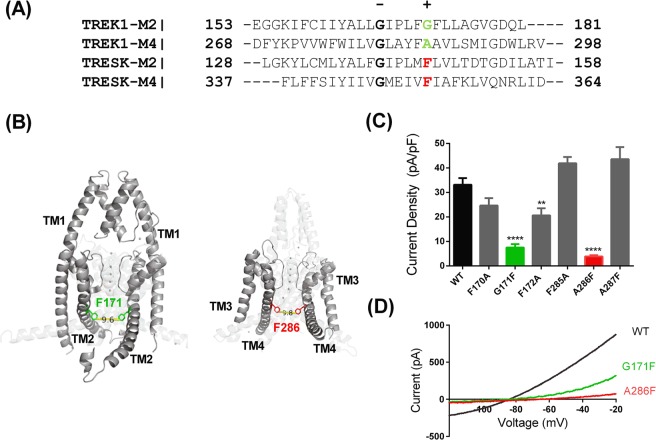
Figure 1
Figure 1
Loss of function through mutation of the TM2.6 and TM4.6 inner pore residues of TREK-1 channels. (A) Alignment of the inner pore amino acids of TREK-1 and TRESK channels. The conserved hinge glycine residues are indicated by “−” and the TM2.6 and TM4.6 amino acids by “+”. (B) Illustration of hTREK-1_G171F/A286F structure created from the pdb file for the crystal structure of TREK-1 (6GC6). For clarity, TM3 and TM4 are rotated through 90° and separated from TM1 and TM2. F171 residues are green, F286 residues are red. (C) Histogram of outward currents measured as the difference current between that at −40 mV and −80 mV for WT TREK-1 and mutated TREK-1 channels (** = significantly different from wild type at <0.05 level, **** = significantly different from wild type at <0.001 level, 1-way ANOVA followed by Dunnett’s test, WT vs F172A, p = 0.0007; WT vs G171F, p < 0.0001; WT vs A286F, p < 0.0001). (D) Representative current-voltage relationships for WT TREK-1, TREK-1_G171F and TREK-1_A286F channels.
Figure 2
Figure 2
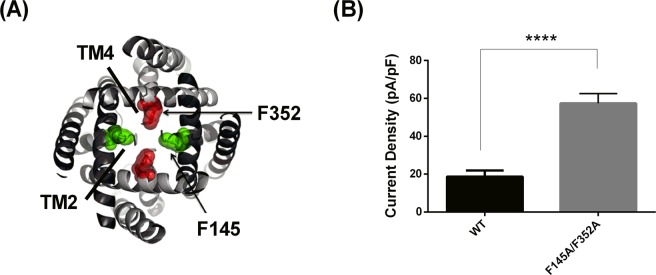
Gain of function through mutation of the TM2.6 and TM4.6 inner pore residues of TRESK channels. (A) Model of hTRESK based on TRAAK crystal structure, highlighting the constriction point amino acids in the inner pore. F145 residues are green, F352 are red. (B) Histogram of outward current measured as the difference current between that at −40 mV and −80 mV for WT TRESK and TRESK_F145A/F352A channels (****p < 0.001, t-test).
Figure 3
Figure 3
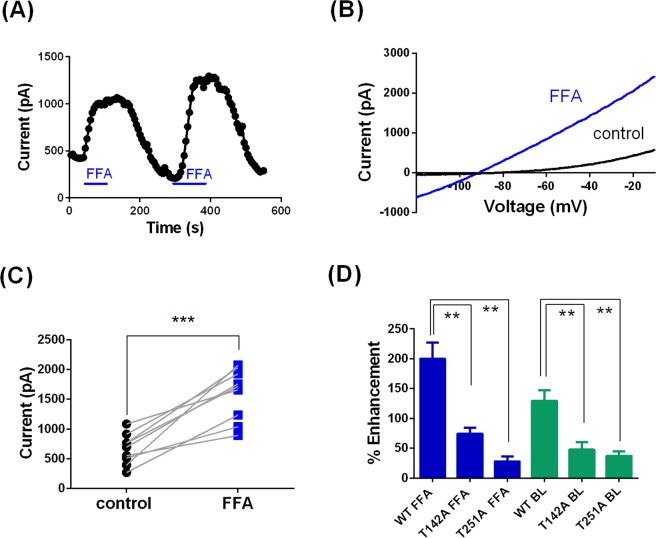
FFA enhancement of TREK-1 channel current is blocked by selectivity filter mutations. (A) Representative time course for enhancement of WT TREK-1 current by FFA (100 µM). Application of FFA is indicated by the blue bar. (B) Representative current-voltage relationship for WT TREK-1 channels in the presence (blue) and absence of FFA. (C) Enhancement of WT TREK-1 current by FFA in individual cells (*** = significant difference following application of FFA at <0.01 level, paired t test). (D) Histogram of percentage enhancement by FFA (100 µM, blue) and BL-1249 (1 µM, green) of WT TREK-1 and mutated TREK-1 channels (** = significantly different from wild type at <0.05 level, ANOVA followed by Tukey’s test).
Figure 4
Figure 4
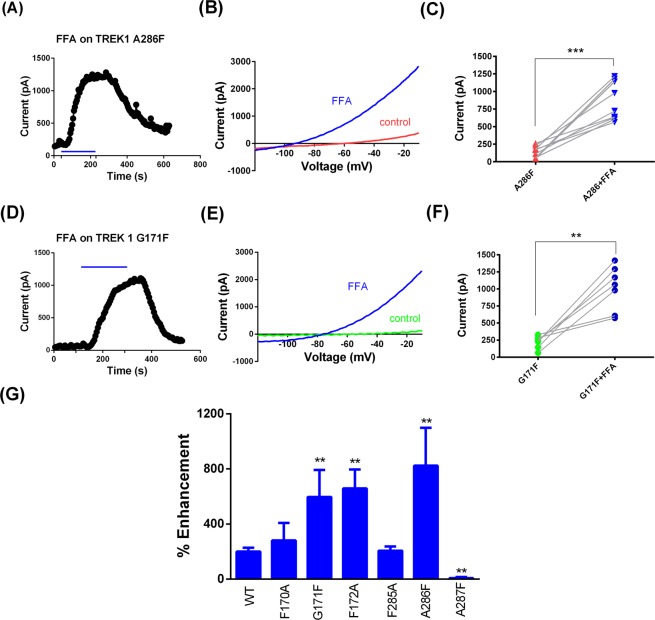
FFA substantially enhances current through TM2.6 (G171F) and TM4.6 (A286F) loss of function mutated TREK-1 channels. (A) Representative time course for enhancement of TREK-1_A286F current by FFA (100 µM). (B) Representative current-voltage relationship for TREK-1_A286F channels in the presence (blue) and absence (red) of FFA. (C) Enhancement of TREK-1_A286F current by FFA in individual cells (*** = significant difference following application of FFA at <0.01 level, paired t test). (D) Representative time course for enhancement of TREK-1_G171F current by FFA (100 µM). (E) Representative current-voltage relationship for TREK-1_G171F channels in the presence (blue) and absence (green) of FFA. (F) Enhancement of TREK-1_G171F current by FFA in individual cells (** = significant difference following application of FFA at <0.05 level, paired t test). (G) Histogram of percentage enhancement by FFA (100 µM) of WT TREK-1 and mutated TREK-1 channels (** = significantly different from wild type at <0.05 level, ANOVA followed by Tukey’s test).
Figure 5
Figure 5
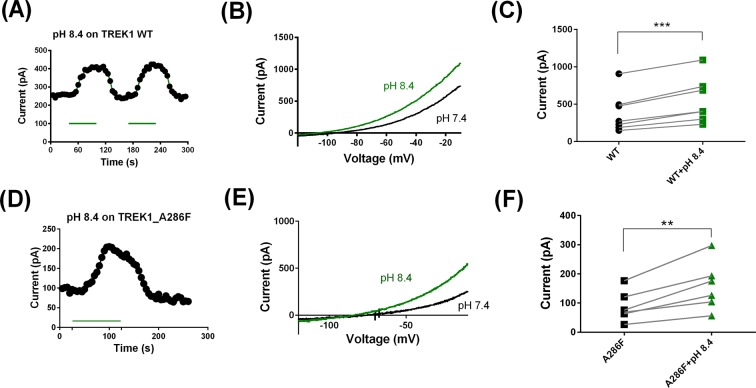
Alkalinisation has similar, modest effects on WT and TM4.6 (A286F) loss of function mutated TREK-1 channels. (A) Representative time course for enhancement of WT TREK-1 current by pH 8.4. (B) Representative current-voltage relationship for WT TREK-1 channels in pH 8.4 (green) and pH 7.4. (C) Enhancement of WT TREK-1 current by pH 8.4 in individual cells (*** = significant difference at <0.01 level, paired t test). (D) Representative time course for enhancement of TREK-1_A286F current by pH 8,4. (E) Representative current-voltage relationship for TREK-1_A286F channels in pH 8.4 (green) and pH 7.4. (F) Enhancement of TREK-1_A286F current by pH 8.4 in individual cells (** = significant difference at <0.05 level, paired t test).
Figure 6
Figure 6
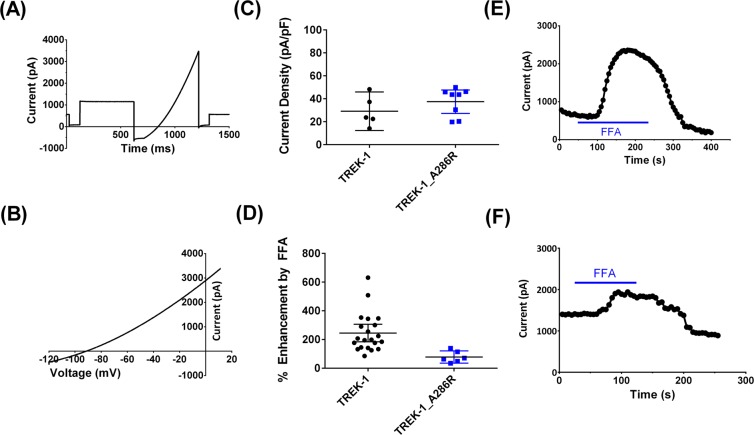
TM4.6 A286R mutant TREK-1 channels have reduced sensitivity to FFA. (A,B) Representative currents through TREK-1_A286R channels. (C) Current density for WT and TREK-1_A286R channels. There was no significant difference in current density between the two. (D) Percentage enhancement of WT and A286R channels by FFA. Percentage enhancement was significantly reduced for the mutant channel compared to WT (p = 0.006, t test). (E,F) Representative time course plots for enhancement by FFA of WT (E) and A286R (F) channels.
Figure 7
Figure 7
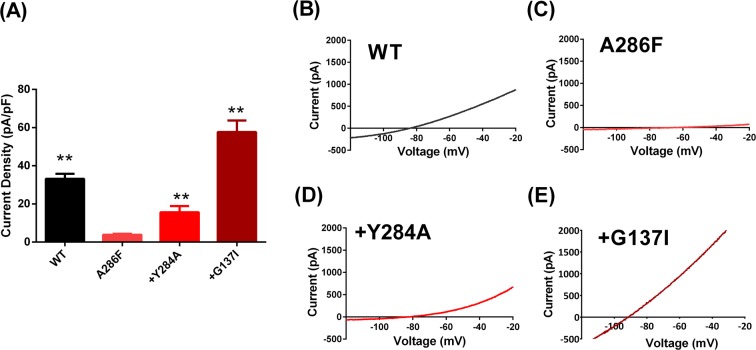
Gain of function mutations recover current through TM4.6 (A286F) mutated TREK-1 channels. (A) Histogram of outward currents measured as the difference current between that at −40 mV and −80 mV for WT TREK-1 and mutated TREK-1 channels (** = significantly different from TREK-1_A286F channels at <0.05 level, ANOVA followed by Tukey’s test). (BE) Representative current-voltage relationships for WT and mutated TREK-1 channels.
Figure 8
Figure 8
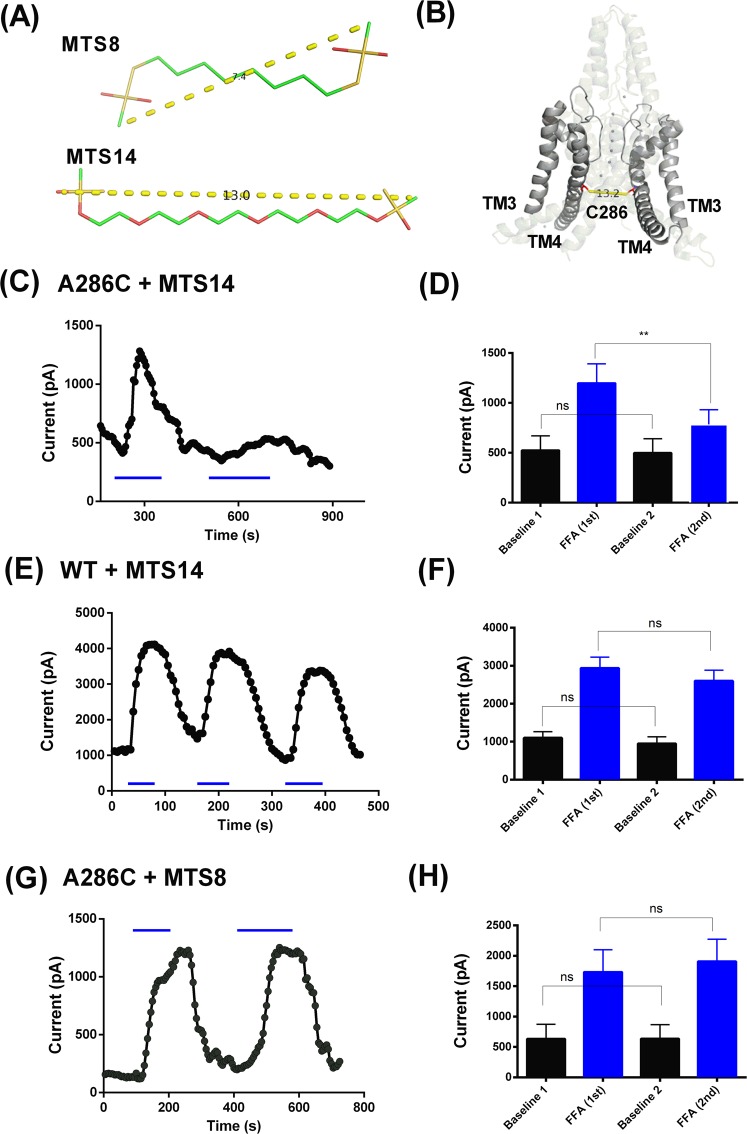
TM4.6 crosslinking hampers FFA regulation of TREK-1. (A) Molecular representation of MTS-8 and MTS-14. (B) Illustration of the TM3 and TM4 regions of TREK-1_ A286C structure created from the pdb file for the crystal structure of TREK-1 (6GC6), indicating the distance between the C286 residues. (C) Representative time course for enhancement of TREK-1_A286C current by FFA (100 µM) in the presence of intracellular MTS-14. (D) Histogram of outward currents measured as the difference current between that at −40 mV and −80 mV for TREK-1_A286C channels before (black) and during (blue) consecutive applications of FFA (100 µM) in the presence of intracellular MTS-14 (** = significant difference between first and second applications of FFA at p = 0.002, paired t test). (E) Representative time course for enhancement of WT TREK-1 current by FFA (100 µM) in the presence of intracellular MTS-14. (F) Histogram of outward currents measured as the difference current between that at −40 mV and −80 mV for WT TREK-1 channels before (black) and during (blue) consecutive applications of FFA (100 µM) in the presence of intracellular MTS-14 (no significant difference between first and second applications of FFA at 0.05 level, paired t test). (G) Representative time course for enhancement of TREK-1_A286C current by FFA (100 µM) in the presence of intracellular MTS-8. (H) Histogram of outward currents measured as the difference current between that at −40 mV and −80 mV for TREK-1_A286C channels before (black) and during (blue) consecutive applications of FFA (100 µM) in the presence of intracellular MTS-8 (no significant difference between first and second applications of FFA at 0.05 level, paired t test).

References

    1. Enyedi P, Czirjak G. Molecular background of leak K+ currents: Two-pore domain potassium channels. Physiol. Rev. 2010;90:559–605. doi: 10.1152/physrev.00029.2009. - DOI - PubMed
    1. Feliciangeli S, Chatelain FC, Bichet D, Lesage F. The family of K2P channels: salient structural and functional properties. J. Physiol. 2015;593:2587–2603. doi: 10.1113/jphysiol.2014.287268. - DOI - PMC - PubMed
    1. Renigunta V, Schlichthörl G, Daut J. Much more than a leak: structure and function of K2p-channels. Pflugers Arch. 2015;467:867–894. doi: 10.1007/s00424-015-1703-7. - DOI - PubMed
    1. Honoré E. The neuronal background K2P channels: focus on TREK-1. Nat. Rev. Neurosci. 2007;8:251–261. doi: 10.1038/nrn2117. - DOI - PubMed
    1. Noël J, Sandoz G, Lesage F. Molecular regulations governing TREK and TRAAK channel functions. Channels. 2011;5:402–409. doi: 10.4161/chan.5.5.16469. - DOI - PMC - PubMed

Publication types

MeSH terms

Substances