. 2019 Aug 27;9(1):12445.
doi: 10.1038/s41598-019-47447-3.

Deformed wing virus type A, a major honey bee pathogen, is vectored by the mite Varroa destructor in a non-propagative manner

Affiliations

Deformed wing virus type A, a major honey bee pathogen, is vectored by the mite Varroa destructor in a non-propagative manner

Francisco Posada-Florez et al. Sci Rep. .

Abstract

Honey bees, the primary managed insect pollinator, suffer considerable losses due to Deformed wing virus (DWV), an RNA virus vectored by the mite Varroa destructor. Mite vectoring has resulted in the emergence of virulent DWV variants. The basis for such changes in DWV is poorly understood. Most importantly, it remains unclear whether replication of DWV occurs in the mite. In this study, we exposed Varroa mites to DWV type A via feeding on artificially infected honey bees. A significant, 357-fold increase in DWV load was observed in these mites after 2 days. However, after 8 additional days of passage on honey bee pupae with low viral loads, the DWV load dropped by 29-fold. This decrease significantly reduced the mites' ability to transmit DWV to honey bees. Notably, negative-strand DWV RNA, which could indicate viral replication, was detected only in mites collected from pupae with high DWV levels but not in the passaged mites. We also found that Varroa mites contain honey bee mRNAs, consistent with the acquisition of honey bee cells which would additionally contain DWV replication complexes with negative-strand DWV RNA. We propose that transmission of DWV type A by Varroa mites occurs in a non-propagative manner.


Conflict of interest statement

The authors declare no competing interests. Mention of trade names or commercial products in this publication is solely for the purpose of providing specific information and does not imply recommendation or endorsement by the U.S. Department of Agriculture.

Figures
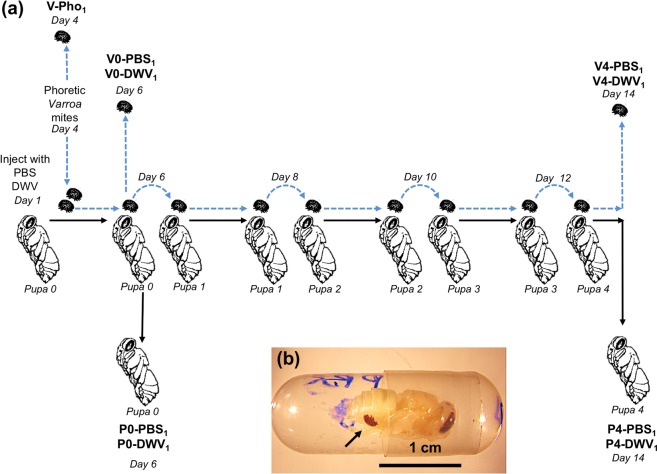
Figure 1
Figure 1
Experiment 1 design: “Varroa mite DWV acquisition experiment”. (a) Honey bee and the mite treatment groups are shown in bold. Times of sampling (days of the experiment) are indicated. (b) In vitro incubation of honey bee pupa with Varroa mites in gelatin capsule.
Figure 2
Figure 2
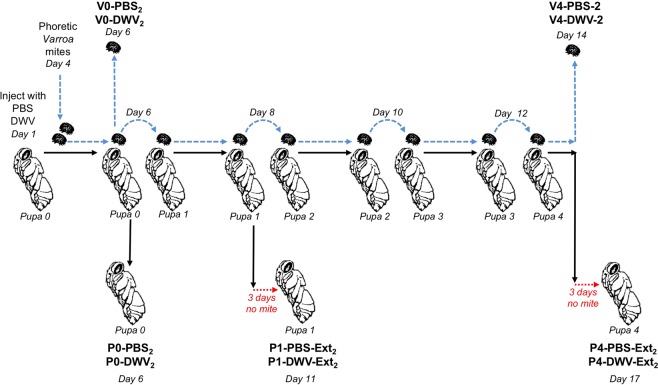
Experiment 2 design: “Varroa-mediated DWV transmission experiment”. Honey bee and the mite treatment groups are shown in bold. Times of sampling (days of the experiment) are indicated.
Figure 3
Figure 3
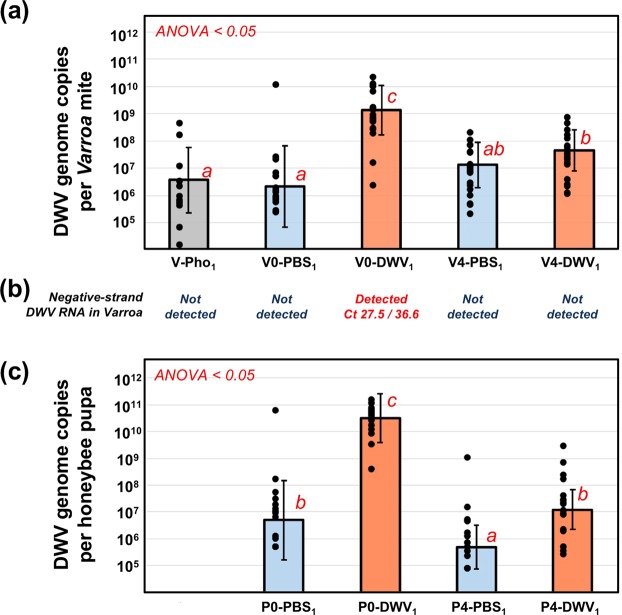
Dynamics of DWV RNA accumulation in Varroa destructor mites and honey bee pupae from Experiment 1: “Varroa mite DWV acquisition experiment”. (a,c) Average DWV RNA copies per (a) Varroa destructor mites, and (b) honey bee pupae, ± SD. Red letters above the bars indicate significantly and non-significantly different groups (ANOVA). Treatment groups are named as in the Fig. 1. Individual mite and pupa copy numbers indicated by black dots. Corresponding mite (a) and pupae (c) groups are aligned vertically. (b) Detection of negative strand DWV RNA in Varroa mite groups. The Ct values shown are as follows: Assay 1/Assay 2.
Figure 4
Figure 4
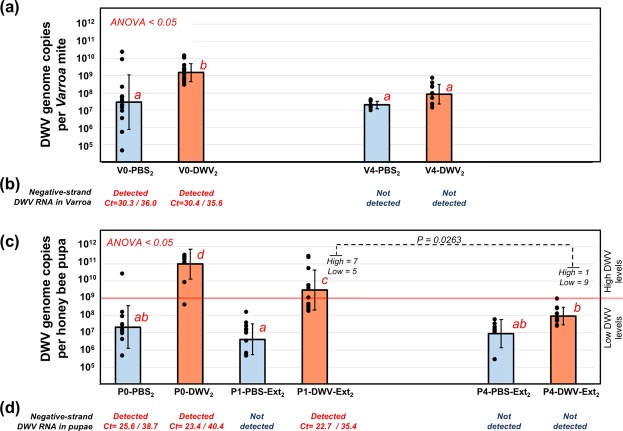
Dynamics of DWV RNA accumulation in Varroa destructor mites and honey bee pupae from Experiment 2: “Varroa-mediated DWV transmission experiment”. (a,c) Average DWV RNA copies per (a) Varroa destructor mites, and (b) honey bee pupae, ±SD. Red letters above the bars indicate significantly and non-significantly different groups (ANOVA). Treatment groups are named as in Fig. 2. Individual mite and pupa copy numbers indicated by black dots. Corresponding mite (a) and pupae (c) groups are aligned vertically. The threshold levels of 109 DWV genomic RNA copies per honey bee pupae is shown as a red line in (c). Detection of the negative strand DWV RNA in (b) Varroa mite groups and (d) honey bee pupae. The Ct values shown are as follows: Assay 1/Assay 2.
Figure 5
Figure 5
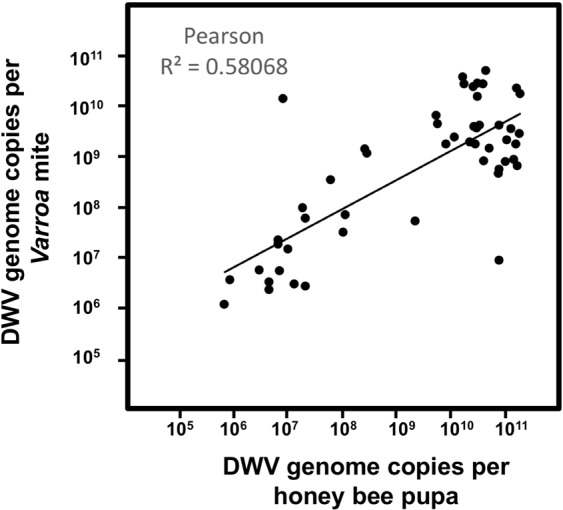
Prevalence of DWV in honey bees (X axis) and associated Varroa mites (Y-axis) in simultaneously sampled pupae and mites. Positive correlation between DWV copy numbers (Pearson R2 = 0.58068, n = 51, p < 0.0001). Only mites and pupae with DWV levels above the detection thresholds were used.

References

    1. Vanbergen AJ, et al. Threats to an ecosystem service: pressures on pollinators. Frontiers in Ecology and the Environment. 2013;11:251–259. doi: 10.1890/120126. - DOI
    1. Brutscher LM, McMenamin AJ, Flenniken ML. The Buzz about honey bee viruses. PLoS Pathog. 2016;12:e1005757. doi: 10.1371/journal.ppat.1005757. - DOI - PMC - PubMed
    1. Lanzi G, et al. Molecular and biological characterization of deformed wing virus of honeybees (Apis mellifera L.) J. Virol. 2006;80:4998–5009. doi: 10.1128/JVI.80.10.4998-5009.2006. - DOI - PMC - PubMed
    1. Gallai N, Salles J-M, Settele J, Vaissiere BE. Economic valuation of the vulnerability of world agriculture confronted with pollinator decline. Ecological Economics. 2009;68:810–821. doi: 10.1016/j.ecolecon.2008.06.014. - DOI
    1. Goulson D, Nicholls E, Botias C, Rotheray EL. Bee declines driven by combined stress from parasites, pesticides, and lack of flowers. Science. 2015;347:1255957. doi: 10.1126/science.1255957. - DOI - PubMed

Publication types

Supplementary concepts