


Comparison of Goldmann applanation and Ocular Response Analyser tonometry: intraocular pressure agreement and patient preference
- PMID: 31455900
- PMCID: PMC7042243
- DOI: 10.1038/s41433-019-0556-2
Comparison of Goldmann applanation and Ocular Response Analyser tonometry: intraocular pressure agreement and patient preference
Abstract
Objectives: To evaluate the agreement between Goldmann applanation tonometry (GAT) and Ocular Response Analyser (ORA) intraocular pressure (IOP) measurements, and patients' preferences.
Methods: Both eyes of participants in the 'Glaucoma within the Northern Ireland Cohort for the Longitudinal Study of Ageing' (GwNICOLA) were included. Participants underwent GAT by a glaucoma expert and ORA tonometry in a random order. Investigators were masked to measurements between devices. Participants were asked which tonometer, if any, they would prefer. We estimated the 95% limits of agreement (95% LoA) and the variables that influence agreement between tonometers.
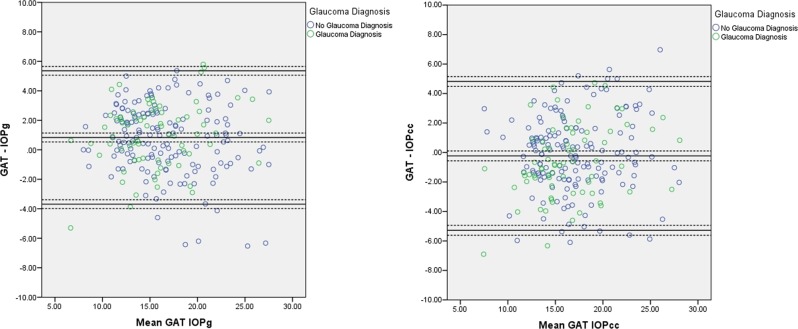
Results: There were 228 eyes of 120 participants included in this study. Mean age of participants was 68.0 years (SD 8.79) and 52.5% were female. For GAT-ORA IOPcc the mean difference with GAT (95% CI) was -0.23 mmHg (-0.57 mmHg, 0.11 mmHg) and the 95% LoA (95% CIs) were from 4.82 mmHg (5.15 mmHg, 4.48 mmHg) to -5.28 mmHg (-5.61 mmHg, -4.94 mmHg). 40.8% of eyes had an IOP difference of 2 mmHg or more between GAT and ORA IOPcc. Corneal resistance factor (CRF) as estimated by ORA influenced the agreement between GAT and ORA IOPcc. There were no differences in preference for method of tonometry.
Conclusions: Although ORA IOPcc measurements with ORA did not show significant bias compared with GAT, the relatively large proportion of measurement differences between ORA IOPcc and GAT that were >2 mmHg indicates that GAT and ORA IOP measurements may not be interchangeable. There were no differences in preference for method of tonometry.
Conflict of interest statement
The authors declare that they have no conflict of interest.
Figures
References
Publication types
MeSH terms
Grants and funding
LinkOut - more resources
Full Text Sources
