


Chemotherapy-induced peripheral neuropathy (CIPN) in breast cancer survivors: a comparison of patient-reported outcomes and quantitative sensory testing
- PMID: 31456070
- PMCID: PMC6819268
- DOI: 10.1007/s10549-019-05416-4
Chemotherapy-induced peripheral neuropathy (CIPN) in breast cancer survivors: a comparison of patient-reported outcomes and quantitative sensory testing
Abstract
Purpose: CIPN is a common, debilitating, and dose-limiting side effect of chemotherapy. Here, we describe characteristics of patients with CIPN using both patient-reported outcomes (PRO) and quantitative sensory testing (QST).
Methods: Breast cancer survivors with persistent moderate to severe CIPN defined by a rating of 4 or greater on a 0-10 Numeric Rating Scale (NRS) from two ongoing clinical trials were included. PROs included the Neuropathic Pain Scale (NPS) and Functional Assessment of Cancer Therapy-Gynecologic Oncology Group/Neurotoxicity (FACT/GOG-Ntx). QST included tactile and vibration detection threshold measurements. Data were analyzed using descriptive statistics and Spearman correlation coefficients.
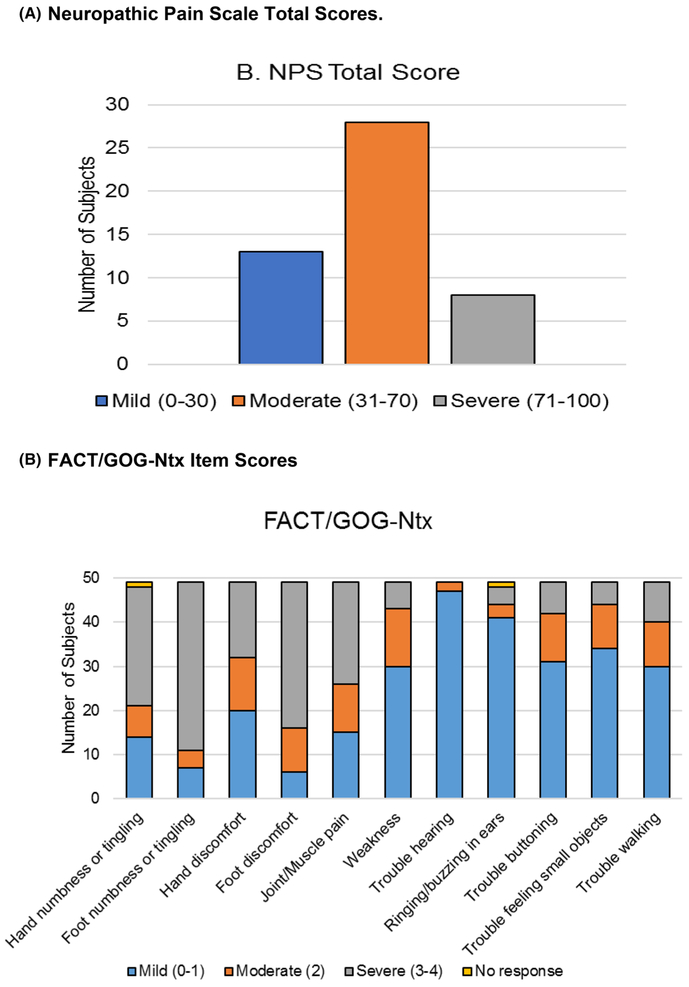
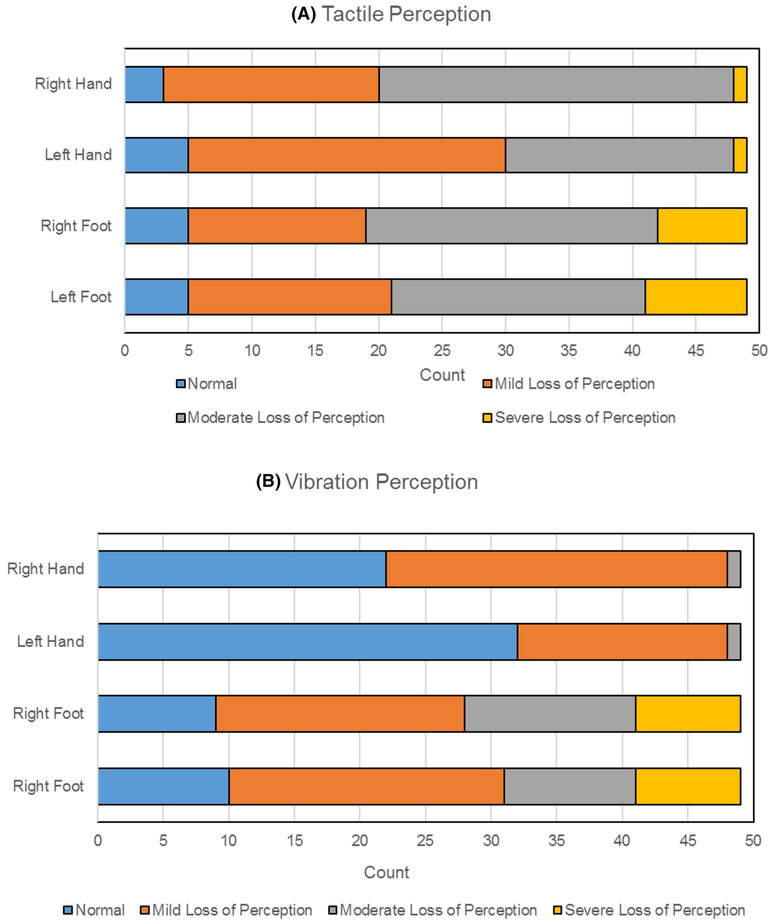
Results: 49 female patients with a mean age of 61 years were assessed; 63% were Caucasian. Mean NRS scores were 4.2, 5.7, and 4.3 on 0-10 scale for pain, numbness, and tingling, respectively. Mean NPS score was 41.0 on a 0-100 scale, and the mean FACT/GOG-Ntx score was 25.8 on a 0-44 scale. QST showed mild to moderate impairments in tactile and vibration perception. The FACT/GOG-Ntx subscale for numbness was negatively correlated with tactile and vibration thresholds in both hands and feet (both p < 0.05). NPS was positively correlated with tactile thresholds in the hands and feet (p < 0.05).
Conclusion: Patients with moderate to severe CIPN report moderate pain, numbness, and tingling, and exhibit reduced tactile and vibration perception on QST. Weak to moderate correlations were observed between PRO and QST. These data suggest that QST outcomes are associated with CIPN symptoms and may be useful in helping monitor and manage CIPN treatment.
Trial registration: ClinicalTrials.gov NCT03183037 NCT03292328.
Keywords: Breast cancer; Chemotherapy; Patient-reported outcomes; Peripheral neuropathy; Quantitative sensory testing.
Conflict of interest statement
Figures
References
-
- Henderson IC, Berry DA, Demetri GD, Cirrincione CT, Goldstein LJ, Martino S, Ingle JN, Cooper MR, Hayes DF, Tkaczuk KH, Fleming G, Holland JF, Duggan DB, Carpenter JT, Frei E 3rd, Schilsky RL, Wood WC, Muss HB, Norton L (2003) Improved outcomes from adding sequential paclitaxel but not from escalating doxorubicin dose in an adjuvant chemotherapy regimen for patients with node-positive primary breast cancer. J Clin Oncol 21:976–983 - PubMed
-
- De Laurentiis M, Cancello G, D’Agostino D, Giuliano M, Giordano A, Montagna E, Lauria R, Forestieri V, Esposito A, Silvestro L, Pennacchio R, Criscitiello C, Montanino A, Limite G, Bianco AR, De Placido S (2008) Taxane-based combinations as adjuvant chemotherapy of early breast cancer: a meta-analysis of randomized trials. J Clin Oncol 26:44–53 - PubMed
-
- Seretny M, Currie GL, Sena ES, Ramnarine S, Grant R, MacLeod MR, Colvin LA, Fallon M (2014) Incidence, prevalence, and predictors of chemotherapy-induced peripheral neuropathy: a systematic review and meta-analysis. PAIN® 155:2461–2470 - PubMed
-
- Sun S, Wang LP, Zhang J, Yang XY, Zhang QL, Jia Z, Hu XC, Wang BY (2012) Phase II study of oxaliplatin plus leucovorin and 5-fluorouracil in heavily pretreated metastatic breast cancer patients. Med Oncol 29:418–424 - PubMed
Publication types
MeSH terms
Substances
Associated data
Grants and funding
LinkOut - more resources
Full Text Sources
Other Literature Sources
Medical
Miscellaneous
