. 2019 Aug 13:10:1897.
doi: 10.3389/fmicb.2019.01897. eCollection 2019.

Genetic Diversity of Brucella melitensis in Kazakhstan in Relation to World-Wide Diversity

Affiliations

Genetic Diversity of Brucella melitensis in Kazakhstan in Relation to World-Wide Diversity

Elena Shevtsova et al. Front Microbiol. .

Abstract

We describe the genetic diversity of 1327 Brucella strains from human patients in Kazakhstan using multiple-locus variable-number tandem repeat (VNTR) analysis (MLVA). All strains were assigned to the Brucella melitensis East Mediterranean group and clustered into 16 MLVA11 genotypes, nine of which are reported for the first time. MLVA11 genotype 116 predominates (86.8%) and is present all over Kazakhstan indicating existence and temporary preservation of a "founder effect" among B. melitensis strains circulating in Central Eurasia. The diversity pattern observed in humans is highly similar to the pattern previously reported in animals. The diversity observed by MLVA suggested that the epidemiological status of brucellosis in Kazakhstan is the result of the introduction of a few lineages, which have subsequently diversified at the most unstable tandem repeat loci. This investigation will allow to select the most relevant strains for testing these hypotheses via whole genome sequencing and to subsequently adjust the genotyping scheme to the Kazakhstan epidemiological situation.

Keywords: Brucella melitensis; Kazakhstan; genetic diversity; genotyping; multiple-locus variable-number tandem repeat (VNTR) analysis (MLVA).


Figures
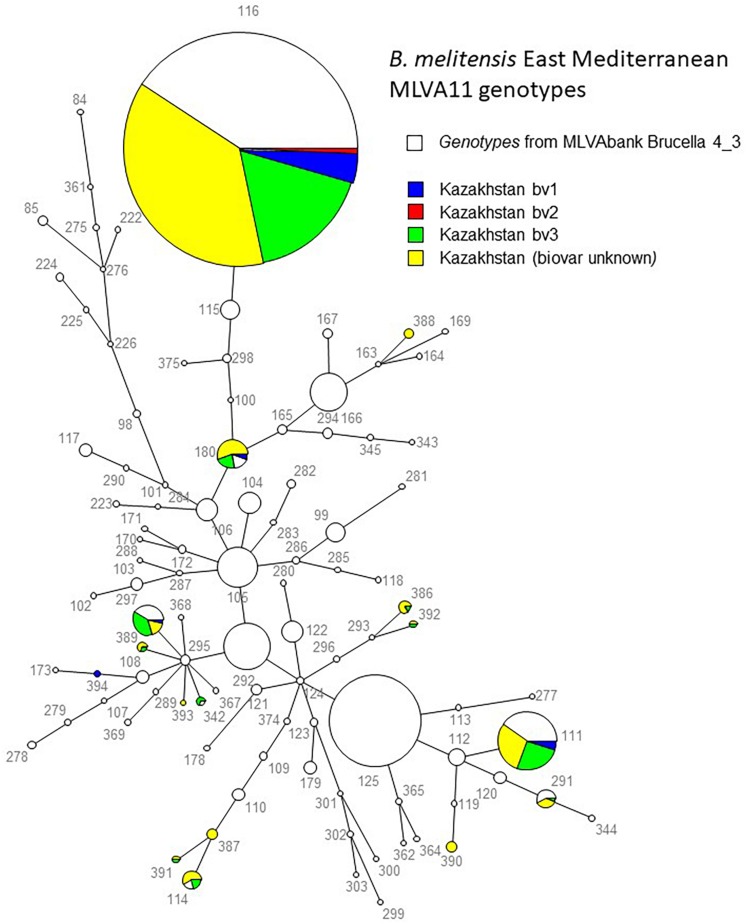
FIGURE 1
FIGURE 1
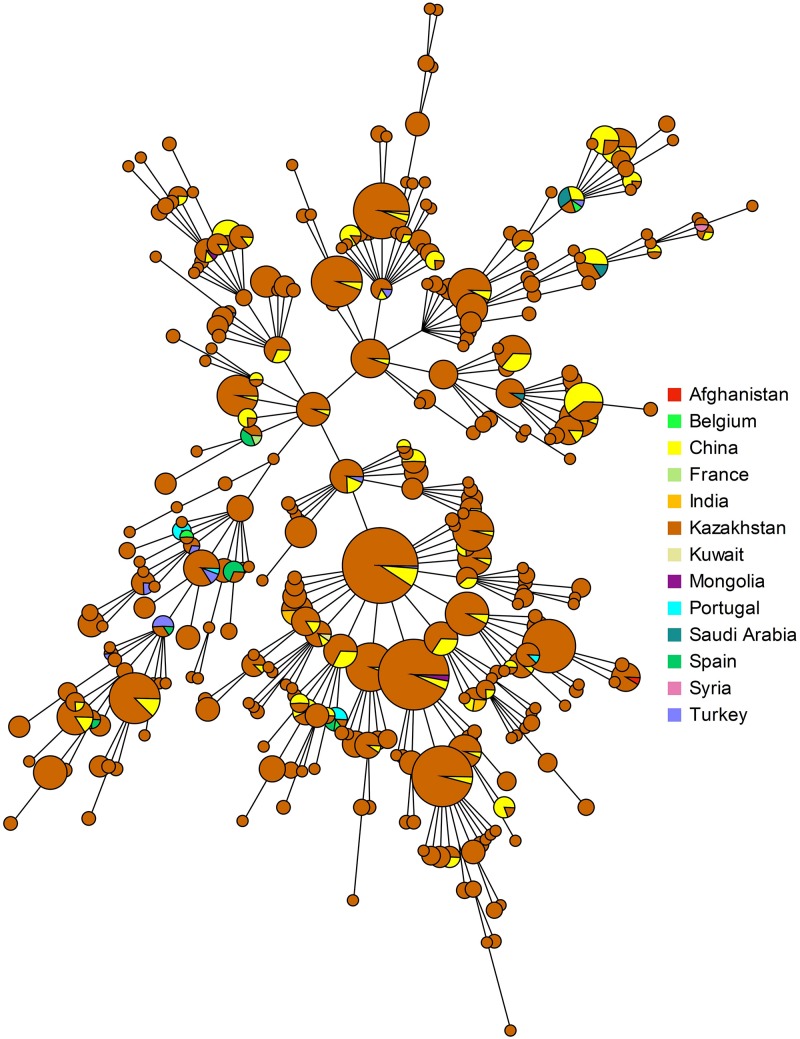
MLVA11 in 2900 East Mediterranean B. melitensis entries including 1580 from Brucella MLVAbank version 4.3. The 1327 strains from the present study are colored. The biovar assignment is indicated when known. The numbers are the MLVA11 genotypes. The genotypes are connected by branches with a length of one or two corresponding to the categorical distance between them.
FIGURE 2
FIGURE 2
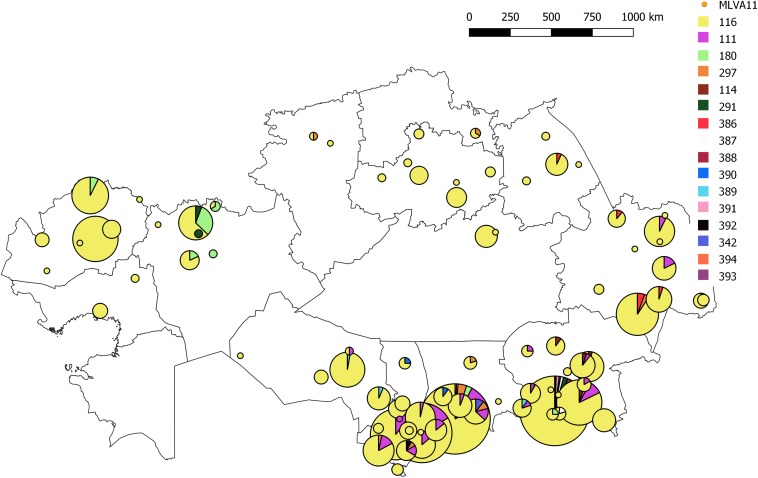
Map of Kazakhstan showing the distribution of B. melitensis MLVA11 genotypes of the 1327 strains from human patients. The color code reflects the MLVA11 genotype. The number of strains assigned to a given genotype is indicated in detail in Supplementary Table S2.
FIGURE 3
FIGURE 3
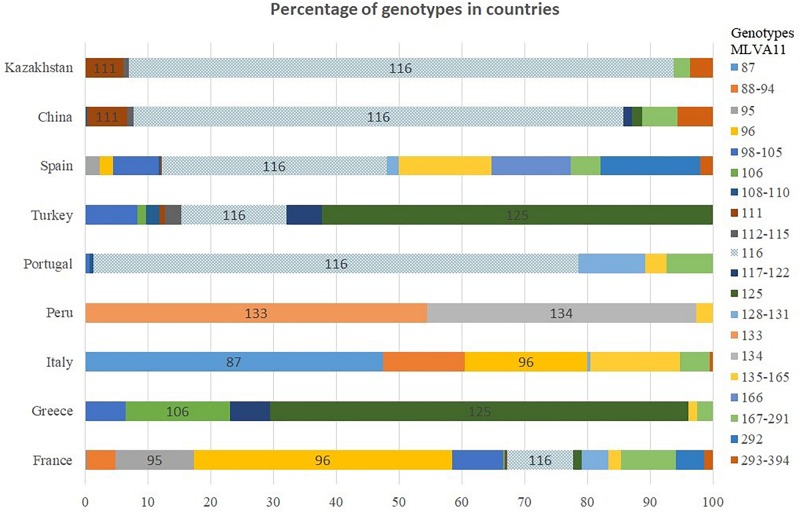
Distribution of B. melitensis MLVA11 genotypes by country.
FIGURE 4
FIGURE 4
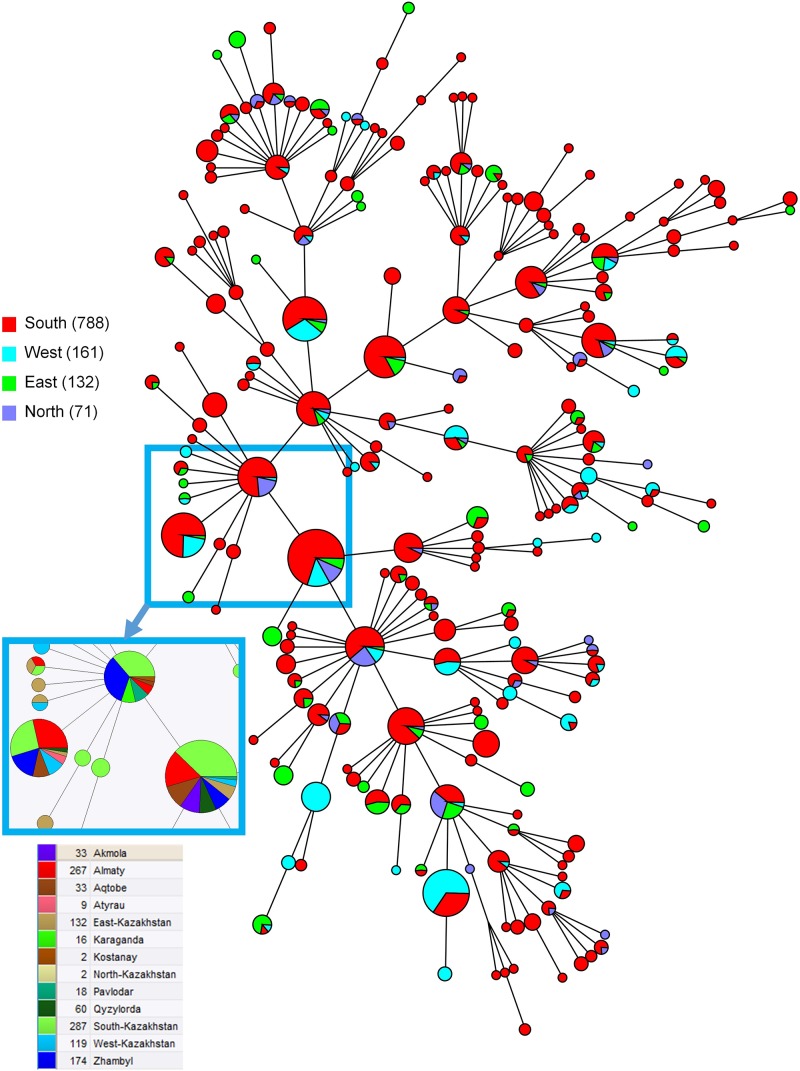
Maximum parsimony analysis using MLVA16 for 1152 genotype 116 B. melitensis strains isolated from humans in Kazakhstan. The color code reflect the geographic origin of the strains (South: Almaty, Qyzylorda, Zhambyl, South-Kazakhstan; West: Aqtobe, Atyrau, West Kazakhstan; East: East Kazakhstan; North: Akmola, Kostanay, Karaganda, Pavlodar, North Kazakhstan). Inset: color code by region for a subset of the most frequent MLVA16 genotypes showing their wide geographic spreading. Branch lengths correspond to one up to two differences among the 16 values constituting the MLVA16 genotype.
FIGURE 5
FIGURE 5
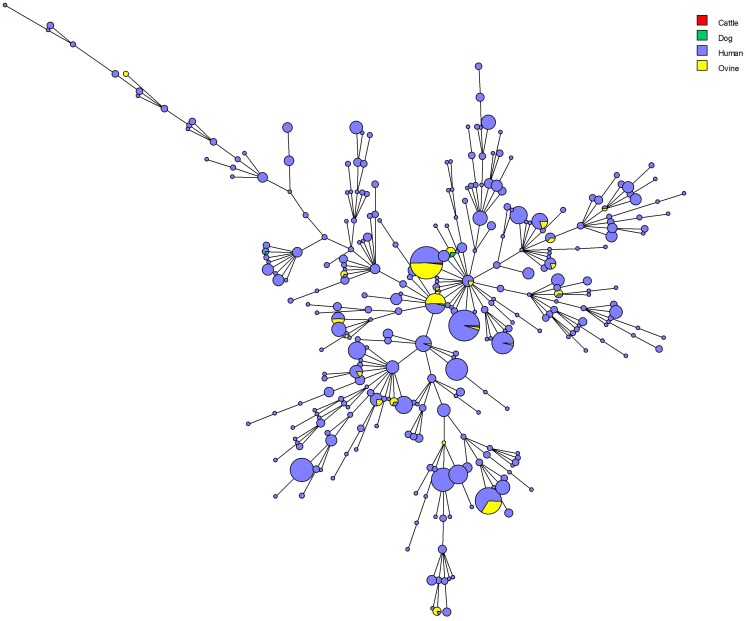
Maximum parsimony analysis using MLVA16 data from 1455 B. melitensis strains isolated from humans and animals in Kazakhstan. The color code reflects the host origin (cattle: 1 strain, genotype 116; dog: 5 strains, 2 belong to genotype 111, 3 to genotype 116; human: 1327 strains; sheep: 122 strains).
FIGURE 6
FIGURE 6
Geographic origin of strains present in MLVAbank Brucella_4_3 and showing an MLVA16 genotype present in Kazakhstan.

References

    1. Al Dahouk S., Le Flèche P., Nockler K., Jacques I., Grayon M., Scholz H. C., et al. (2007). Evaluation of Brucella MLVA typing for human brucellosis. J. Microbiol. Methods 69 137–145. 10.1016/j.mimet.2006.12.015 - DOI - PubMed
    1. Al Dahouk S., Tomaso H., Nockler K., Neubauer H., Frangoulidis D. (2003). Laboratory-based diagnosis of brucellosis–a review of the literature. Part I: techniques for direct detection and identification of Brucella spp. Clin. Lab. 49 487–505. - PubMed
    1. Castaneda M. R. (1947). A practical method for routine blood cultures in brucellosis. Proc. Soc. Exp. Biol. Med. 64:114. 10.3181/00379727-64-15717 - DOI - PubMed
    1. Charypkhan D., Sultanov A. A., Ivanov N. P., Baramova S. A., Taitubayev M. K., Torgerson P. R. (2019). Economic and health burden of brucellosis in Kazakhstan. Zoonoses Public Health 66 487–494. 10.1111/zph.12582 - DOI - PubMed
    1. Daugaliyeva A., Sultanov A., Usserbayev B., Baramova S., Modesto P., Adambayeva A., et al. (2018). Genotyping of Brucella melitensis and Brucella abortus strains in Kazakhstan using MLVA-15. Infect. Genet. Evol. 58 135–144. 10.1016/j.meegid.2017.12.022 - DOI - PubMed

LinkOut - more resources