Delay Discounting as a Transdiagnostic Process in Psychiatric Disorders: A Meta-analysis
- PMID: 31461131
- PMCID: PMC6714026
- DOI: 10.1001/jamapsychiatry.2019.2102
Delay Discounting as a Transdiagnostic Process in Psychiatric Disorders: A Meta-analysis
Erratum in
-
Errors in Text, Tables, and Figure.JAMA Psychiatry. 2023 Jan 1;80(1):96. doi: 10.1001/jamapsychiatry.2022.3755. JAMA Psychiatry. 2023. PMID: 36383397 Free PMC article. No abstract available.
Abstract
Importance: Delay discounting is a behavioral economic index of impulsive preferences for smaller-immediate or larger-delayed rewards that is argued to be a transdiagnostic process across health conditions. Studies suggest some psychiatric disorders are associated with differences in discounting compared with controls, but null findings have also been reported.
Objective: To conduct a meta-analysis of the published literature on delay discounting in people with psychiatric disorders.
Data sources: PubMed, MEDLINE, PsycInfo, Embase, and Web of Science databases were searched through December 10, 2018. The psychiatric keywords used were based on DSM-IV or DSM-5 diagnostic categories. Collected data were analyzed from December 10, 2018, through June 1, 2019.
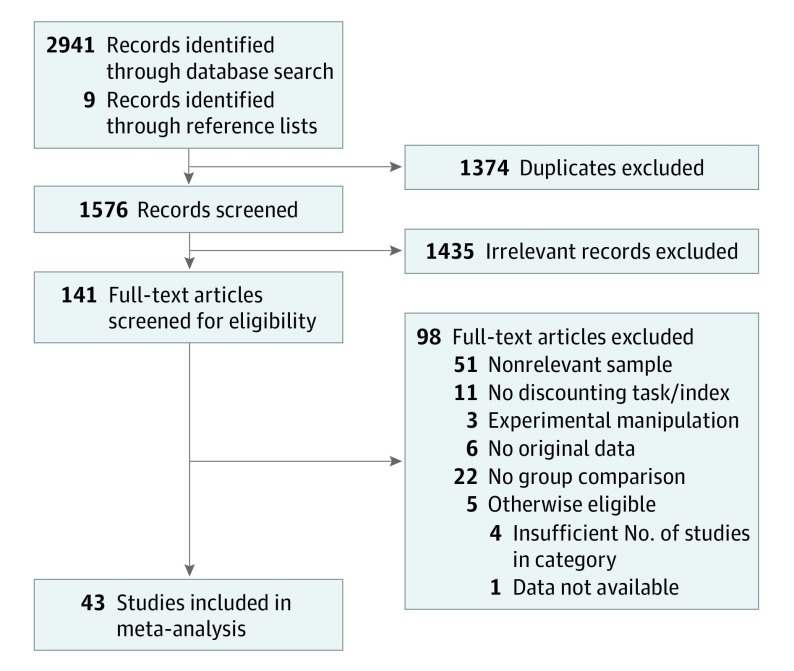
Study selection: Following a preregistered Preferred Reporting Items for Systematic Reviews and Meta-Analysis (PRISMA) protocol, 2 independent raters reviewed titles, abstracts, and full-text articles. English-language articles comparing monetary delay discounting between participants with psychiatric disorders and controls were included.
Data extraction and synthesis: Hedges g effect sizes were computed and random-effects models were used for all analyses. Heterogeneity statistics, one-study-removed analyses, and publication bias indices were also examined.
Main outcomes and measures: Categorical comparisons of delay discounting between a psychiatric group and a control group.
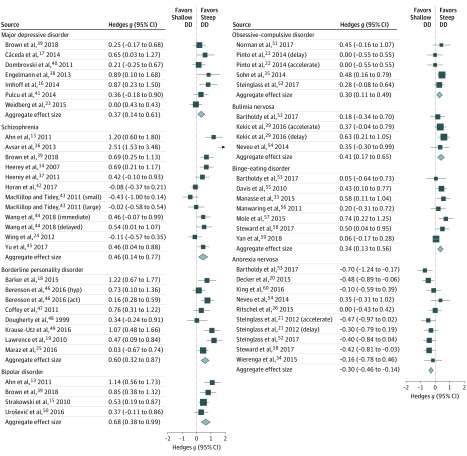
Results: The sample included 57 effect sizes from 43 studies across 8 diagnostic categories. Significantly steeper discounting for individuals with a psychiatric disorder compared with controls was observed for major depressive disorder (Hedges g = 0.37; P = .002; k = 7), schizophrenia (Hedges g = 0.46; P = .004; k = 12), borderline personality disorder (Hedges g = 0.60; P < .001; k = 8), bipolar disorder (Hedges g = 0.68; P < .001; k = 4), bulimia nervosa (Hedges g = 0.41; P = .001; k = 4), and binge-eating disorder (Hedges g = 0.34; P = .001; k = 7). In contrast, anorexia nervosa exhibited statistically significantly shallower discounting (Hedges g = -0.30; P < .001; k = 10). Modest evidence of publication bias was indicated by a statistically significant Egger test for schizophrenia and at the aggregate level across studies.
Conclusions and relevance: Results of this study appear to provide empirical support for delay discounting as a transdiagnostic process across most of the psychiatric disorders examined; the literature search also revealed limited studies in some disorders, notably posttraumatic stress disorder, which is a priority area for research.
Conflict of interest statement
Figures
Comment in
-
The Elusive Nature of Delay Discounting as a Transdiagnostic Process in Psychiatric Disorders-The Devil Is in the Detail-Reply.JAMA Psychiatry. 2020 Mar 1;77(3):325-326. doi: 10.1001/jamapsychiatry.2019.4124. JAMA Psychiatry. 2020. PMID: 31851334 No abstract available.
-
The Elusive Nature of Delay Discounting as a Transdiagnostic Process in Psychiatric Disorders-The Devil Is in the Detail.JAMA Psychiatry. 2020 Mar 1;77(3):325. doi: 10.1001/jamapsychiatry.2019.4121. JAMA Psychiatry. 2020. PMID: 31851336 No abstract available.
-
Errors in Data Set and Effect Sizes for 1 Study Included in Meta-analysis of Delay Discounting as a Transdiagnostic Process in Psychiatric Disorders.JAMA Psychiatry. 2023 Jan 1;80(1):95. doi: 10.1001/jamapsychiatry.2022.3739. JAMA Psychiatry. 2023. PMID: 36383398 No abstract available.
References
-
- Madden GJ, Bickel WK. Impulsivity: The Behavioral and Neurological Science of Discounting. Washington, DC: American Psychological Association; 2009.
Publication types
MeSH terms
LinkOut - more resources
Full Text Sources
Other Literature Sources
Medical