


Progression of Disease Within 24 Months in Follicular Lymphoma Is Associated With Reduced Intratumoral Immune Infiltration
- PMID: 31461379
- PMCID: PMC6881104
- DOI: 10.1200/JCO.18.02365
Progression of Disease Within 24 Months in Follicular Lymphoma Is Associated With Reduced Intratumoral Immune Infiltration
Abstract
Purpose: Understanding the immunobiology of the 15% to 30% of patients with follicular lymphoma (FL) who experience progression of disease within 24 months (POD24) remains a priority. Solid tumors with low levels of intratumoral immune infiltration have inferior outcomes. It is unknown whether a similar relationship exists between POD24 in FL.
Patients and methods: Digital gene expression using a custom code set-five immune effector, six immune checkpoint, one macrophage molecules-was applied to a discovery cohort of patients with early- and advanced-stage FL (n = 132). T-cell receptor repertoire analysis, flow cytometry, multispectral immunofluorescence, and next-generation sequencing were performed. The immune infiltration profile was validated in two independent cohorts of patients with advanced-stage FL requiring systemic treatment (n = 138, rituximab plus cyclophosphamide, vincristine, prednisone; n = 45, rituximab plus cyclophosphamide, doxorubicin, vincristine, and prednisone), with the latter selected to permit comparison of patients experiencing a POD24 event with those having no progression at 5 years or more.
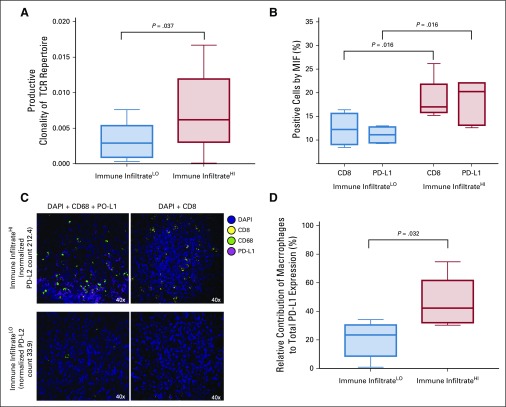
Results: Immune molecules showed distinct clustering, characterized by either high or low expression regardless of categorization as an immune effector, immune checkpoint, or macrophage molecule. Low programmed death-ligand 2 (PD-L2) was the most sensitive/specific marker to segregate patients with adverse outcomes; therefore, PD-L2 expression was chosen to distinguish immune infiltrationHI (ie, high PD-L2) FL biopsies from immune infiltrationLO (ie, low PD-L2) tumors. Immune infiltrationHI tissues were highly infiltrated with macrophages and expanded populations of T-cell clones. Of note, the immune infiltrationLO subset of patients with FL was enriched for POD24 events (odds ratio [OR], 4.32; c-statistic, 0.81; P = .001), validated in the independent cohorts (rituximab plus cyclophosphamide, vincristine, prednisone: OR, 2.95; c-statistic, 0.75; P = .011; and rituximab plus cyclophosphamide, doxorubicin, vincristine, and prednisone: OR, 7.09; c-statistic, 0.88; P = .011). Mutations were equally proportioned across tissues, which indicated that degree of immune infiltration is capturing aspects of FL biology distinct from its mutational profile.
Conclusion: Assessment of immune-infiltration by PD-L2 expression is a promising tool with which to help identify patients who are at risk for POD24.
Figures




Comment in
-
Reply to M. Sorigue.J Clin Oncol. 2020 Feb 20;38(6):648-649. doi: 10.1200/JCO.19.02935. Epub 2019 Dec 9. J Clin Oncol. 2020. PMID: 31815583 No abstract available.
-
Immune Infiltration and the Potential for a Biology-Guided Approach to Follicular Lymphoma.J Clin Oncol. 2020 Feb 20;38(6):647-648. doi: 10.1200/JCO.19.02398. Epub 2019 Dec 9. J Clin Oncol. 2020. PMID: 31815585 No abstract available.
References
-
- Gandhi MK, Marcus RE. Follicular lymphoma: Time for a re-think? Blood Rev. 2005;19:165–178. - PubMed
-
- Solal-Céligny P, Roy P, Colombat P, et al. Follicular lymphoma international prognostic index. Blood. 2004;104:1258–1265. - PubMed
-
- Shi Q, Flowers CR, Hiddemann W, et al. Thirty-month complete response as a surrogate end point in first-line follicular lymphoma therapy: An individual patient-level analysis of multiple randomized trials. J Clin Oncol. 2017;35:552–560. - PubMed
Publication types
MeSH terms
Substances
LinkOut - more resources
Full Text Sources
Research Materials
