Review
. 2019 Aug 27;8(9):984.
doi: 10.3390/cells8090984.

The Rebirth of Matrix Metalloproteinase Inhibitors: Moving Beyond the Dogma

Affiliations
Review

The Rebirth of Matrix Metalloproteinase Inhibitors: Moving Beyond the Dogma

Gregg B Fields. Cells. .

Abstract

The pursuit of matrix metalloproteinase (MMP) inhibitors began in earnest over three decades ago. Initial clinical trials were disappointing, resulting in a negative view of MMPs as therapeutic targets. As a better understanding of MMP biology and inhibitor pharmacokinetic properties emerged, it became clear that initial MMP inhibitor clinical trials were held prematurely. Further complicating matters were problematic conclusions drawn from animal model studies. The most recent generation of MMP inhibitors have desirable selectivities and improved pharmacokinetics, resulting in improved toxicity profiles. Application of selective MMP inhibitors led to the conclusion that MMP-2, MMP-9, MMP-13, and MT1-MMP are not involved in musculoskeletal syndrome, a common side effect observed with broad spectrum MMP inhibitors. Specific activities within a single MMP can now be inhibited. Better definition of the roles of MMPs in immunological responses and inflammation will help inform clinic trials, and multiple studies indicate that modulating MMP activity can improve immunotherapy. There is a U.S. Food and Drug Administration (FDA)-approved MMP inhibitor for periodontal disease, and several MMP inhibitors are in clinic trials, targeting a variety of maladies including gastric cancer, diabetic foot ulcers, and multiple sclerosis. It is clearly time to move on from the dogma of viewing MMP inhibition as intractable.

Keywords: arthritis; cancer; matrix metalloproteinase; protease inhibitor; wound healing.


Conflict of interest statement

The author is Vice President of MMP Biopharma, Inc.

Figures
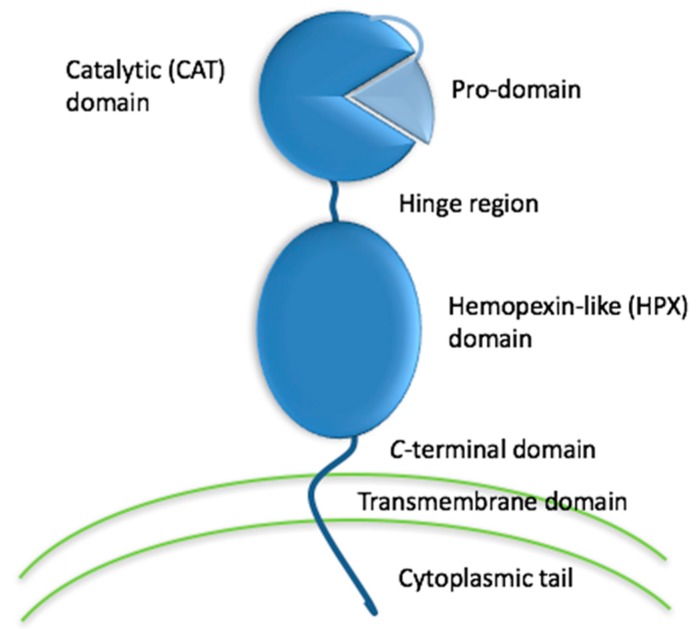
Figure 1
Figure 1
Schematic depiction of the domains of a representative MMP family member, membrane type 1 matrix metalloproteinase (MT1-MMP).
Figure 2
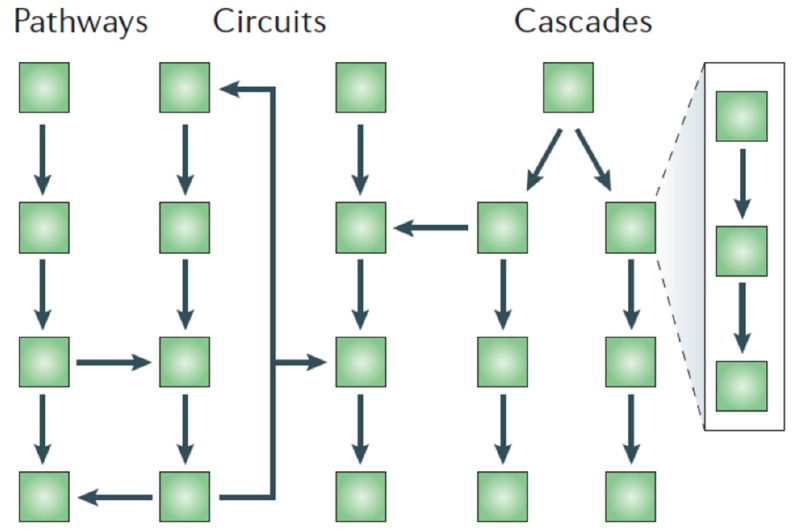
Figure 2
The “protease web”, in which proteases act in linear pathways, amplification cascades (with a one-way flow of information), or in circuits (with information feedback) [33]. Figure reproduced with permission of the Nature Publishing Group.
Figure 3
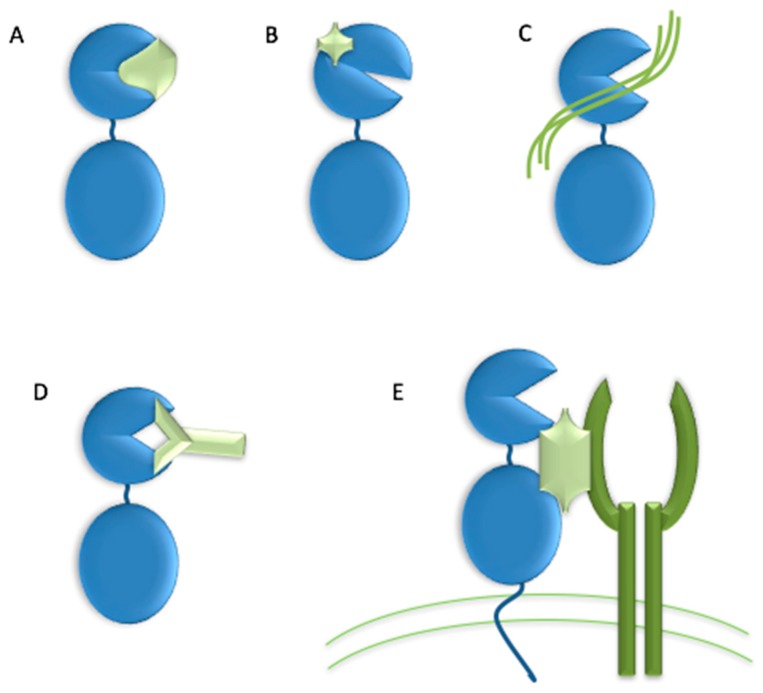
Figure 3
Strategies for creating selective MMP inhibitors. (A) endogenous-like inhibitors, (B) exosite targeting inhibitors, (C) combination of exosite binding and metal chelating inhibitor, (D) function blocking antibodies, and (E) inhibitor disrupting MMP interactions with cell surface binding partners.
Figure 4
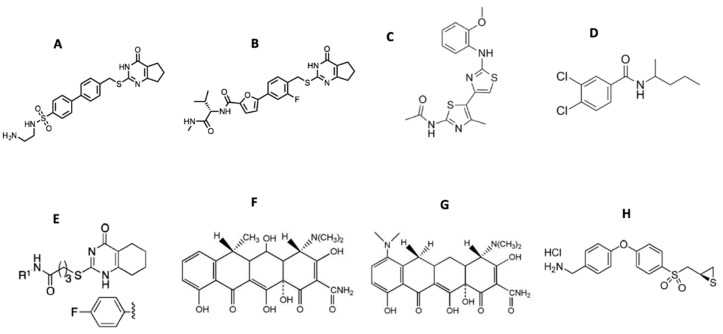
Figure 4
Structures of small molecule MMP inhibitors (A) 10d, (B) (S)-17b, (C) JNJ0966 [N-(2-((2-methoxyphenyl)amino)-4’-methyl-[4,5’-bithiazol]-2’-yl)acetamide], (D) NSC405020 [3,4-dichloro-N-(1-methylbutyl)benzamide], (E) N-(4-fluorophenyl)-4-(4-oxo-3,4,5,6,7,8-hexahydroquinazolin-2-ylthio)butanamide, (F) doxycycline, (G) minocycline, and (H) (R)-ND-336.

References

    1. Fingleton B. Matrix metalloproteinases as valid clinical targets. Curr. Pharm. Design. 2007;13:333–346. doi: 10.2174/138161207779313551. - DOI - PubMed
    1. Hu J., Van den Steen P.E., Sang Q.-X.A., Opdenakker G. Matrix metalloproteinase inhibitors as therapy for inflammatory and vascular diseases. Nat. Rev. Drug Discov. 2007;6:480–498. doi: 10.1038/nrd2308. - DOI - PubMed
    1. Murphy G., Nagase H. Progress in matrix metalloproteinase research. Mol. Aspects Med. 2008;29:290–308. doi: 10.1016/j.mam.2008.05.002. - DOI - PMC - PubMed
    1. Candelario-Jalil E., Yang Y., Rosenberg G.A. Diverse roles of matrix metalloproteinases and tissue inhibitors of metalloproteinases in neuroinflammation and cerebral ischemia. Neuroscience. 2009;158:983–994. doi: 10.1016/j.neuroscience.2008.06.025. - DOI - PMC - PubMed
    1. Khokha R., Murthy A., Weiss A. Metalloproteinases and their natural inhibitors in inflammation and immunity. Nat. Rev. Immunol. 2013;13:649–665. doi: 10.1038/nri3499. - DOI - PubMed

Publication types

MeSH terms

Substances