Review
. 2019 Aug 28;11(1):56.
doi: 10.1186/s13073-019-0666-2.

Best practices for bioinformatic characterization of neoantigens for clinical utility

Affiliations
Review

Best practices for bioinformatic characterization of neoantigens for clinical utility

Megan M Richters et al. Genome Med. .

Abstract

Neoantigens are newly formed peptides created from somatic mutations that are capable of inducing tumor-specific T cell recognition. Recently, researchers and clinicians have leveraged next generation sequencing technologies to identify neoantigens and to create personalized immunotherapies for cancer treatment. To create a personalized cancer vaccine, neoantigens must be computationally predicted from matched tumor-normal sequencing data, and then ranked according to their predicted capability in stimulating a T cell response. This candidate neoantigen prediction process involves multiple steps, including somatic mutation identification, HLA typing, peptide processing, and peptide-MHC binding prediction. The general workflow has been utilized for many preclinical and clinical trials, but there is no current consensus approach and few established best practices. In this article, we review recent discoveries, summarize the available computational tools, and provide analysis considerations for each step, including neoantigen prediction, prioritization, delivery, and validation methods. In addition to reviewing the current state of neoantigen analysis, we provide practical guidance, specific recommendations, and extensive discussion of critical concepts and points of confusion in the practice of neoantigen characterization for clinical use. Finally, we outline necessary areas of development, including the need to improve HLA class II typing accuracy, to expand software support for diverse neoantigen sources, and to incorporate clinical response data to improve neoantigen prediction algorithms. The ultimate goal of neoantigen characterization workflows is to create personalized vaccines that improve patient outcomes in diverse cancer types.


Conflict of interest statement

The authors declare that they have no competing interests.

Figures
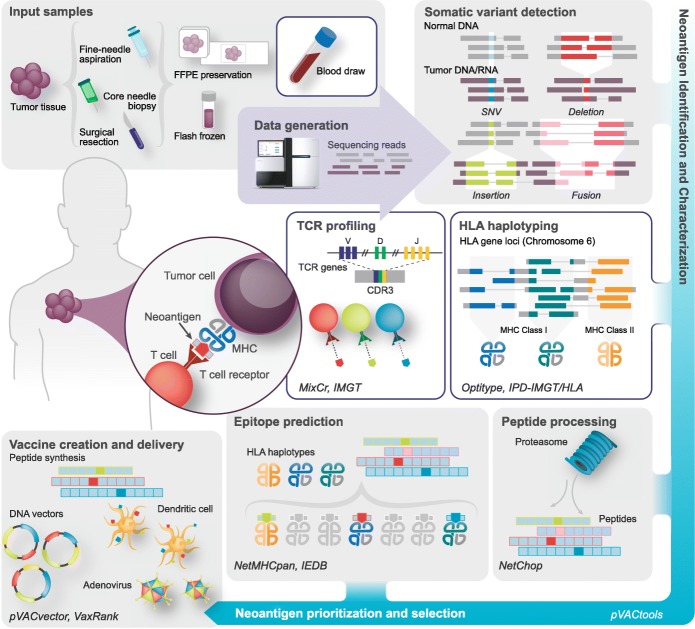
Fig. 1
Fig. 1
Overview of the bioinformatic characterization of neoantigens. Major analysis steps in a comprehensive workflow for neoantigen characterization are depicted in a simplified form. For each component, critical concepts and analysis considerations are indicated. Specific exemplar bioinformatics tools for each step are indicated in italics. Starting at the top left, patient sequences are analyzed to determine human leukocyte antigen (HLA) types and to predict the corresponding major histocompatibility complexes (MHC) for each tumor. Somatic variants of various types, including single nucleotide variants (SNVs; blue), deletions (red), insertions (green), and fusions (pink), are detected and the corresponding peptide sequences are analyzed with respect to their predicted expression, processing, and ability to bind the patient’s MHC complexes. Candidates are then selected for vaccine design and additional analyses are performed to assess the T cell response. Abbreviations: CDR3 complementarity-determining region 3, FFPE formalin-fixed paraffin-embedded, IEDB Immune Epitope Database, TCR T cell receptor

References

    1. Zitvogel L, Apetoh L, Ghiringhelli F, André F, Tesniere A, Kroemer G. The anticancer immune response: indispensable for therapeutic success? J Clin Invest. 2008;118:1991–2001. doi: 10.1172/JCI35180. - DOI - PMC - PubMed
    1. Medler TR, Cotechini T, Coussens LM. Immune response to cancer therapy: mounting an effective antitumor response and mechanisms of resistance. Trends Cancer Res. 2015;1:66–75. doi: 10.1016/j.trecan.2015.07.008. - DOI - PMC - PubMed
    1. Lennerz V, Fatho M, Gentilini C, Frye RA, Lifke A, Ferel D, et al. The response of autologous T cells to a human melanoma is dominated by mutated neoantigens. Proc Natl Acad Sci U S A. 2005;102:16013–16018. doi: 10.1073/pnas.0500090102. - DOI - PMC - PubMed
    1. Robbins PF, Lu Y-C, El-Gamil M, Li YF, Gross C, Gartner J, et al. Mining exomic sequencing data to identify mutated antigens recognized by adoptively transferred tumor-reactive T cells. Nat Med. 2013;19:747–752. doi: 10.1038/nm.3161. - DOI - PMC - PubMed
    1. van Rooij N, van Buuren MM, Philips D, Velds A, Toebes M, Heemskerk B, et al. Tumor exome analysis reveals neoantigen-specific T-cell reactivity in an ipilimumab-responsive melanoma. J Clin Oncol. 2013;31:e439–e442. doi: 10.1200/JCO.2012.47.7521. - DOI - PMC - PubMed

Publication types

MeSH terms
