Whole-Genome Sequencing of Childhood Cancer Survivors Treated with Cranial Radiation Therapy Identifies 5p15.33 Locus for Stroke: A Report from the St. Jude Lifetime Cohort Study
- PMID: 31462438
- PMCID: PMC6858960
- DOI: 10.1158/1078-0432.CCR-19-1231
Whole-Genome Sequencing of Childhood Cancer Survivors Treated with Cranial Radiation Therapy Identifies 5p15.33 Locus for Stroke: A Report from the St. Jude Lifetime Cohort Study
Abstract
Purpose: To identify genetic factors associated with risk of stroke among survivors of childhood cancer treated with cranial radiotherapy (CRT).
Experimental design: We analyzed whole-genome sequencing (36.8-fold) data of 686 childhood cancer survivors of European ancestry [median (range), 40.4 (12.4-64.7) years old; 54% male] from the St. Jude Lifetime Cohort study treated with CRT, of whom 116 (17%) had clinically diagnosed stroke. Association analyses (single-variant and Burden/SKAT tests) were performed, adjusting for demographic characteristics and childhood cancer treatment exposures.
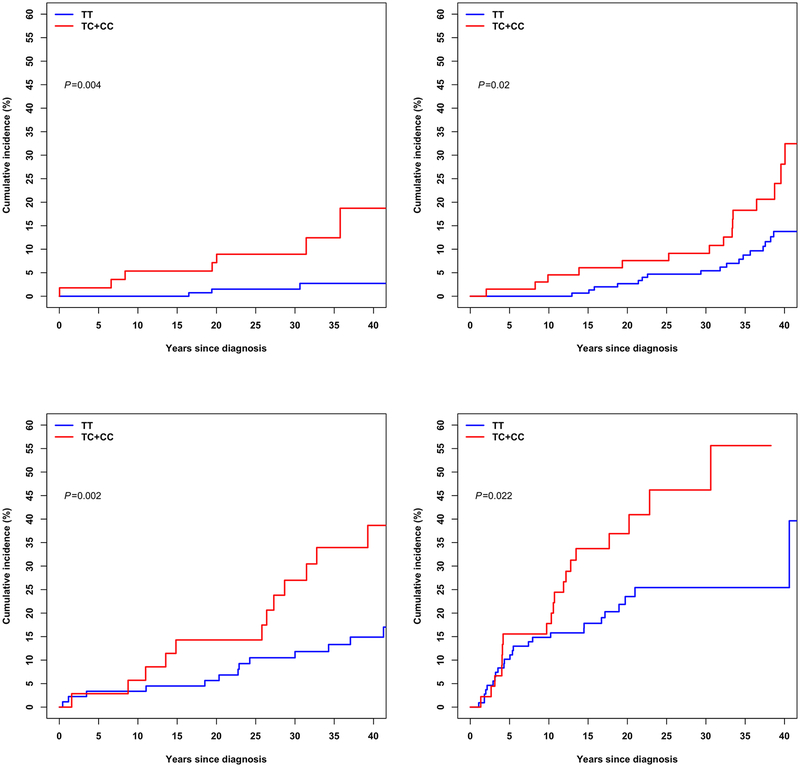
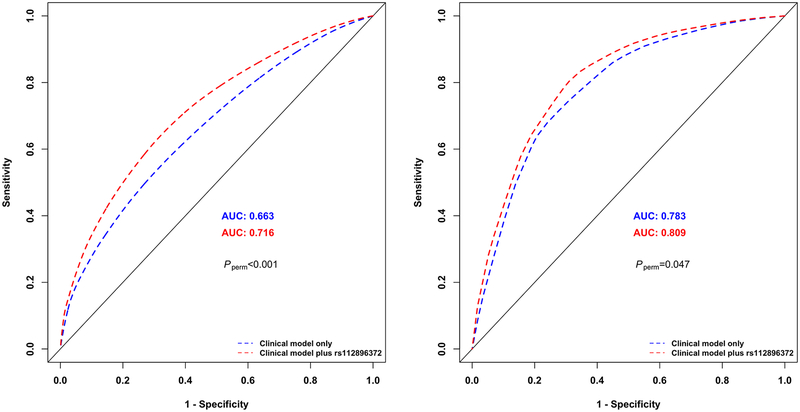
Results: We identified a genome-wide significant association between 5p15.33 locus and stroke [rs112896372: HR = 2.55; P = 1.42 × 10⁻⁸], with a stronger association (HR = 3.68) among survivors treated with CRT dose 25-50 Gray (Gy) and weaker associations among those treated with CRT doses <20 or 20-25 or >50 Gy (HRs = 2.14, 2.40, and 2.28). The association was replicated in 90 CRT-exposed African survivors (HR = 3.05; P = 0.034). In CRT-exposed Europeans, rs112896372 significantly (P < 0.001) improved predictive ability (AUC = 0.717) for determining stroke risk than nongenetic factors alone (AUC = 0.663) at 30 years since diagnosis, with significant improvement among African survivors (P = 0.047). SNP rs112896372 was further evaluated in three independent datasets including 1,641 European (HR = 1.54; P = 0.055) and 316 African survivors (HR = 1.88; P = 0.283) not treated with CRT, and 166,988 males in the UK Biobank (OR = 1.0012; P = 0.042).
Conclusions: A novel locus 5p15.33 is associated with stroke risk among childhood cancer survivors, with a possible CRT dose-specific effect. The locus is of potential clinical utility in characterizing individuals who may benefit from surveillance and intervention strategies.
©2019 American Association for Cancer Research.
Conflict of interest statement
DECLARATION OF INTERESTS
None declared.
Figures
References
-
- Mueller S, Fullerton HJ, Stratton K, Leisenring W, Weathers RE, Stovall M, et al. Radiation, Atherosclerotic Risk Factors, and Stroke Risk in Survivors of Pediatric Cancer: A Report From the Childhood Cancer Survivor Study. Int J Radiat Oncol 2013;86(4):649–55 doi 10.1016/j.ijrobp.2013.03.034. - DOI - PMC - PubMed
Publication types
MeSH terms
Grants and funding
LinkOut - more resources
Full Text Sources
Medical
Research Materials