Review
. 2019 Aug 28;10(1):3875.
doi: 10.1038/s41467-019-11812-7.

Emerging epigenomic landscapes of pancreatic cancer in the era of precision medicine

Affiliations
Review

Emerging epigenomic landscapes of pancreatic cancer in the era of precision medicine

Gwen Lomberk et al. Nat Commun. .

Abstract

Genetic studies have advanced our understanding of pancreatic cancer at a mechanistic and translational level. Genetic concepts and tools are increasingly starting to be applied to clinical practice, in particular for precision medicine efforts. However, epigenomics is rapidly emerging as a promising conceptual and methodological paradigm for advancing the knowledge of this disease. More importantly, recent studies have uncovered potentially actionable pathways, which support the prediction that future trials for pancreatic cancer will involve the vigorous testing of epigenomic therapeutics. Thus, epigenomics promises to generate a significant amount of new knowledge of both biological and medical importance.


Conflict of interest statement

The authors declare that they have no competing interests.

Figures
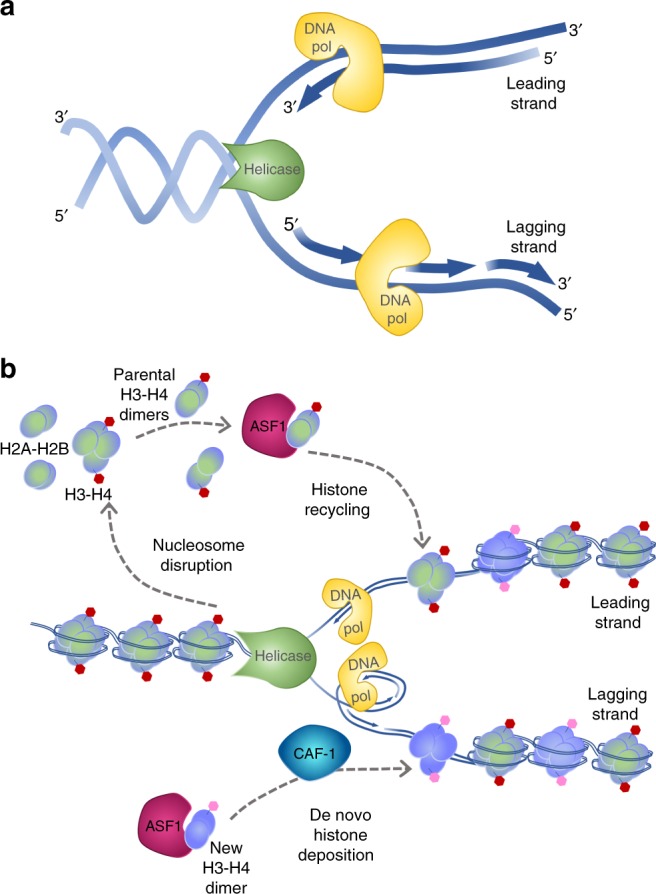
Fig. 1
Fig. 1
Inheritance at the replication fork. a The Naked DNA Paradigm: although the classical semi-conservative model of DNA duplication is useful for explaining Mendelian genetics, the model of DNA in isolation is imperfect for most nuclear processes that require the cooperation of DNA with nuclear proteins, such as inheritance during S-phase, which requires more than just passing a gene to daughter cells. This model simply shows DNA strands unwound at the replication fork by helicase, which is followed by the leading and lagging strands of DNA replication by DNA polymerase. b A modern model for inheritance: the more complete model of inheritance, which includes the DNA along with chromatin. At the replication fork, nucleosomes are disrupted to provide access to the DNA polymerase for DNA duplication. These displaced parental histones (shaded green-purple) are reassembled after fork passage with the assistance of chaperone proteins, such as ASF1. In addition, new histones (purple) are required to fully reconstitute chromatin on the two daughter strands, which is also facilitated by chaperone proteins, including ASF1 and CAF-1. New histones acquire marks in accordance to the pattern carried by the parental histones to inherit gene expression states
Fig. 2
Fig. 2
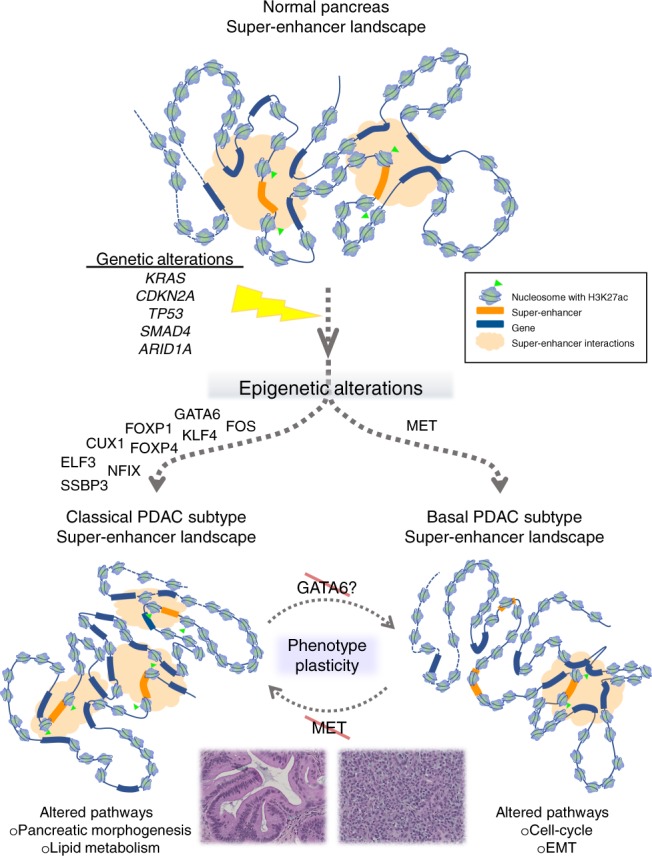
Epigenomic landscapes explain the progression of PDAC into two subtypes. While PDAC initiates with certain genetic alterations, including KRAS, CDKN2A, TP53, and others as indicated, mounting evidence reveals that the subsequent establishment of the classical and basal subtypes is a consequence of epigenetic alterations, which include specific super-enhancers driven by distinct upstream regulators to result in altered gene expression networks that define each subtype. Experimental data from knockdown of MET in the basal subtype substantiates the potential conversion to the classical subtype, suggesting the possibility of phenotype plasticity. Similarly, it may be feasible to convert the classical into the basal subtype through targeting upstream transcription factors, such as GATA6

References

    1. Lucas AL, et al. Global trends in pancreatic cancer mortality from 1980 through 2013 and predictions for 2017. Clin. Gastroenterol. Hepatol. 2016;14:1452–1462.e1454. doi: 10.1016/j.cgh.2016.05.034. - DOI - PMC - PubMed
    1. McGranahan N, Swanton C. Clonal heterogeneity and tumor evolution: past, present, and the future. Cell. 2017;168:613–628. doi: 10.1016/j.cell.2017.01.018. - DOI - PubMed
    1. Bailey MH, et al. Comprehensive characterization of cancer driver genes and mutations. Cell. 2018;173:371–385.e318. doi: 10.1016/j.cell.2018.02.060. - DOI - PMC - PubMed
    1. Aguirre AJ, et al. Real-time genomic characterization of advanced pancreatic cancer to enable precision medicine. Cancer Discov. 2018;8:1096. doi: 10.1158/2159-8290.CD-18-0275. - DOI - PMC - PubMed
    1. Balachandran VP, et al. Identification of unique neoantigen qualities in long-term survivors of pancreatic cancer. Nature. 2017;551:512–516. doi: 10.1038/nature24462. - DOI - PMC - PubMed

Publication types

MeSH terms

Substances