. 2019 Jun 11;12(8):1583-1594.
doi: 10.1111/eva.12804. eCollection 2019 Sep.

Natural Wolbachia infections are common in the major malaria vectors in Central Africa

Affiliations

Natural Wolbachia infections are common in the major malaria vectors in Central Africa

Diego Ayala et al. Evol Appl. .

Abstract

During the last decade, the endosymbiont bacterium Wolbachia has emerged as a biological tool for vector disease control. However, for long time, it was believed that Wolbachia was absent in natural populations of Anopheles. The recent discovery that species within the Anopheles gambiae complex host Wolbachia in natural conditions has opened new opportunities for malaria control research in Africa. Here, we investigated the prevalence and diversity of Wolbachia infection in 25 African Anopheles species in Gabon (Central Africa). Our results revealed the presence of Wolbachia in 16 of these species, including the major malaria vectors in this area. The infection prevalence varied greatly among species, confirming that sample size is a key factor to detect the infection. Moreover, our sequencing and phylogenetic analyses showed the important diversity of Wolbachia strains that infect Anopheles. Co-evolutionary analysis unveiled patterns of Wolbachia transmission within some Anopheles species, suggesting that past independent acquisition events were followed by co-cladogenesis. The large diversity of Wolbachia strains that infect natural populations of Anopheles offers a promising opportunity to select suitable phenotypes for suppressing Plasmodium transmission and/or manipulating Anopheles reproduction, which in turn could be used to reduce the malaria burden in Africa.

Keywords: Anopheles; Wolbachia; co‐evolution; disease control; diversity.


Conflict of interest statement

None declared.

Figures
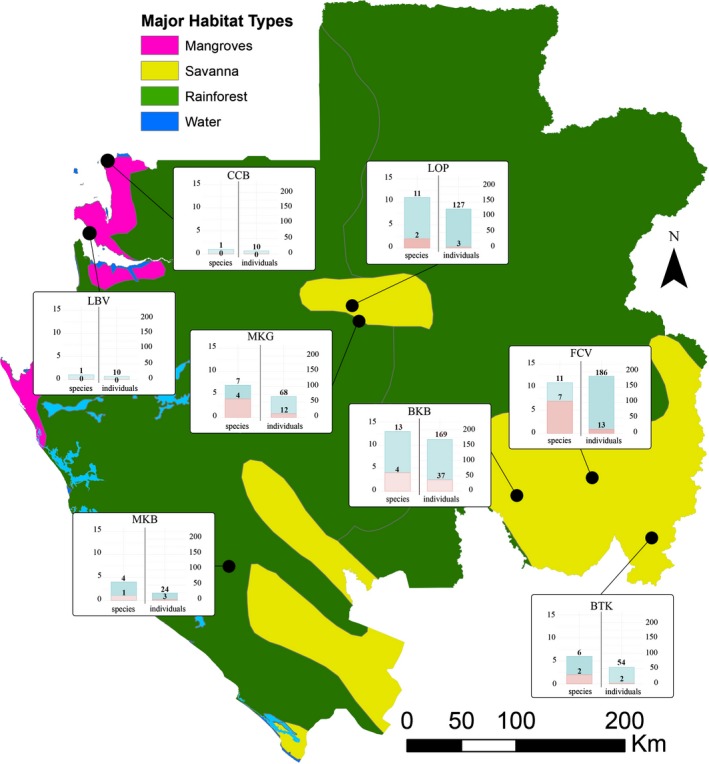
Figure 1
Figure 1
Sampling sites and Wolbachia infection prevalence. Map of Gabon showing the main African habitat types ((Olson et al., 2001), free ly available at http://maps.tnc.org/gis_data.html) and the villages where sampling took place (black dots). The map was drawn using ArcGIS Basic v.10. The prevalence of Wolbachia infection (number of infected Anopheles species and individuals) per site is presented in bar charts. The pink colour indicates positive species/individuals and blue the total number of species/individuals screened for Wolbachia infection at that site. BKB: Bakoumba; BTK: National Park of Plateaux Batékés; CCB: Cocobeach; FCV: Franceville; LBV: Libreville; LOP: Lopé; MKB: National Park of Moukalaba‐Doudou; MKG: Mikongo
Figure 2
Figure 2
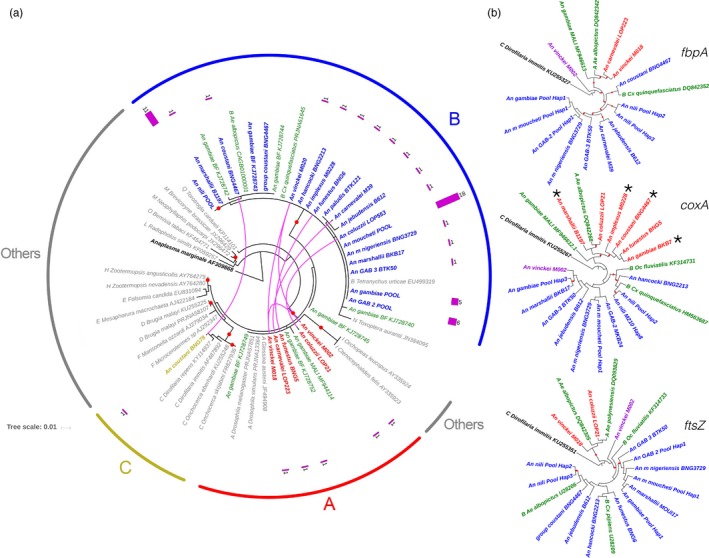
Circular phylograms of the Wolbachia strains isolated in the 16 Anopheles species. The phylogenetic trees were built with RAxML (Stamatakis, 2014). The names of the Anopheles species from which the Wolbachia‐specific sequences were isolated in this study are shown in blue (positive for Wolbachia supergroup B), red (positive for supergroup A) and brown (positive for supergroup C), while the names of mosquitoes species (Diptera) from which the previously published Wolbachia sequences were isolated are in green. Other Wolbachia strains sequences (“others,” in grey) were obtained directly from gene sequence repository ncbi (https://www.ncbi.nlm.nih.gov/). Red dots show branches supporting a bootstrap >70% from 1,000 replicates. (a) Circular phylogenetic tree using the Wolbachia‐specific 16S rRNA fragment and Anaplasma marginale as outgroup. Different Wolbachia strains found in the same Anopheles species are connected by pink lines. The pink bar charts indicate the number of identical Wolbachia haplotypes found in each species. Scale bar corresponds to nucleotide substitutions per site. (b) Circular phylogenetic trees based on the coxA, fbpA and ftsZ fragment sequences using Dirofilaria immitis (supergroup C) as outgroup. Specimens with a different supergroup assignation than 16S are marked with asterisks. Only, Anopheles vinckei M002 (purple) oscillated between groups B and A across the four genes
Figure 3
Figure 3
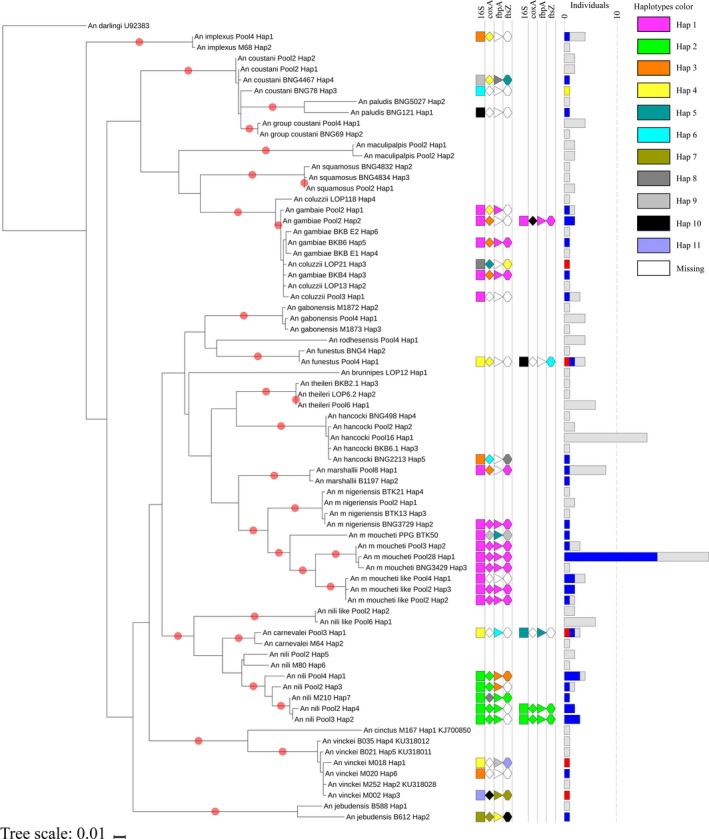
Maximum likelihood phylogeny of the 25 Anopheles species under study and Wolbachia haplotypes. The tree was inferred with RAxML (Stamatakis, 2014) using the sequences of the COII fragment from 176 Anopheles specimens belonging to the 25 species under study and rooted with Anopheles darlingi as outgroup (New World mosquito, diverged 100 Myr ago (Neafsey et al., 2015)). Red dots in branches represent bootstrap values >70% from 1,000 replicates. The shape of each field column represents the 16S (rectangle), coxA (rhombus), fbpA (triangle) and ftsZ (hexagon) genes. The different Wolbachia gene haplotypes (i.e., unique allelic profiles) are indicated with colour codes (all pink = the newly identified wAnmo strain). The bar chart size indicates the number of individuals of the same species with the same haplotype, and the colour represents their infection status: grey, noninfected; blue, infected by the Wolbachia supergroup B; red, infected by supergroup A; brown, infected by supergroup C

References

    1. Ahmed, M. Z. , De Barro, P. J. , Ren, S. X. , Greeff, J. M. , & Qiu, B. L. (2013). Evidence for horizontal transmission of secondary endosymbionts in the Bemisia tabaci cryptic species complex. PLoS ONE, 8(1), e53084 10.1371/journal.pone.0053084 - DOI - PMC - PubMed
    1. Arthofer, W. , Riegler, M. , Avtzis, D. N. , & Stauffer, C. (2009). Evidence for low‐titre infections in insect symbiosis: Wolbachia in the bark beetle Pityogenes chalcographus (Coleoptera, Scolytinae). Environmental Microbiology, 11(8), 1923–1933. 10.1111/j.1462-2920.2009.01914.x - DOI - PubMed
    1. Augustinos, A. A. , Santos‐Garcia, D. , Dionyssopoulou, E. , Moreira, M. , Papapanagiotou, A. , Scarvelakis, M. , … Bourtzis, K. (2011). Detection and characterization of Wolbachia Infections in Natural Populations of Aphids: Is the hidden diversity fully unraveled? PLoS ONE, 6(12), e28695 10.1371/journal.pone.0028695 - DOI - PMC - PubMed
    1. Ayala, D. , Akone‐Ella, O. , Rahola, N. , Kengne, P. , Ngangue, M. F. , Mezeme, F. , … Paupy, C. (2019). Natural Wolbachia infections are common in the major malaria vectors in Central Africa. Evolutionary Applications. Dryad digital Repository; 10.5061/dryad.sn81548 - DOI - PMC - PubMed
    1. Baldini, F. , Rouge, J. , Kreppel, K. , Mkandawile, G. , Mapua, S. A. , Sikulu‐Lord, M. , … Okumu, F. O. (2018). First report of natural Wolbachia infection in the malaria mosquito Anopheles arabiensis in Tanzania. Parasit Vectors, 11(1), 635 10.1186/s13071-018-3249-y - DOI - PMC - PubMed

LinkOut - more resources