


"Closer-to-home" strategy benefits juvenile survival in a long-distance migratory bird
- PMID: 31462993
- PMCID: PMC6706183
- DOI: 10.1002/ece3.5395
"Closer-to-home" strategy benefits juvenile survival in a long-distance migratory bird
Abstract
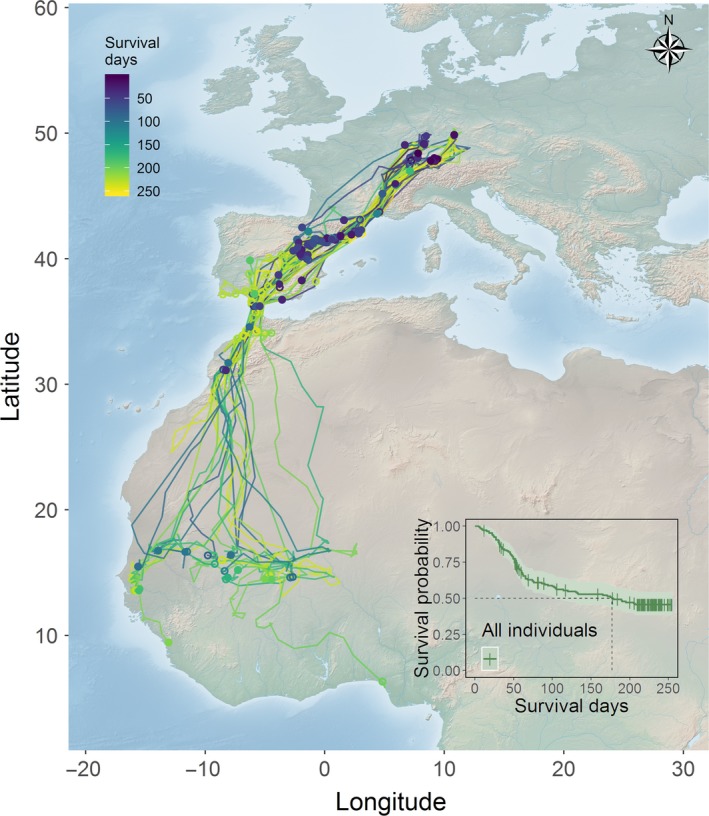
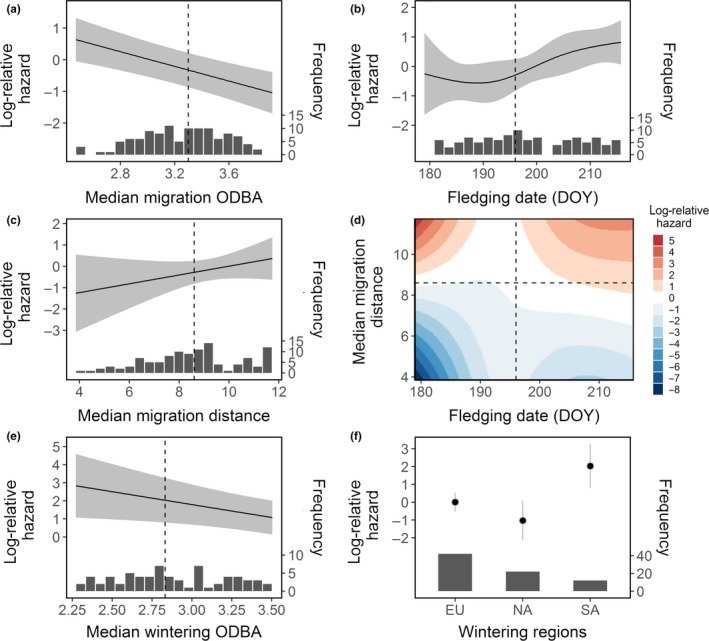
Human-induced changes in the climate and environment that occur at an unprecedented speed are challenging the existence of migratory species. Faced with these new challenges, species with diverse and flexible migratory behaviors may suffer less from population decline, as they may be better at responding to these changes by altering their migratory behavior. At the individual level, variations in migratory behavior may lead to differences in fitness and subsequently influence the population's demographic dynamics. Using lifetime GPS bio-logging data from 169 white storks (Ciconia ciconia), we explore whether the recently shortened migration distance of storks affects their survival during different stages of their juvenile life. We also explore how other variations in migratory decisions (i.e., time, destination), movement activity (measured using overall body dynamic acceleration), and early life conditions influence juvenile survival. We observed that their first autumn migration was the riskiest period for juvenile white storks. Individuals that migrated shorter distances and fledged earlier experienced lower mortality risks. In addition, higher movement activity and overwintering "closer-to-home" (with 84.21% of the tracked individuals stayed Europe or North Africa) were associated with higher survival. Our study shows how avian migrants can change life history decisions over only a few decades, and thus it helps us to understand and predict how migrants respond to the rapidly changing world.
Keywords: ODBA; bio‐logging; long‐distant migration; migration strategy; survival.
Conflict of interest statement
None declared.
Figures
References
-
- Aguirre, J. I. , & Vergara, P. (2007). Younger, weaker white stork (Ciconia ciconia) nestlings become the best breeders. Evolutionary Ecology Research, 9, 355–364.
-
- Arizaga, J. , Resano‐Mayor, J. , Villanúa, D. , Alonso, D. , Barbarin, J. M. , Herrero, A. , … Rodríguez, R. (2018). Importance of artificial stopover sites through avian migration flyways: A landfill‐based assessment with the White Stork Ciconia ciconia . Ibis, 160, 542–553.
-
- Catry, I. , Encarnação, V. , Pacheco, C. , Catry, T. , Tenreiro, P. , da Silva, L. P. , … Moreira, F. (2017). Recent changes on migratory behaviour of the White stork (Ciconia ciconia) in Portugal: Towards the end of migration? Airo, 24, 28–35.
-
- Chapman, B. B. , Brönmark, C. , Nilsson, J.‐Å. , & Hansson, L.‐A. (2011). The ecology and evolution of partial migration. Oikos, 120, 1764–1775. 10.1111/j.1600-0706.2011.20131.x - DOI
-
- Collett, D. (2015). Modelling survival data in medical research (3rd ed.). New York, NY: Chapman and Hall/CRC.
LinkOut - more resources
Full Text Sources
