


Extremophilic models for astrobiology: haloarchaeal survival strategies and pigments for remote sensing
- PMID: 31463573
- PMCID: PMC6954306
- DOI: 10.1007/s00792-019-01126-3
Extremophilic models for astrobiology: haloarchaeal survival strategies and pigments for remote sensing
Abstract
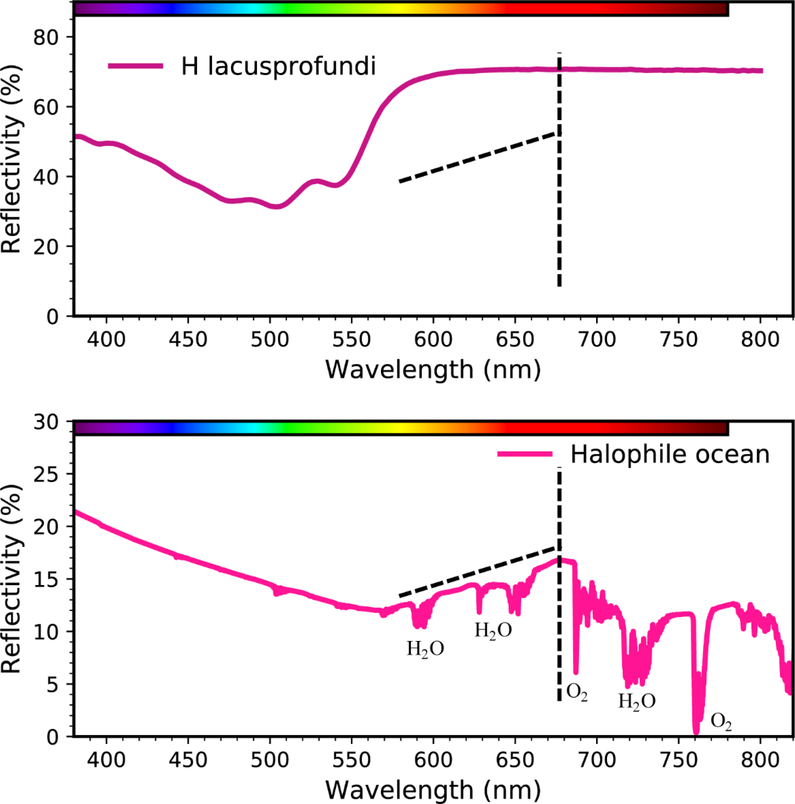
Recent progress in extremophile biology, exploration of planetary bodies in the solar system, and the detection and characterization of extrasolar planets are leading to new insights in the field of astrobiology and possible distribution of life in the universe. Among the many extremophiles on Earth, the halophilic Archaea (Haloarchaea) are especially attractive models for astrobiology, being evolutionarily ancient and physiologically versatile, potentially surviving in a variety of planetary environments and with relevance for in situ life detection. Haloarchaea are polyextremophilic with tolerance of saturating salinity, anaerobic conditions, high levels of ultraviolet and ionizing radiation, subzero temperatures, desiccation, and toxic ions. Haloarchaea survive launches into Earth's stratosphere encountering conditions similar to those found on the surface of Mars. Studies of their unique proteins are revealing mechanisms permitting activity and function in high ionic strength, perchlorates, and subzero temperatures. Haloarchaea also produce spectacular blooms visible from space due to synthesis of red-orange isoprenoid carotenoids used for photoprotection and photorepair processes and purple retinal chromoproteins for phototrophy and phototaxis. Remote sensing using visible and infrared spectroscopy has shown that haloarchaeal pigments exhibit both a discernable peak of absorption and a reflective "green edge". Since the pigments produce remotely detectable features, they may influence the spectrum from an inhabited exoplanet imaged by a future large space-based telescope. In this review, we focus primarily on studies of two Haloarchaea, Halobacterium sp. NRC-1 and Halorubrum lacusprofundi.
Keywords: Astrobiology; Biosignature; Haloarchaea; Phototrophy; Polyextremophile; Purple membrane; Retinal.
Figures
References
-
- Anderson IJ, DasSarma P, Lucas S, Copeland A, Lapidus A, Del Rio TG, Tice H, Dalin E, Bruce DC, Goodwin L, Pitluck S, Sims D, Brettin TS, Detter JC, Han CS, Larimer F, Hauser L, Land M, Ivanova N, Richardson P, Cavicchioli R, DasSarma S, Woese CR and Kyrpides NC (2016) Complete genome sequence of the Antarctic Halorubrum lacusprofundi type strain ACAM 34. Standards in Genomic Sciences 11: 10.1186/s40793-016-0194-2 - DOI - PMC - PubMed
-
- Bolcar MR, Aloezos S, Bly VT, Collins C, Crooke J, Dressing CD, Fantano L, Feinberg LD, France K, Gochar G, Gong Q, Hylan JE, Jones A., Linares I, Postman M, Pueyo L, Roberge A, Sacks L, Tompkins S, West G (2017) The large UV/optical/infrared surveyor (LUVOIR): decadal mission concept design update. In: MacEwen HA, Breckinridge JB (eds) Proceedings Volume 10398, UV/Optical/IR space telescopes and instruments: innovative technologies and concepts VIII. Society of Photo-Optical Instrumentation Engineers Optical Engineering + Applications 2017, pp 9 https://doi:10.1117/12.2273848 - DOI
Publication types
MeSH terms
Grants and funding
LinkOut - more resources
Full Text Sources
Other Literature Sources
Miscellaneous
