


Employees' perceptions of patient safety culture in Norwegian nursing homes and home care services
- PMID: 31464630
- PMCID: PMC6716833
- DOI: 10.1186/s12913-019-4456-8
Employees' perceptions of patient safety culture in Norwegian nursing homes and home care services
Abstract
Background: Most health care services are provided in the primary health care sector, and an increasing number of elderly is in need of these services. Nonetheless, the research on patient safety culture in home care services and nursing homes remains scarce. This study describes staff perceptions of patient safety culture in Norwegian home care services and nursing homes, and assesses how various patient safety culture dimensions contribute to explaining overall perceptions of patient safety.
Methods: Cross-sectional surveys were conducted among healthcare professionals in Norwegian home care services (N = 139) and nursing homes (N = 165) in 2018, response rates being 67.5% and 65%, respectively. A Norwegian version of the international recognized Nursing Home Survey on Patient Safety Culture was used. Descriptive statistics and t-tests were used to explore staff perceptions of patient safety culture. We used multiple regression analyses to explore the degree to which patient safety culture dimensions could explain overall perceptions of patient safety.
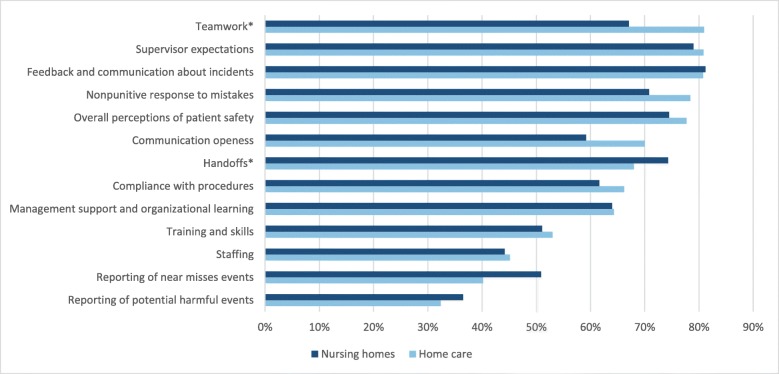
Results: The number of patient safety dimensions having an average score of more than 60% positive responses was seven out of 10 in nursing homes, and nine out of 10 in home care. Staffing had the lowest scores in both health care services. Home care services scored significantly higher than nursing homes on teamwork (eta squared = .053), while nursing homes scored somewhat higher on handover (eta squared = .027). In home care, total explained variance of overall perceptions of patient safety was 45%, with teamwork, staffing, and handoffs as significant predictors. The explained variance in nursing homes was 42.7%, with staffing and communication openness as significant predictors.
Conclusions: There are differences in perceptions of patient safety culture between nursing homes and home care services. Staffing is important for patient safety perceptions in both health care services. In home care, teamwork seems to be a significant contributing factor to patient safety, and building sound teams with mutual trust and collaboration should therefore be an essential part of managers' work with patient safety. In nursing homes, the main focus when building a good patient safety culture should be on open communication, ensuring that staff's ideas and suggestions are valued.
Keywords: Home care services; Incident reporting; Nursing homes; Patient safety; Patient safety culture; Staffing; Teamwork.
Conflict of interest statement
Author SW is member of the editorial board (associate editor) of BMC Health Services Research. All authors declare that they have no other competing interests.
Figures
References
-
- Kohn LT, Corrigan JM, Donaldson MS. To err is human: building a safer health system. Washington (DC): National Academies Press; 2000. - PubMed
-
- National Patient Safety Foundation. Free from harm. Accelerating patient safety improvement fifteen years after to err is human. Boston: National Patient Safety Foundation; 2015.
-
- Ministry of Health and Care Services . Meld. St. 11 (2014–2015). Kvalitet og pasientsikkerhet [Norwegian] Oslo: Ministry of Health and Care Services; 2014.
-
- Ministry of Health and Care Services. Nasjonal handlingsplan for pasientsikkerhet og kvalitetsforbedring 2019–2023 [Norwegian]. Oslo: Ministry of Health and Care Services; 2019.
-
- Minstry of Health and Care Services. Meld. St. 26 (2014–2015) Fremtidens primærhelsetjeneste – nærhet og helhet [Norwegian]. Oslo: Ministry of Health and Care Services; 2014.
Publication types
MeSH terms
Grants and funding
LinkOut - more resources
Full Text Sources
Medical
