


Review on cochlear implant electrode array tip fold-over and scalar deviation
- PMID: 31467506
- PMCID: PMC6712287
- DOI: 10.1016/j.joto.2019.01.002
Review on cochlear implant electrode array tip fold-over and scalar deviation
Erratum in
-
Erratum regarding missing Declaration of Competing Interest statements in previously published articles.J Otol. 2020 Dec;15(4):180. doi: 10.1016/j.joto.2020.10.001. Epub 2020 Oct 13. J Otol. 2020. PMID: 33293924 Free PMC article.
Abstract
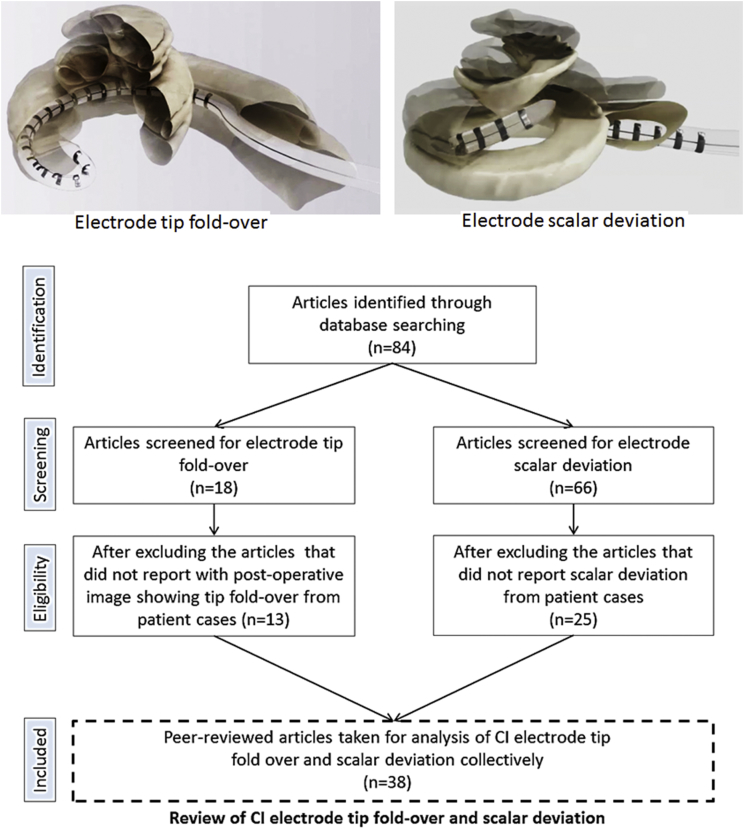
Objective: Determine the occurrence rate of cochlear implant (CI) electrode tip fold-over and electrode scalar deviation as reported in patient cases with different commercial electrode types.
Data-sources: PubMed search for identifying peer-reviewed articles published till 2018 on CI electrode tip fold-over and scalar deviation. Key-words for searching were "Cochlear electrode tip fold-over", "Cochlear electrode scalar position" and "Cochlear electrode scalar location".
Articles-selection: Only if electrode related issues were investigated in patient cases. 38 articles met the inclusion-criteria.
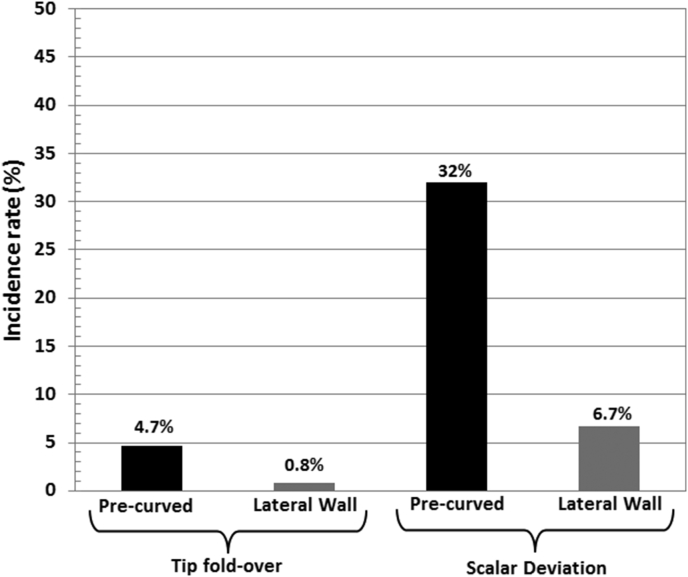
Results: 13 articles on electrode tip fold-over issue covering 3177 implanted ears, out of which 50 ears were identified with electrode tip fold-over with an occurrence rate of 1.57%. Out of 50 ears, 43 were implanted with pre-curved electrodes and the remaining 7 with lateral-wall electrodes. One article reported on both tip fold-over and scalar deviation. 26 articles reported on the electrode scalar deviation covering an overall number of 2046 ears out of which, 458 were identified with electrode scalar deviation at a rate of 22.38%. After removing the studies that did not report on the number of electrodes per electrode type, it was 1324 ears implanted with pre-curved electrode and 507 ears with lateral-wall electrode. Out of 1324 pre-curved electrode implanted ears, 424 were reported with scalar deviation making an occurrence rate of 32%. Out of 507 lateral-wall electrode implanted ears, 43 were associated with scalar deviation at an occurrence rate of 6.7%.
Conclusion: This literature review revealing the fact of higher rate of electrode insertion trauma associated with pre-curved electrode type irrespective of CI brand is one step closer to obsolete it from the clinical practice in the interest of patient's cochlear health.
Keywords: Electrode tip fold-over; Pre-curved electrode; Scalar deviation; Straight electrode.
Figures
References
-
- An S.Y., An C.H., Lee K.Y., Jang J.H., Choung Y.H., Lee S.H. Diagnostic role of cone beam computed tomography for the position of straight array. Acta Otolaryngol. 2017 Nov 26:1–7. - PubMed
-
- Aschendorff A., Kromeier J., Klenzner T., Laszig R. Quality control after insertion of the nucleus contour and contour advance electrode in adults. Ear Hear. 2007 Apr;28(2 Suppl. l):75S–79S. - PubMed
-
- Aschendorff A., Klenzner T., Arndt S., Beck R., Schild C., Roddiger L., Maier W., Laszig R. Insertion results for contour and contour Advance electrodes: are there individual learning curves? HNO. 2011 May;59(5):448–452. - PubMed
-
- Aschendorff A., Briggs R., Brademann G., Helbig S., Hornung J., Lenarz T., Marx M., Ramos A., Stöver T., Escudé B., James C.J. Clinical investigation of the nucleus slim modiolar electrode. Audiol. Neuro. Otol. 2017;22(3):169–179. - PubMed
Publication types
LinkOut - more resources
Full Text Sources
Miscellaneous
