


Top-100 Most Cited Publications Concerning Network Pharmacology: A Bibliometric Analysis
- PMID: 31467569
- PMCID: PMC6701366
- DOI: 10.1155/2019/1704816
Top-100 Most Cited Publications Concerning Network Pharmacology: A Bibliometric Analysis
Abstract
Background: Network pharmacology (NP) has become an increasingly important focus in the drug research field over the past decade. However, no study to date has mapped the current status of NP. Therefore, we performed a bibliometric study to evaluate the top 100 cited papers on NP.
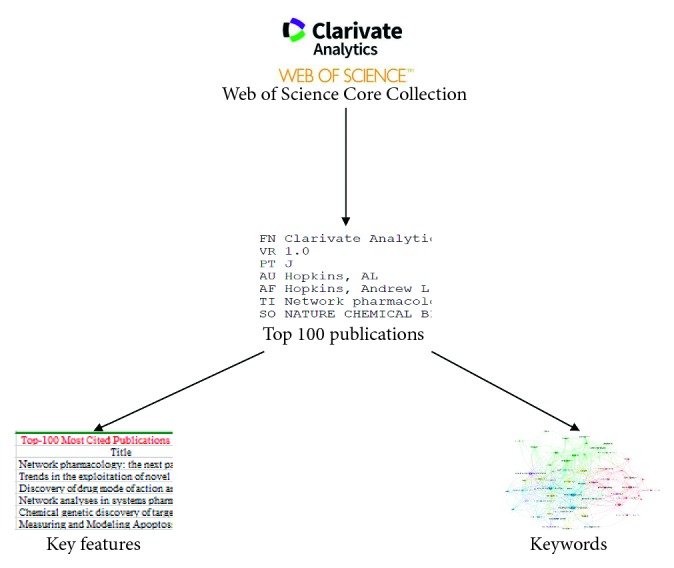
Methods: We searched the Web of Science Core Collection from its inception to February 25, 2019, using the terms "network pharmacology" and "systems pharmacology." Key data, including title, publication year, number of citations, authors, countries/regions, organizations, and journals, were retrieved and analyzed using Excel 2016 and VOSviewer 1.6.10.
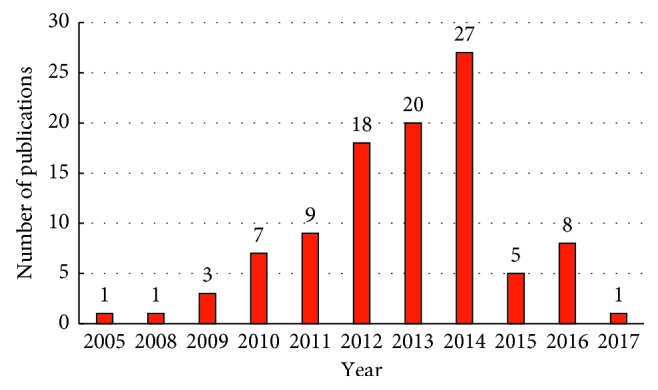
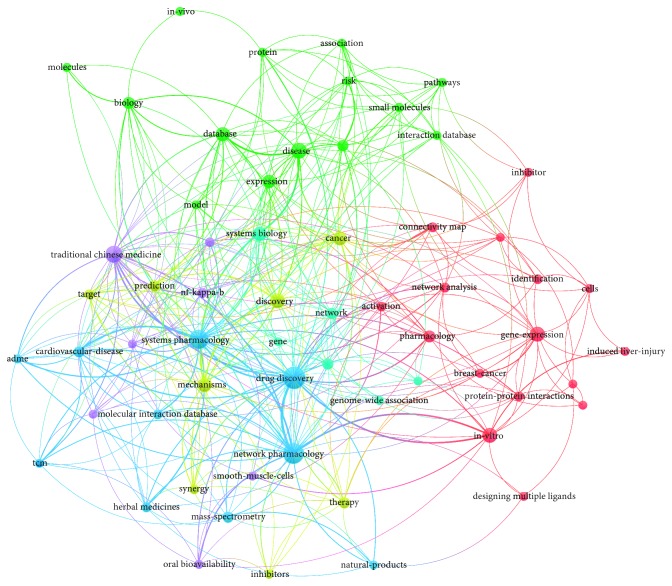
Results: The total number of citations for the 100 cited papers ranged from 21 to 1,238, published in 53 journals, from 2005 to 2017. The top three journals with the most publications on NP were Clinical Pharmacology & Therapeutics (n = 8, IF2017 = 6.544), Journal of Ethnopharmacology (n = 8, IF2017 = 3.115), and PLoS One (n = 7, IF2017 = 2.766). Most published articles were from the USA (n = 41) and China (n = 35). The most active author was Wang Yonghua from the Northwest A&F University, and of the 100 publications, 14 listing his name. The most frequently used substantive terms included "drug discovery," "traditional Chinese medicine (TCM)," "in-vitro," "cancer," and "cardiovascular disease." Conclusions. The USA and China made the greatest contribution to NP research. The current NP research mainly focused on NP methods (including experimental validation) and using them to explore the molecular mechanisms of TCM for some critical diseases such as cardiovascular diseases and cancers. Furthermore, we believe some guidelines should be developed to regulate NP studies.
Conflict of interest statement
All authors declare that they do not have potential conflicts of interest.
Figures
References
Publication types
LinkOut - more resources
Full Text Sources
Miscellaneous
