. 2019 Aug 28;3(8):e00164.
doi: 10.1002/pld3.164. eCollection 2019 Aug.

The rhg1-a (Rhg1 low-copy) nematode resistance source harbors a copia-family retrotransposon within the Rhg1- encoded α-SNAP gene

Affiliations

The rhg1-a (Rhg1 low-copy) nematode resistance source harbors a copia-family retrotransposon within the Rhg1- encoded α-SNAP gene

Adam M Bayless et al. Plant Direct. .

Abstract

Soybean growers widely use the Resistance to Heterodera glycines 1 (Rhg1) locus to reduce yield losses caused by soybean cyst nematode (SCN). Rhg1 is a tandemly repeated four gene block. Two classes of SCN resistance-conferring Rhg1 haplotypes are recognized: rhg1-a ("Peking-type," low-copy number, three or fewer Rhg1 repeats) and rhg1-b ("PI 88788-type," high-copy number, four or more Rhg1 repeats). The rhg1-a and rhg1-b haplotypes encode α-SNAP (alpha-Soluble NSF Attachment Protein) variants α-SNAP Rhg1 LC and α-SNAP Rhg1 HC, respectively, with differing atypical C-terminal domains, that contribute to SCN resistance. Here we report that rhg1-a soybean accessions harbor a copia retrotransposon within their Rhg1 Glyma.18G022500 (α-SNAP-encoding) gene. We termed this retrotransposon "RAC," for Rhg1 alpha-SNAP copia. Soybean carries multiple RAC-like retrotransposon sequences. The Rhg1 RAC insertion is in the Glyma.18G022500 genes of all true rhg1-a haplotypes we tested and was not detected in any examined rhg1-b or Rhg1WT (single-copy) soybeans. RAC is an intact element residing within intron 1, anti-sense to the rhg1-a α-SNAP open reading frame. RAC has intrinsic promoter activities, but overt impacts of RAC on transgenic α-SNAP Rhg1 LC mRNA and protein abundance were not detected. From the native rhg1-a RAC+ genomic context, elevated α-SNAP Rhg1 LC protein abundance was observed in syncytium cells, as was previously observed for α-SNAP Rhg1 HC (whose rhg1-b does not carry RAC). Using a SoySNP50K SNP corresponding with RAC presence, just ~42% of USDA accessions bearing previously identified rhg1-a SoySNP50K SNP signatures harbor the RAC insertion. Subsequent analysis of several of these putative rhg1-a accessions lacking RAC revealed that none encoded α-SNAPRhg1LC, and thus, they are not rhg1-a. rhg1-a haplotypes are of rising interest, with Rhg4, for combating SCN populations that exhibit increased virulence against the widely used rhg1-b resistance. The present study reveals another unexpected structural feature of many Rhg1 loci, and a selectable feature that is predictive of rhg1-a haplotypes.

Keywords: Rhg1; plant disease resistance; retrotransposon; soybean cyst nematode.


Conflict of interest statement

The authors declare no conflict of interest associated with the work described in this manuscript.

Figures
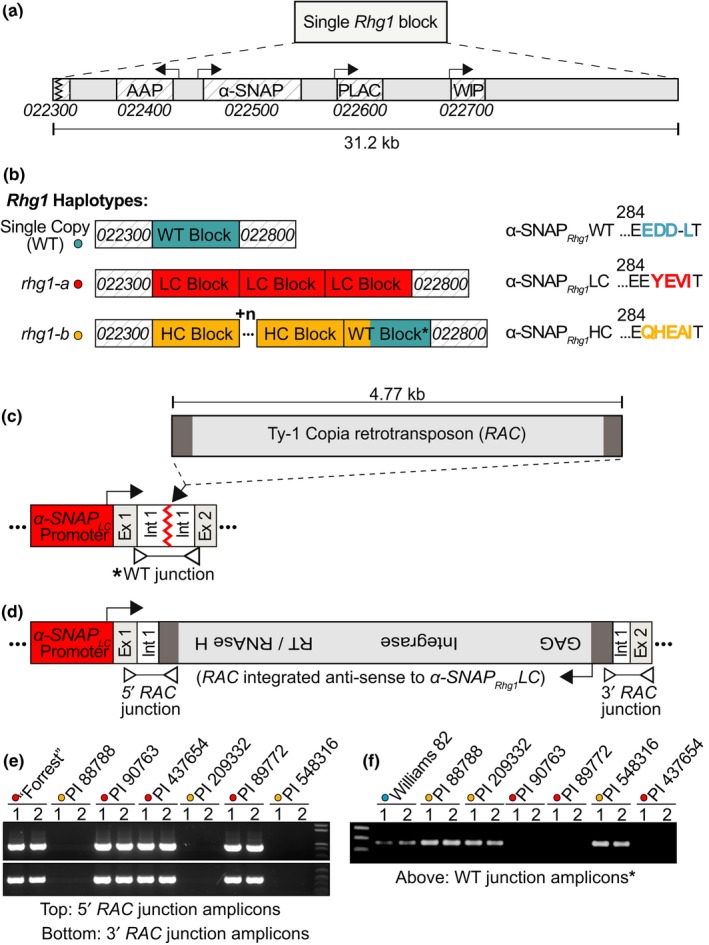
Figure 1
Figure 1
Multiple rhg1‐a haplotypes harbor an intronic copia retrotransposon (RAC) within the Rhg1‐encoded α‐SNAP (Glyma.18g022500). (a) Diagram of a single 31.2 kb Rhg1 block and the four Rhg1‐encoded genes: Glyma.18G022400 (amino acid permease, AAP), Glyma.18G022500 (α‐SNAP), Glyma.18G022600 (PLAC‐domain protein), and Glyma.18G022700 (wound‐inducible protein, WIP). Glyma.18G022300 and Glyma.18G022800 flank Rhg1, but each repeat also includes a truncated 3′ fragment of Glyma.18G022300. (b) Schematic of the three known Rhg1 haplotypes: Rhg1 wild‐type (single‐copy, shown blue), rhg1‐a (low‐copy, shown red), and rhg1‐b (high‐copy, shown orange). Rhg1 α‐SNAP C‐terminal amino acid polymorphisms colored to match Rhg1 block type. (c, d) Model from DNA sequencing of Rhg1 alpha‐SNAP copia (RAC) integration site within the PI 89772 (rhg1‐a) encoded α‐SNAP. The 4.77 kb RAC element (shown gray) is anti‐sense to α‐SNAPRhg1LC and increases predicted overall rhg1-a repeat size to ~36 kb. RAC ORF is intact and encodes a 1438 residue polyprotein. RAC LTRs are shown in dark gray; α‐SNAPRhg1LC promoter are shown in red. “Ex.” and “int.” are α‐SNAPRhg1LC exons and introns, respectively. Connected open triangles indicate PCR products of Figure 1e,f. LTR: long terminal repeat; GAG: group‐specific antigen, RT: reverse transcriptase. (e) Agarose gel showing 5′ and 3′ α‐SNAP‐RAC junction products from the rhg1‐a (low‐copy, red dots) accessions: “Forrest,” PI 90763, PI 437654, PI 89772. No α‐SNAP‐RAC junctions detected from rhg1‐b (high‐copy; orange dots) accessions: PI 88788, PI 209332, or PI 548316. (f) Similar to E and using same template DNA samples, but PCR amplification of a "WT junction" products (Figure 1c) of size similar to the wild‐type α‐SNAP exon 1–2 distance, as in the Williams 82 reference genome
Figure 2
Figure 2
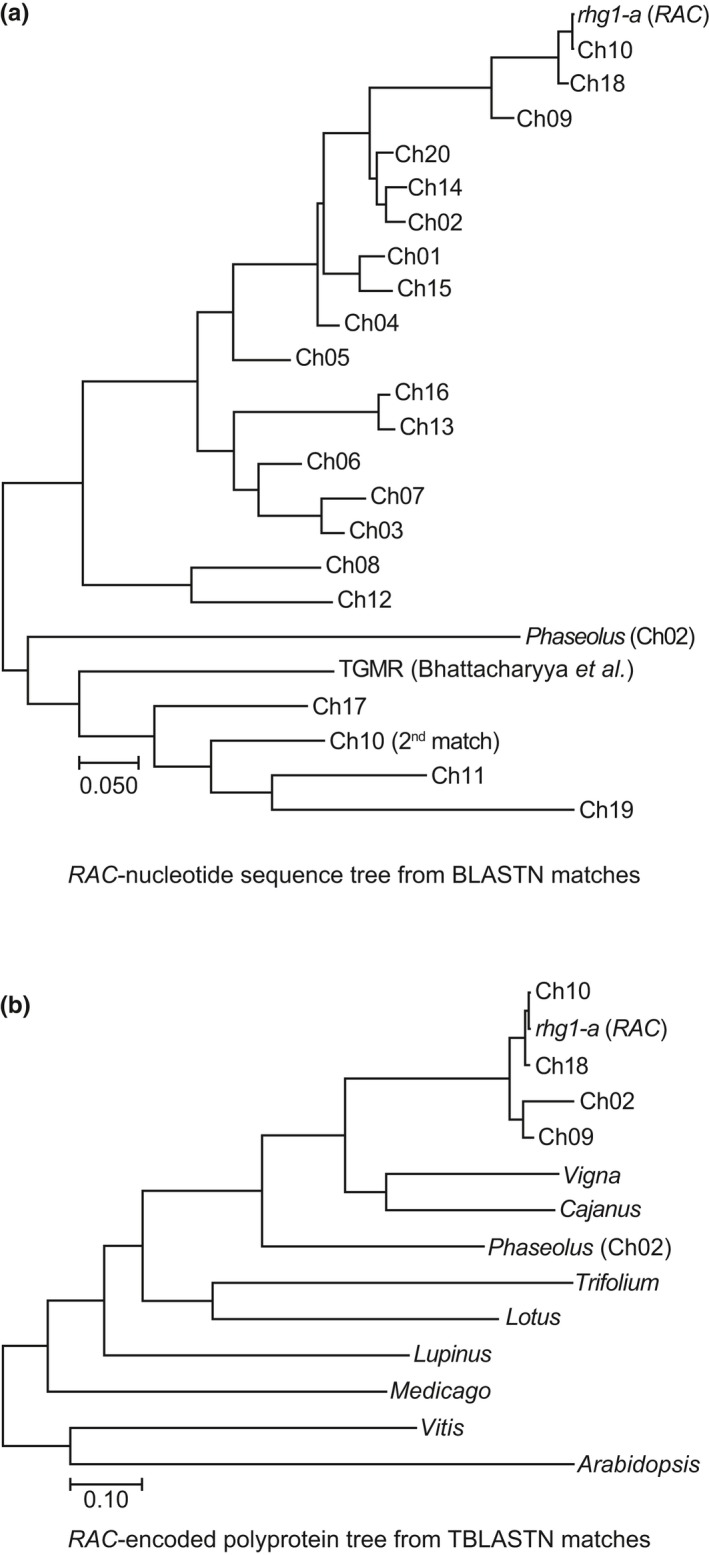
The RAC‐like subfamily of copia retrotransposons is common in soybean and other legumes. (a) Maximum likelihood phylogenetic tree of RAC‐like element nucleotide sequences from soybean. The top hit from each soybean chromosome was included, as was the known soybean retrotransposon “TGMR” and the top RAC‐like match from Phaseolus (common bean). (b) Similar to A; a maximum likelihood tree, but using the RAC‐encoded polyprotein sequences from the four most similar soybean RAC‐like elements, and the most similar element matches from the indicated plant species
Figure 3
Figure 3
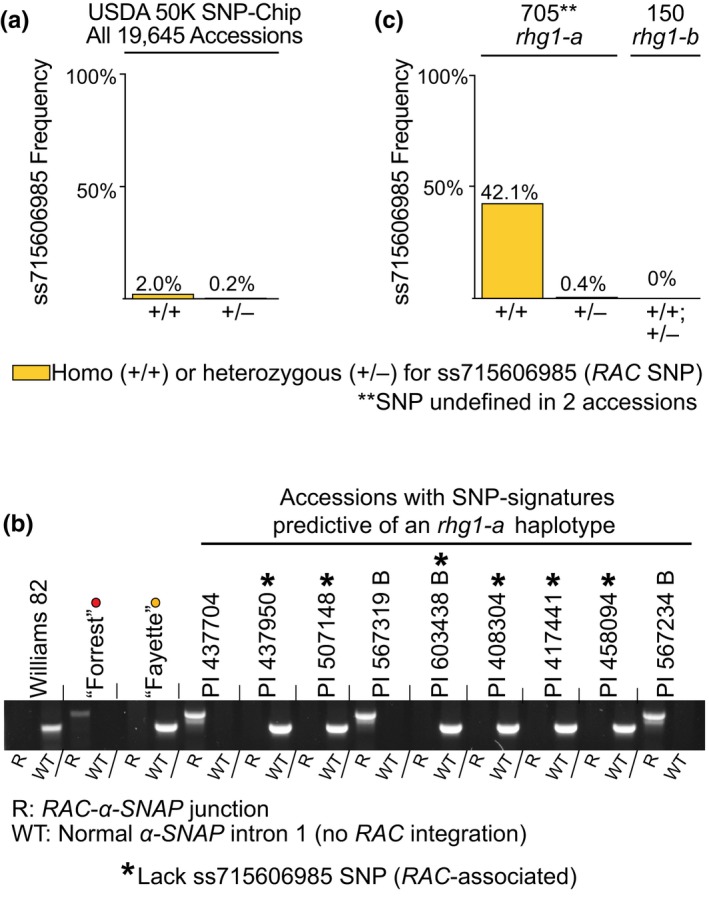
RAC is present within a subclass of rhg1‐a signature soybean accessions. (a) Frequency of RAC‐associated SNP, ss715606985, among 19,645 SoySNP50K‐genotyped USDA soybean accessions. (b) Agarose gel showing PCR detection of α‐SNAPRAC junctions or WT α‐SNAP exon 1–2 distances among rhg1‐a signature accessions positive or negative for the RAC‐SNP, ss71560698. Williams 82 (Rhg1WT), “Forrest” (rhg1‐a), and “Fayette” (rhg1‐b) included as controls; Rhg1 haplotypes color coded with dots as in Figure 1. An * denotes an rhg1‐a signature accession lacking the RAC‐SNP. (c) Frequency of RAC‐associated SNP among all USDA Glycine max accessions with consensus SNP signatures of rhg1‐a or rhg1‐b haplotypes
Figure 4
Figure 4
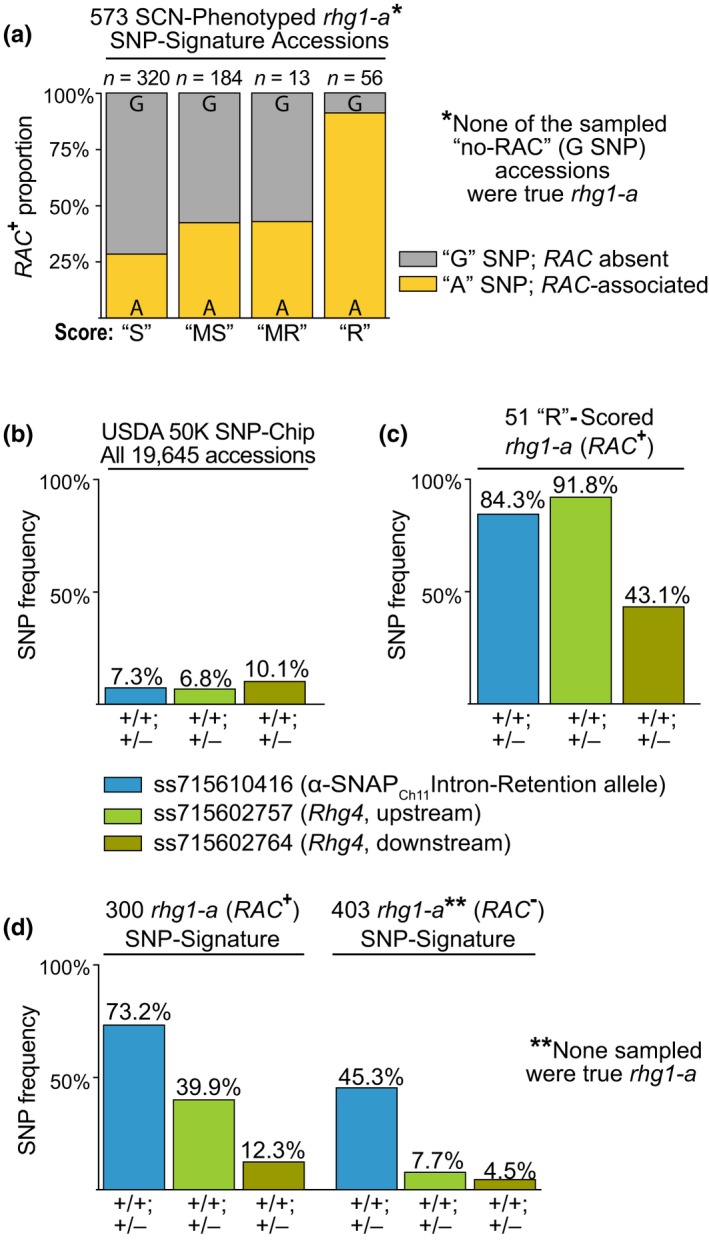
RAC presence correlates with a stronger SCN‐resistance profile and the co‐presence of other loci that augment rhg1‐a resistance. (a) Proportion of RAC + (ss715606985 A SNP) versus RAC (G SNP) accessions among 573 SCN‐phenotyped soybeans with consensus SoySNP50K SNP signatures predictive of rhg1‐a. *Note that none of the sampled RAC (G SNP) accessions had rhg1‐a (none encoded α‐SNAPRhg1LC). “S”: susceptible in all trials, “MS”: moderately susceptible in at least one trial, “MR”: moderately resistant in at least one trial, “R”: resistant in at least one trial. Fisher's Exact Test pairwise comparisons: “R‐MR” (p = 2.6E‐4), “R‐MS” (p = 2.3E‐11), “R‐S” (p = 2.2E‐16), “MR‐MS” (p = 1.0), “MR‐S” (p = .25), “MS‐S” (p = 2.4E‐3). (b) Frequency of SNPs associated with Rhg4 (ss715602757, ss715602764) or the Chromosome 11‐encoded α‐SNAP intron‐retention (α‐SNAPCh11IR) allele, ss71559743 among 19,645 USDA accessions. (c) Frequency of the Rhg4 and α‐SNAPCh11IR associated SNPs among the 51 “Resistant” scored RAC + rhg1‐a signature accessions. (d) Frequency of the Rhg4 and α‐SNAPCh11‐IR associated SNPs among all RAC + (300) or RAC (403) USDA G. max accessions with consensus SNP signatures predictive of rhg1‐a (705 total; two accessions undefined for ss715606985 SNP)
Figure 5
Figure 5
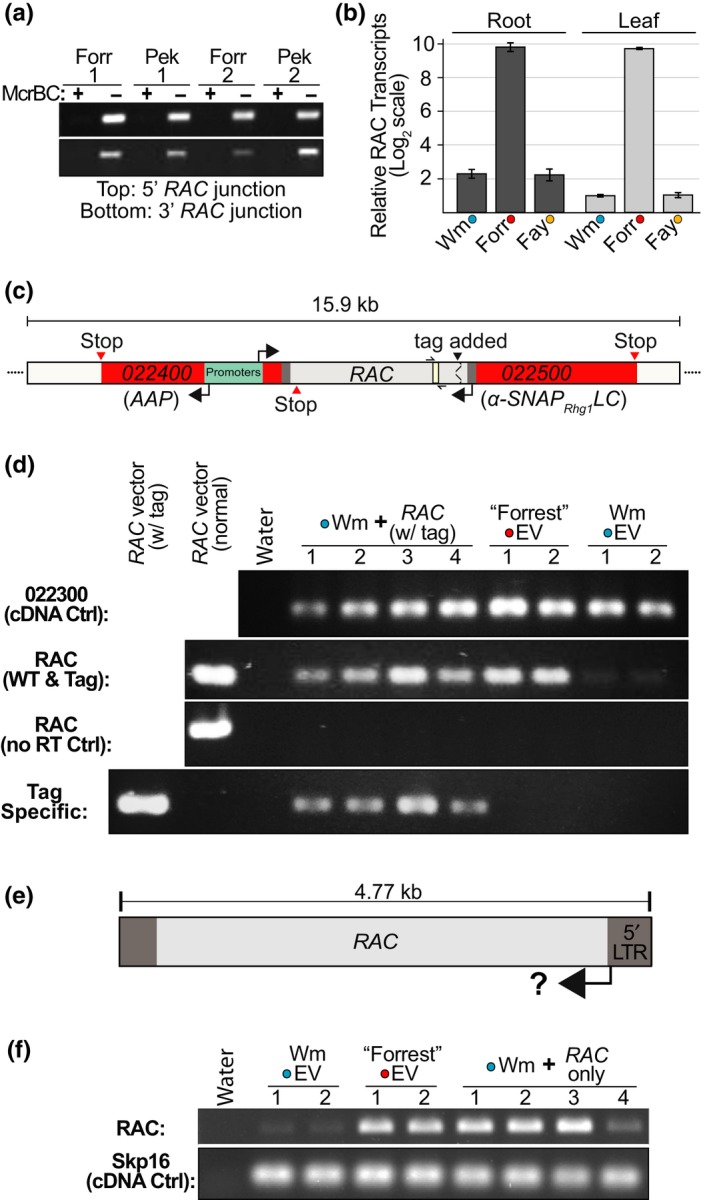
The rhg1‐a RAC element is methylated but has intrinsic transcriptional activity. (a) Agarose gel showing PCR amplicons for α‐SNAPRAC regions from McrBC‐treated (+) or mock‐treated (−) genomic DNAs from “Forrest” (Forr) or “Peking” (Pek, PI 548402) roots. (b) qPCR analysis of mRNA transcript abundance for RAC and similar RAC‐like elements, in leaf or root tissues of Williams 82 (Wm; Rhg1WT), “Forrest” (Forr; rhg1‐a) or “Fayette” (Fay; rhg1‐b). Colored dots indicate Rhg1 haplotype as in Figure 1. Normalized RAC transcript abundances are presented relative to the mean abundance of RAC transcript for Williams 82 leaf samples. Y‐axis uses log2 scale. (c) Schematic showing unique nucleotide tag addition to an otherwise native α‐SNAPRAC cassette. This construct contains native flanking Rhg1 sequence including Glyma.18G022400 (transcribes from the bidirectional α‐SNAP promoter) and 1.8 kb upstream, as well as 4.7 kb of downstream RAC flanking sequence (~1.0 kb after the α‐SNAPRhg1LC termination codon). The RAC region detected and amplified via qPCR or RT‐PCR is colored ivory and flanked by half‐arrows. (d) Agarose gel of RT‐PCR cDNAs of “Forrest” or Wm 82 transgenic roots transformed with an empty vector (EV) or the native tagged α‐SNAPRAC construct. Tag primers amplify only the modified α‐SNAPRAC while the normal RAC primer set amplifies both endogenous RAC‐like transcripts as well as the tagged α‐SNAPRAC transgene. Glyma.18G022300 mRNA transcript used as a cDNA quality and loading control; no RT (reverse transcriptase) ctrl verifies absence of amplifiable genomic DNA. (e) Schematic showing the sub‐cloned 4.77 kb RAC expression cassette tested in F. (f) Like D, but “Forrest” or Wm 82 roots transformed with empty vector or the 4.77 kb RAC element (all flanking Rhg1 sequence context removed)
Figure 6
Figure 6
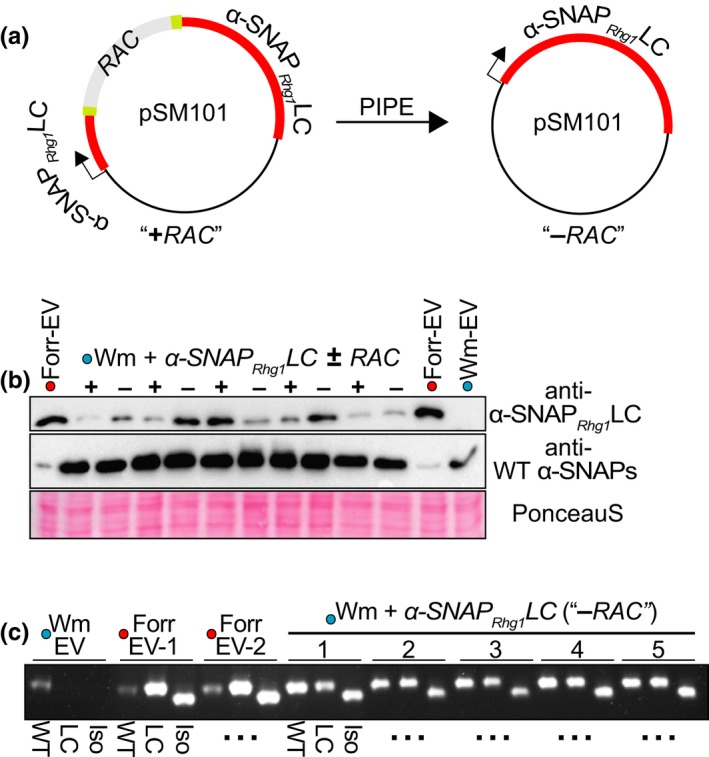
α‐SNAPRhg1LC protein is expressed despite RAC presence. (a) Schematic showing PIPE‐mediated removal of RAC from the native α‐SNAPRAC construct, pSM101. (b) Immunoblots of independent “Forrest” or Wm82 transgenic root lysates using previously described antibodies for α‐SNAPRhg1LC or WT α‐SNAP proteins. “+” denotes α‐SNAPRAC transformation, “−” indicates transformation with α‐SNAPRhg1LC (RAC removed), and EV is transformed with empty vector. Ponceau S staining serves as a loading control. (c) Agarose gel showing RT‐PCR amplification of mature α‐SNAPRhg1LC transcript isoforms from roots of Wm 82 or “Forrest” transformed with α‐SNAPRAC (+), or a native α‐SNAPRhg1LC cassette with RAC removed (−), or an empty vector control. WT refers to primers specific for WT α‐SNAP transcripts, LC detects full‐length α‐SNAPRhg1LC transcripts, while “Iso” amplifies a previously described α‐SNAPRhg1LC alternative transcript isoform that splices out 36 bp (Cook et al., 2014). "...": same WT‐LC‐Iso pattern
Figure 7
Figure 7
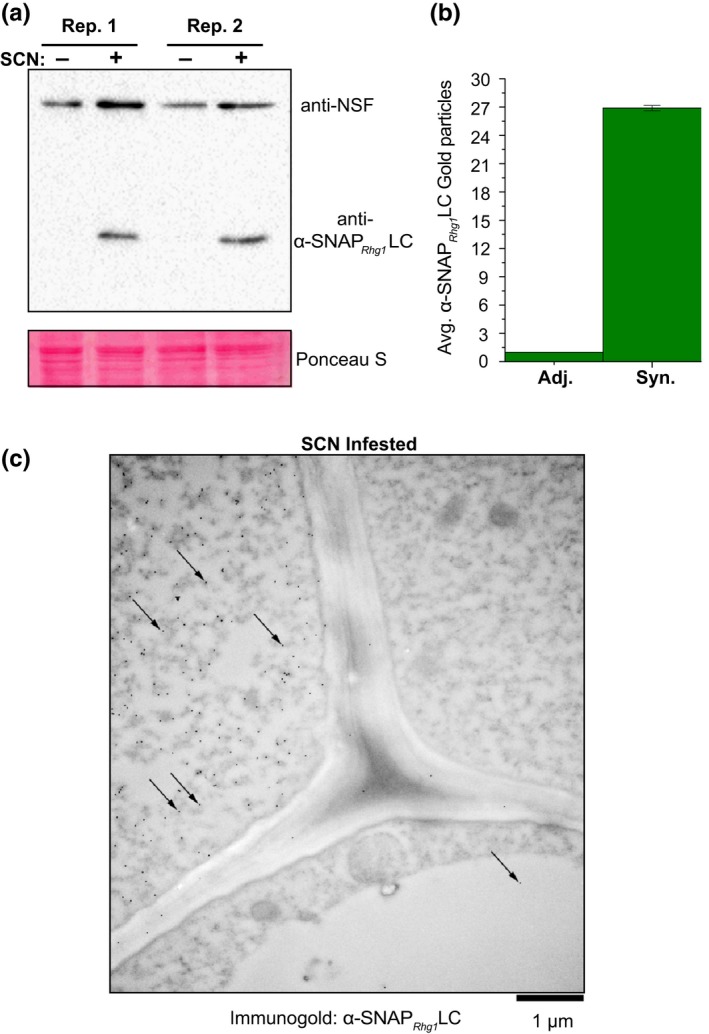
α‐SNAPRhg1LC hyperaccumulates at SCN infection sites in low‐copy rhg1‐a soybean accession “Forrest.” (a) Immunoblot of non‐transgenic “Forrest” root samples from SCN‐infested root regions (SCN +) harvested 4 days after SCN infection, or similar regions from mock‐inoculated controls (SCN −). Blot was probed simultaneously with anti‐α‐SNAPRhg1LC and anti‐NSF polyclonal antibodies. Ponceau S staining before blotting served as a loading control. (b) Representative electron microscope image (7 dpi) showing anti‐α‐SNAPRhg1LC immunogold signal in SCN‐associated syncytium cells from “Forrest” roots. Arrows highlight only some of the 15 nm immunogold particle dots. Frequent α‐SNAPRhg1LC signal was observed in syncytium cells (upper left, “Syn”) but rare in adjacent cells (upper right and bottom, “Adj.”). CW, cell wall; M, mitochondrion; Vac, vacuole. Bar = 1 µm. (c) Mean and SEM of α‐SNAPRhg1LC gold particle abundance in syncytia, normalized to the count from adjacent cells in the same image. Anti‐α‐SNAPRhg1LC immunogold particles were counted for one 9 µm2 area within cells having syncytium morphology and in a region with the highest observable signal in directly adjacent cells with normal root cell morphology (large central vacuole). Data are for 23 images (11 and 12 root sections, respectively, from two experiments), for root sections 7 days after inoculation

References

    1. Allen, T. W. , Bradley, C. A. , Sisson, A. J. , Byamukama, E. , Chilvers, M. I. , Coker, C. M. , … Wrather, J. A. (2017). Soybean yield loss estimates due to diseases in the United States and Ontario, Canada, from 2010 to 2014. Plant Health Progress, 18(1), 19–27. 10.1094/PHP-RS-16-0066 - DOI
    1. Anand, S. C. , & Gallo, K. M. (1984) Identification of additional soybean germ plasm with resistance to race 3 of the soybean cyst nematode. Plant Disease, 68(7), 593– 10.1094/PD-69-593 - DOI
    1. Arelli, P. R. , Sleper, D. A. , Yue, P. , & Wilcox, J. A. (2000). Soybean reaction to races 1 and 2 of Heterodera glycines. Contribution of the Missouri Agric. Exp. Stn. Journal Series No. 12,751. Crop Science, 40, 824–826. 10.2135/cropsci2000.403824x - DOI
    1. Bayless, A. M. , Smith, J. M. , Song, J. , McMinn, P. H. , Teillet, A. , August, B. K. , & Bent, A. F. (2016). Disease resistance through impairment of alpha‐SNAP‐NSF interaction and vesicular trafficking by soybean Rhg1 . Proceedings of the National Academy of Sciences of the United States of America, 113, E7375–E7382. - PMC - PubMed
    1. Bayless, A. M. , Zapotocny, R. W. , Grunwald, D. J. , Amundson, K. K. , Diers, B. W. , & Bent, A. F. (2018). An atypical N‐ethylmaleimide sensitive factor enables the viability of nematode‐resistant Rhg1 soybeans. Proceedings of the National Academy of Sciences of the United States of America, 115, E4512–E4521. - PMC - PubMed