


S-100B as an extra selection tool for FDG PET/CT scanning in follow-up of AJCC stage III melanoma patients
- PMID: 31468535
- PMCID: PMC6851671
- DOI: 10.1002/jso.25682
S-100B as an extra selection tool for FDG PET/CT scanning in follow-up of AJCC stage III melanoma patients
Abstract
Background and objectives: This current study assessed the value of S-100B measurement to guide fluorodeoxyglucose (FDG) positron emission tomography/computed tomography (PET/CT) scanning for detecting recurrent disease in stage III melanoma patients.
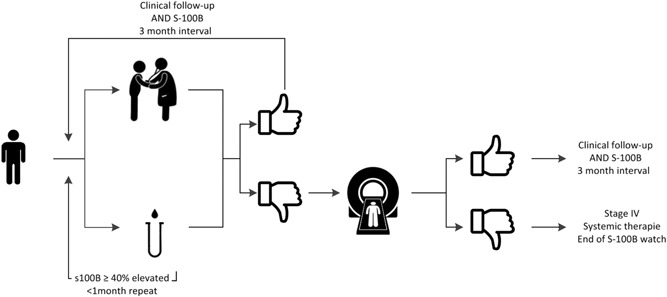
Methods: This study included 100 stage III melanoma patients in follow-up after curative lymph node dissection. Follow-up visits included physical examination and S-100B monitoring. FDG PET/CT scanning was indicated by clinical symptoms and/or elevated S-100B.
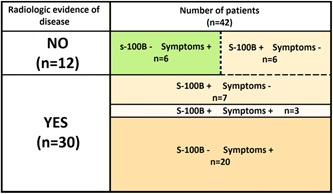
Results: Of 100 patients, 13 (13%) had elevated S-100B without clinical symptoms, of whom 7 (54%) showed disease evidence upon FDG PET/CT scanning. Twenty-six patients (26%) had clinical symptoms with normal S-100B and FDG PET/CT revealed metastasis in 20 (77%). Three patients had clinical symptoms and elevated S-100B, and FDG PET/CT revealed metastasis in all three (100%). Overall, FDG PET/CT scanning revealed metastasis in 30 of the 42 patients (71.4%). For seven recurrences, elevated S-100B prompted early detection of asymptomatic disease; 10% of all asymptomatic patients in follow-up, 23% of all patients with recurrent disease.
Conclusion: S-100B cannot exclude recurrent disease during follow-up of stage III melanoma. However, adding S-100B measurement to standard clinical assessment can guide FDG PET/CT scanning for detecting recurrent melanoma.
Keywords: FDG PET/CT; S-100B; biomarker; follow-up; melanoma; recurrence.
© 2019 The Authors. Journal of Surgical Oncology published by Wiley Periodicals, Inc.
Conflict of interest statement
The authors declare that there are no conflict of interests.
Figures
References
-
- Hollestein LM, van den Akker SAW, Nijsten T, Karim‐Kos HE, Coebergh JW, de Vries E. Trends of cutaneous melanoma in The Netherlands: increasing incidence rates among all Breslow thickness categories and rising mortality rates since 1989. Ann Oncol. 2012;23:524‐530. - PubMed
-
- Melanoom incidentie . Nederlandse Kankerregistratie, beheerd door IKNL©. [May] 2019.
-
- Melanoom mortaliteit . Nederlandse Kankerregistratie, beheerd door IKNL©. [May] 2019.
-
- Rueth NM, Xing Y, Chiang YJ, et al. Is surveillance imaging effective for detecting surgically treatable recurrences in patients with melanoma? A comparative analysis of stage‐specific surveillance strategies. Ann Surg. 2014;259:1215‐1222. - PubMed
-
- Bouwhuis MG, Suciu S, Kruit W, et al. Prognostic value of serial blood S100B determinations in stage IIB‐III melanoma patients: a corollary study to EORTC trial 18952. Eur J Cancer. 2011;47:361‐368. - PubMed
MeSH terms
Substances
LinkOut - more resources
Full Text Sources
Medical
Miscellaneous
