


Glycaemic control in patients with type 2 diabetes initiating second-line therapy: Results from the global DISCOVER study programme
- PMID: 31468637
- PMCID: PMC6916552
- DOI: 10.1111/dom.13866
Glycaemic control in patients with type 2 diabetes initiating second-line therapy: Results from the global DISCOVER study programme
Abstract
Aim: To assess glycaemic control and factors associated with poor glycaemic control at initiation of second-line therapy in the DISCOVER programme.
Materials and methods: DISCOVER (NCT02322762 and NCT02226822) comprises two similar prospective observational studies of 15 992 people with type 2 diabetes (T2D) initiating second-line glucose-lowering therapy in 38 countries across six regions (Africa, Americas, South-East Asia, Eastern Mediterranean, Europe and Western Pacific). Data were collected using a standardized case report form. Glycated haemoglobin (HbA1c) levels were measured according to standard clinical practice in each country, and factors associated with poor glycaemic control (HbA1c >8.0%) were evaluated using hierarchical regression models.
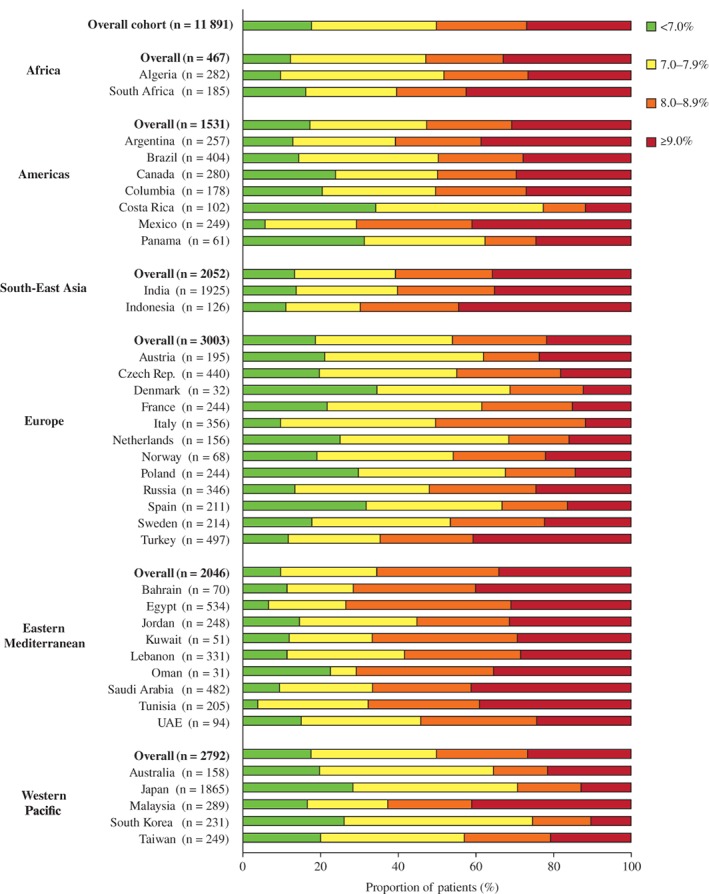
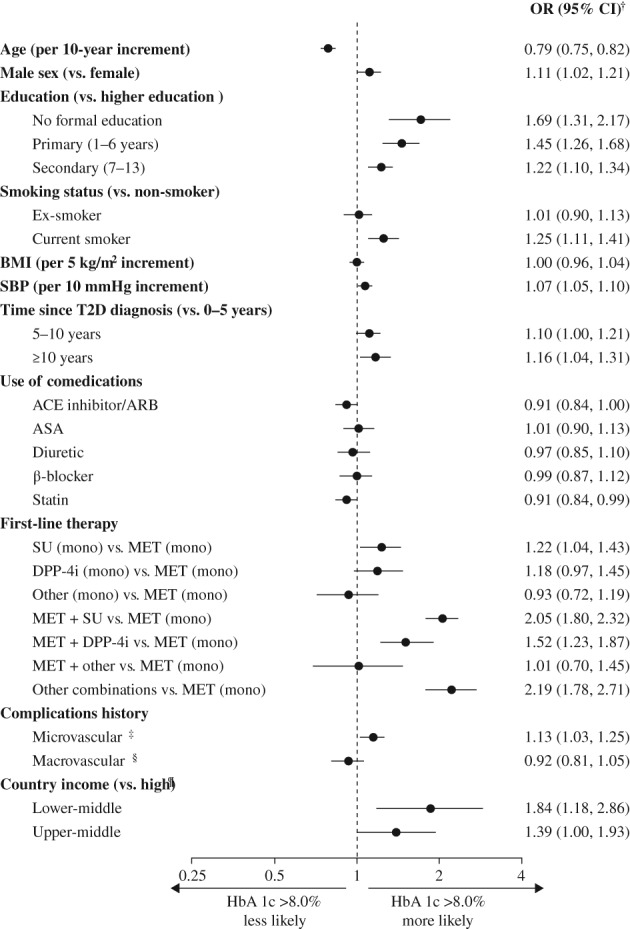
Results: HbA1c levels were available for 80.9% of patients (across-region range [ARR] 57.5%-97.5%); 92.2% (ARR 59.2%-99.1%) of patients had either HbA1c or fasting plasma glucose levels available. The mean HbA1c was 8.3% (ARR 7.9%-8.7%). In total, 26.7% of patients had an HbA1c level ≥9.0%, with the highest proportions in South-East Asia (35.6%). Factors associated with having HbA1c >8.0% at initiation of second-line therapy included low education level, low country income, and longer time since T2D diagnosis.
Conclusions: The poor levels of glycaemic control at initiation of second-line therapy suggest that intensification of glucose-lowering treatment is delayed in many patients with T2D. In some countries, HbA1c levels are not routinely measured. These findings highlight an urgent need for interventions to improve monitoring and management of glycaemic control worldwide, particularly in lower-middle- and upper-middle-income countries.
Keywords: glycaemic control; observational study; type 2 diabetes.
© 2019 The Authors. Diabetes, Obesity and Metabolism published by John Wiley & Sons Ltd.
Conflict of interest statement
K.K., M.B.G., L.J, M.K, S.P., M.V.S., I.S., H.W. and A.N. are members of the DISCOVER Scientific Committee, and received support from AstraZeneca to attend DISCOVER planning and update meetings. N.A., P.F. and S.K. are employees of AstraZeneca. N.H. is a former employee of AstraZeneca. J.C.R. is an employee of Evidera. In addition, K.K. has received honoraria from AstraZeneca, Boehringer Ingelheim, Eli Lilly, Janssen, Merck Sharp & Dohme, Novartis, Novo Nordisk, Roche and Sanofi, and research support from AstraZeneca, Boehringer Ingelheim, Eli Lilly, Janssen, Merck Sharp & Dohme, Novartis, Novo Nordisk, Roche and Sanofi, and also acknowledges support from the National Institute for Health Research Collaboration for Leadership in Applied Health Research and Care – East Midlands (NIHR CLAHRC – EM) and the National Institute of Health Research (NIHR) Leicester Biomedical Research Centre. M.B.G. has received honoraria from Merck‐Serono. L.J. has received honoraria from Eli Lilly, Bristol‐Myers Squibb, Novartis, Novo Nordisk, Merck, Bayer, Merck Sharp & Dohme, Takeda, Sanofi, Roche, Boehringer Ingelheim and AstraZeneca, and research support from Roche, Sanofi, Merck Sharp & Dohme, AstraZeneca, Novartis, Eli Lilly and Bristol‐Myers Squibb. M.K. has received honoraria from Amgen, Applied Therapeutics, AstraZeneca, Bayer, Boehringer Ingelheim, GlaxoSmithKline, Intarcia, Janssen, Novartis, Novo Nordisk, Glytec Systems, Merck (Diabetes) and Sanofi, and research support from AstraZeneca and Boehringer Ingelheim. S.P. has received honoraria from AstraZeneca. M.V.S. has received honoraria from Eli Lilly, Merck Sharp & Dohme, Sanofi, Novo Nordisk, Boehringer Ingelheim and AstraZeneca, and research support from Sanofi. I.S. has received honoraria from Astellas Pharma, AstraZeneca, Boehringer Ingelheim, Kowa, Merck Sharp & Dohme, Mitsubishi Tanabe Pharma, Novo Nordisk, Ono Pharmaceutical, Sanwa Kagaku Kenkyusho and Takeda Pharmaceutical, and research support from Astellas Pharma, AstraZeneca, Daiichi Sankyo, Eli Lilly, Japan Foundation for Applied Enzymology, Japan Science and Technology Agency, Kowa, Kyowa Hakko Kirin, Midori Health Management Center, Mitsubishi Tanabe Pharma, Novo Nordisk, Ono Pharmaceutical, Sanofi, Suzuken Memorial Foundation and Takeda Pharmaceutical. F.T. has received research support from AstraZeneca. H.W. has received honoraria from Boehringer Ingelheim, Daiichi Sankyo, Dainippon Sumitomo Pharma, Eli Lilly, Kowa, Merck Sharp & Dohme, Novo Nordisk, Novartis, Ono Pharmaceutical, Sanofi, Sanwa Kagaku Kenkyusho, Takeda, Astellas Pharma, Mitsubishi Tanabe Pharma, AstraZeneca, Kyowa Hakko Kirin and Kissei Pharma, and research support from AstraZeneca, Boehringer Ingelheim, Daiichi Sankyo, Dainippon Sumitomo Pharma, Eli Lilly, Kissei Pharma, Merck Sharp & Dohme, Mitsubishi Tanabe Pharma, Mochida Pharmaceutical, Novartis, Novo Nordisk, Pfizer, Sanofi, Sanwa Kagaku Kenkyusho, Takeda, Terumo Corp, Astellas Pharma, Abbott, Ono Pharmaceutical, Kyowa Hakko Kirin, Kowa, Johnson & Johnson, Taisho Toyama Pharmaceutical, Nitto Boseki, Bayer, Bristol‐Myers Squibb and Benefit one Health care. A.N. has received honoraria from Novo Nordisk, Medtronic, AstraZeneca and Eli Lilly, and research support from Novo Nordisk, Sanofi‐Aventis, Artsana and Dexcom.
Figures
References
-
- Inzucchi SE, Bergenstal RM, Buse JB, et al. Management of hyperglycaemia in type 2 diabetes, 2015: a patient‐centred approach. Update to a position statement of the American Diabetes Association and the European Association for the Study of Diabetes. Diabetologia. 2015;58:429‐442. - PubMed
-
- Chinese Diabetes Society . Chinese guideline for type 2 diabetes prevention (2013). Chin J Diabetes. 2014;22:2‐42.
-
- Holman RR, Paul SK, Bethel MA, Matthews DR, Neil HA. 10‐year follow‐up of intensive glucose control in type 2 diabetes. N Engl J Med. 2008;359:1577‐1589. - PubMed
-
- Abdul‐Ghani MA, Puckett C, Triplitt C, et al. Initial combination therapy with metformin, pioglitazone and exenatide is more effective than sequential add‐on therapy in subjects with new‐onset diabetes. Results from the Efficacy and Durability of Initial Combination Therapy for Type 2 Diabetes (EDICT): a randomized trial. Diabetes Obes Metab. 2015;17:268‐275. - PMC - PubMed
Publication types
MeSH terms
Substances
Associated data
Grants and funding
LinkOut - more resources
Full Text Sources
Medical
