


Review
doi: 10.3390/v11090794.
Throw out the Map: Neuropathogenesis of the Globally Expanding California Serogroup of Orthobunyaviruses
Affiliations
- PMID: 31470541
- PMCID: PMC6784171
- DOI: 10.3390/v11090794
Item in Clipboard
Review
Throw out the Map: Neuropathogenesis of the Globally Expanding California Serogroup of Orthobunyaviruses
Viruses.
.
Abstract
The California serogroup (CSG) comprises 18 serologically and genetically related mosquito-borne orthobunyaviruses. Of these viruses, at least seven have been shown to cause neurological disease in humans, including the leading cause of pediatric arboviral encephalitis in the USA, La Crosse virus. Despite the disease burden from these viruses, much is still unknown about the CSG viruses. This review summarizes our current knowledge of the CSG viruses, including human disease and the mechanisms of neuropathogenesis.
Keywords: arbovirus; neuroinvasion; neurovirulence; orthobunyavirus; pathogenesis.
Conflict of interest statement
The authors declare no conflicts of interest.
Figures
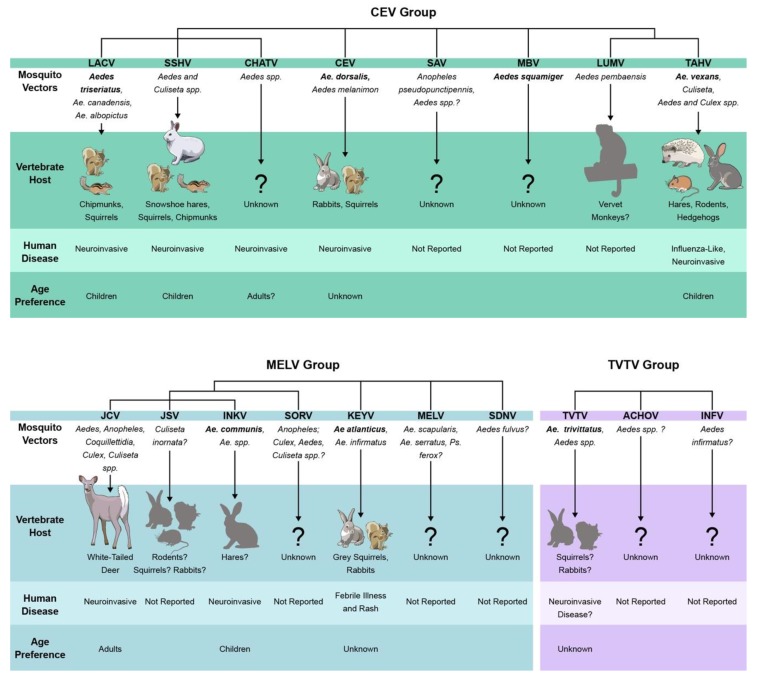
Summary of the genetic relationships, mosquito vectors, vertebrate hosts, and human disease for the California serogroup (CSG) viruses, expanded from Figure 1B in [21]. Groups are divided based on phylogenetic classification. Relationships reflect the compilation and summary of several phylogenetic analyses [8,14,18,19,20]. Monophyletic groups are shown and reflect that these were consistent in the majority of studies, and ungrouped vertical lines indicate relationship discrepancies of those viruses between phylogenetic studies. Mosquito genera and species from which CSG viruses have been isolated from are listed, and species in bold indicate primary vectors as determined by frequent virus isolations and laboratory transmission studies. Confirmed and likely vertebrate hosts are designated with colored icons and are based on evidence of both serological evidence in the field, and experimental viremias or virus isolations from animals in the field. Grayed icons indicate possible hosts based on either serological evidence or experimental viremias.
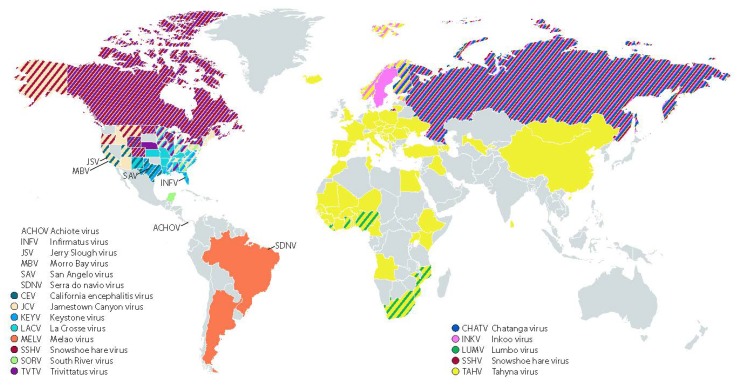
Map of the geographical distribution of the California serogroup viruses, expanded from Figure 1A in [21]. Geographic distribution is based on positive serology of humans and animals, mosquito isolations of virus, and probable and confirmed human cases.
References
-
- Hammon W.M., Reeves W.C., Sather G. California encephalitis virus, a newly described agent. II. Isolations and attempts to identify and characterize the agent. J. Immunol. 1952;69:493–510. - PubMed
-
- Sudia W.D., Chamberlain R.W., Calisher C.H., Newhouse V.F. California Group Arboviruses—Isolations from Mosquitos in North-America. Mosq. News. 1971;31:576–600.
Publication types
MeSH terms
Grants and funding
LinkOut - more resources
Full Text Sources
