. 2019 Oct 30;85(22):e01903-19.
doi: 10.1128/AEM.01903-19. Print 2019 Nov 15.

Horizontal Gene Transfer and Acquired Antibiotic Resistance in Salmonella enterica Serovar Heidelberg following In Vitro Incubation in Broiler Ceca

Affiliations

Horizontal Gene Transfer and Acquired Antibiotic Resistance in Salmonella enterica Serovar Heidelberg following In Vitro Incubation in Broiler Ceca

Adelumola Oladeinde et al. Appl Environ Microbiol. .

Abstract

The chicken gastrointestinal tract harbors microorganisms that play a role in the health and disease status of the host. The cecum is the part of the gut that carries the highest microbial densities, has the longest residence time of digesta, and is a vital site for urea recycling and water regulation. Therefore, the cecum provides a rich environment for bacteria to horizontally transfer genes between one another via mobile genetic elements such as plasmids and bacteriophages. In this study, we used broiler chicken cecum as a model to investigate antibiotic resistance genes that can be transferred in vitro from cecal flora to Salmonella enterica serovar Heidelberg. We used whole-genome sequencing and resistome enrichment to decipher the interactions between S Heidelberg, the gut microbiome, and acquired antibiotic resistance. After 48 h of incubation of ceca under microaerophilic conditions, we recovered one S Heidelberg isolate with an acquired IncK2 plasmid (88 kb) carrying an extended-spectrum-β-lactamase gene (blaCMY-2). In vitro, this plasmid was transferable between Escherichia coli and S Heidelberg strains but transfer was unsuccessful between S Heidelberg strains. An in-depth genetic characterization of transferred plasmids suggests that they share significant homology with P1-like phages. This study contributes to our understanding of horizontal gene transfer between an important foodborne pathogen and the chicken gut microbiome.IMPORTANCES. Heidelberg is a clinically important serovar, linked to foodborne illness and among the top 5 serovars isolated from poultry in the United States and Canada. Acquisition of new genetic material from the microbial flora in the gastrointestinal tract of food animals, including broilers, may contribute to increased fitness of pathogens like S. Heidelberg and may increase their level of antibiotic tolerance. Therefore, it is critical to gain a better understanding of the interactions that occur between important pathogens and the commensals present in the animal gut and other agroecosystems. In this report, we show that the native flora in broiler ceca were capable of transferring mobile genetic elements carrying the AmpC β-lactamase (blaCMY-2) gene to an important foodborne pathogen, S Heidelberg. The potential role for bacteriophage transduction is also discussed.

Keywords: AMR; HGT; Salmonella; chicken.


Figures
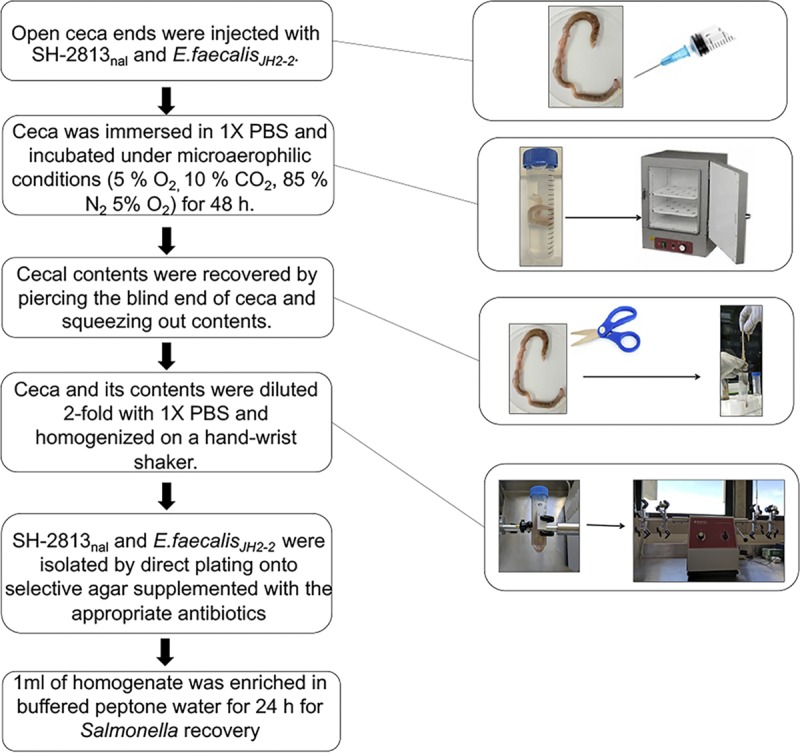
FIG 1
FIG 1
Experimental design. Entire viscera were collected from 18 broiler birds from the evisceration line of a commercial processing plant in Athens, GA. Viscera were put in individual Whirl-Pak bags and transported immediately on ice to the USDA-ARS research unit in Athens. Ceca were removed from viscera and the open end of one cecum/bird was injected with SH-2813nal and E. faecalis JH2-2. Ceca were incubated at 37°C under microaerophilic conditions for 48 h. Three individual ceca were sampled independently at 0.5, 6, 24, and 48 h.
FIG 2
FIG 2
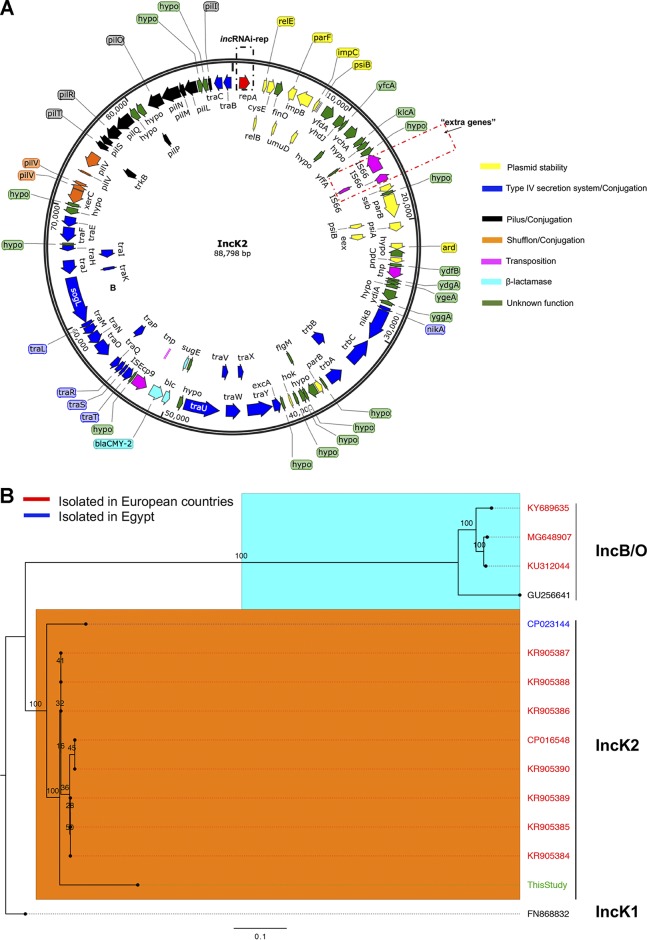
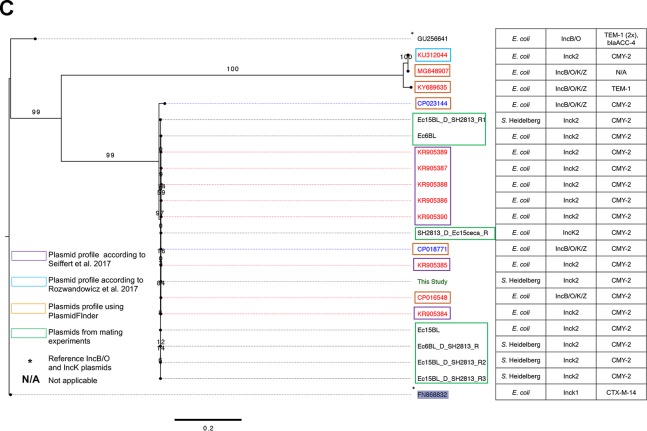
IncK2 acquired by S. Heidelberg. (A) Annotated map of IncK2 plasmid from this study. The dashed red rectangular box shows the extra genes discussed in the text. (B) Maximum likelihood tree of IncB/O/K plasmids based on complete plasmid sequence alignment. (C) Maximum likelihood tree of IncB/O/K plasmids based on incRNAI and rep gene alignment. The TVM model of nucleotide substitution and GAMMA model of rate heterogeneity were used for sequence evolution prediction. Numbers shown next to the branches represent the percentages of replicate trees where associated taxa cluster together based on ∼100 bootstrap replicates. Trees were rooted with reference IncK1 plasmid (GenBank accession number FN868832). The plasmid map was drawn using SnapGene v 4.3.8.1. The tree was viewed using FigTree v 1.4.4. Sources for panel C are Rozwandowicz et al. (25) and Seiffert et al. (26).
FIG 2
FIG 2
IncK2 acquired by S. Heidelberg. (A) Annotated map of IncK2 plasmid from this study. The dashed red rectangular box shows the extra genes discussed in the text. (B) Maximum likelihood tree of IncB/O/K plasmids based on complete plasmid sequence alignment. (C) Maximum likelihood tree of IncB/O/K plasmids based on incRNAI and rep gene alignment. The TVM model of nucleotide substitution and GAMMA model of rate heterogeneity were used for sequence evolution prediction. Numbers shown next to the branches represent the percentages of replicate trees where associated taxa cluster together based on ∼100 bootstrap replicates. Trees were rooted with reference IncK1 plasmid (GenBank accession number FN868832). The plasmid map was drawn using SnapGene v 4.3.8.1. The tree was viewed using FigTree v 1.4.4. Sources for panel C are Rozwandowicz et al. (25) and Seiffert et al. (26).
FIG 3
FIG 3
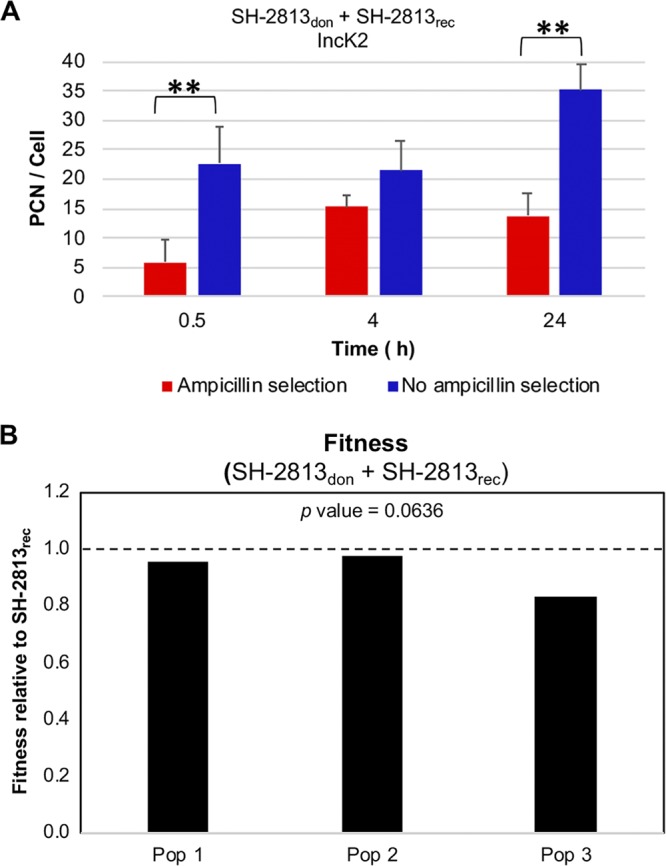
In vitro plasmid copy number (PCN) and fitness of IncK2 in S. Heidelberg host. (A) IncK2 PCN was determined during a mating experiment between IncK2-carrying populations (SH-2813don) and IncK2-free SH-2813rec populations with and without ampicillin selection. (B) Fitness of IncK2-carrying populations relative to IncK2-free populations under no ampicillin selection (**, P < 0.01). Each bar represents the fitness of one population that was established from one single bacterial colony. The horizontal dashed line represents the fitness of SH-2813rec.
FIG 4
FIG 4
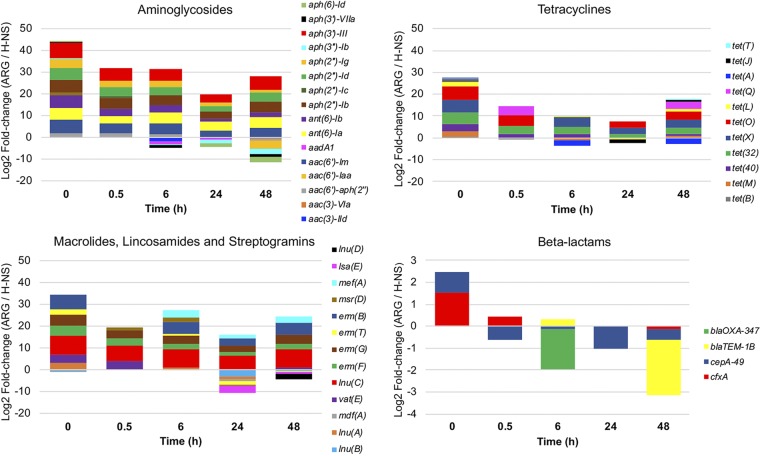
Relative abundances of ARGs determined using resistome enrichment. Targeted enrichment of ARGs using hybridization capture of shotgun metagenomic library was done on each cecum. At each time point, three cecum samples were used for resistome determination and ARG abundance was calculated by dividing the ARG contig coverage by the coverage of H-NS. A positive value indicates that ARG abundance is higher than that of H-NS, while a negative value indicates that ARG abundance is lower than that of H-NS.

References

    1. Colavecchio A, Cadieux B, Lo A, Goodridge LD. 2017. Bacteriophages contribute to the spread of antibiotic resistance genes among foodborne pathogens of the Enterobacteriaceae family—a review. Front Microbiol 8:1108. doi: 10.3389/fmicb.2017.01108. - DOI - PMC - PubMed
    1. Card RM, Cawthraw SA, Nunez-Garcia J, Ellis RJ, Kay G, Pallen MJ, Woodward MJ, Anjum MF. 2017. An in vitro chicken gut model demonstrates transfer of a multidrug resistance plasmid from Salmonella to commensal Escherichia coli. mBio 8:e00777-17. doi: 10.1128/mBio.00777-17. - DOI - PMC - PubMed
    1. Stecher B, Denzler R, Maier L, Bernet F, Sanders MJ, Pickard DJ, Barthel M, Westendorf AM, Krogfelt KA, Walker AW, Ackermann M, Dobrindt U, Thomson NR, Hardt W-D. 2012. Gut inflammation can boost horizontal gene transfer between pathogenic and commensal Enterobacteriaceae. Proc Natl Acad Sci U S A 109:1269–1274. doi: 10.1073/pnas.1113246109. - DOI - PMC - PubMed
    1. Aviv G, Rahav G, Gal-Mor O. 2016. Horizontal transfer of the Salmonella enterica serovar Infantis resistance and virulence plasmid pESI to the gut microbiota of warm-blooded hosts. mBio 7:e01395-16. doi: 10.1128/mBio.01395-16. - DOI - PMC - PubMed
    1. Oladeinde A, Cook K, Orlek A, Zock G, Herrington K, Cox N, Lawrence JP, Hall C. 2018. Hotspot mutations and ColE1 plasmids contribute to the fitness of Salmonella Heidelberg in poultry litter. PLoS One 13:e0202286. doi: 10.1371/journal.pone.0202286. - DOI - PMC - PubMed

MeSH terms

LinkOut - more resources