


Naloxone Dosing After Opioid Overdose in the Era of Illicitly Manufactured Fentanyl
- PMID: 31471760
- PMCID: PMC6942078
- DOI: 10.1007/s13181-019-00735-w
Naloxone Dosing After Opioid Overdose in the Era of Illicitly Manufactured Fentanyl
Abstract
Introduction: Illicitly manufactured fentanyl (IMF) is responsible for a growing number of deaths. Some case series have suggested that IMF overdoses require significantly higher naloxone doses than heroin overdoses. Our objective was to determine if the naloxone dose required to treat an opioid overdose is associated with the finding of fentanyl, opiates, or both on urine drug screen (UDS).
Methods: A retrospective chart review was conducted at a single emergency department and its affiliated emergency medical services (EMS) agency. The charts of all patients who received naloxone through this EMS from 1/1/2017 to 6/15/2018 were reviewed. The study included patients diagnosed with a non-suicidal opioid overdose whose UDS was positive for opiates, fentanyl, or both. Data collected included demographics, vital signs, initial GCS, EMS and ED naloxone administrations, response to treatment, laboratory findings, and ED disposition. The fentanyl-only and fentanyl + opiate groups were compared to the opiate-only group using the stratified (by ED provider) variant of the Mann-Whitney U test.
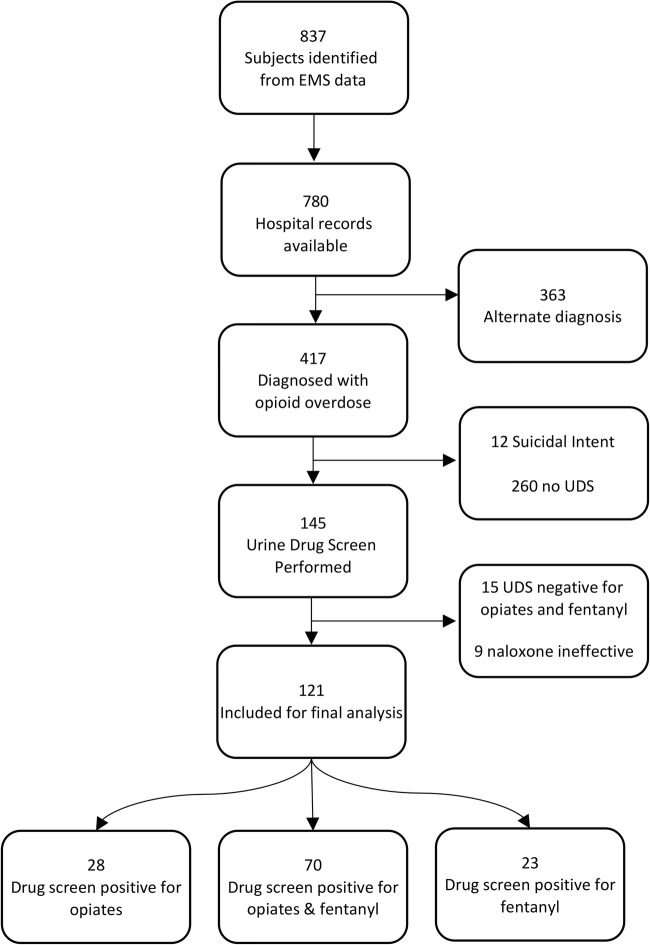
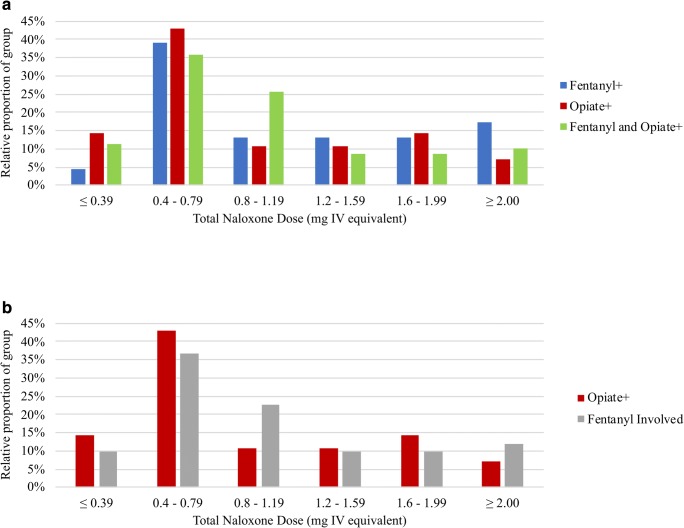
Results: Eight hundred and thirty-seven charts were reviewed, and 121 subjects were included in the final analysis. The median age of included subjects was 38 years and 75% were male. In the naloxone dose analysis, neither the fentanyl-only (median 0.8 mg, IQR 0.4-1.6; p = 0.68) nor the fentanyl + opiate (median 0.8 mg, IQR 0.4-1.2; p = 0.56) groups differed from the opiate-only group (median 0.58 mg, IQR 0.4-1.6).
Conclusion: Our findings refute the notion that high potency synthetic opioids like illicitly manufactured fentanyl require increased doses of naloxone to successfully treat an overdose. There were no significant differences in the dose of naloxone required to treat opioid overdose patients with UDS evidence of exposure to fentanyl, opiates, or both. Further evaluation of naloxone stocking and dosing protocols is needed.
Keywords: Drug overdose; Emergency medical services; Fentanyl; Naloxone; Opiates.
Conflict of interest statement
None.
Figures
References
-
- Ahmad F, Rossen L, Spencer M, Warner M, Sutton P. Provisional drug overdose death counts. National Center for Health Statistics; 2018.
-
- Kochanek K, Muprhy S, Xu J, Arias E. Mortality in the United States, 2016 National Center for Health Statistics; 2017.
-
- Peterson AB, Gladden RM, Delcher C, Spies E, Garcia-Williams A, Wang Y, Halpin J, Zibbell J, McCarty CL, DeFiore-Hyrmer J, DiOrio M, Goldberger BA. Increases in fentanyl-related overdose deaths—Florida and Ohio, 2013-2015. MMWR Morb Mortal Wkly Rep. 2016;65(33):844–849. doi: 10.15585/mmwr.mm6533a3. - DOI - PubMed
-
- CDC Health Alert Network. Increases in fentanyl drug confiscations and fentanyl-related overdose fatalities. 2015. https://emergency.cdc.gov/han/han00384.asp. Accessed 10 Apr 2019.
MeSH terms
Substances
LinkOut - more resources
Full Text Sources
Medical
