


A Video Decision Aid Improves Informed Decision Making in Patients With Advanced Cancer Considering Palliative Radiation Therapy
- PMID: 31472276
- PMCID: PMC8132595
- DOI: 10.1016/j.jpainsymman.2019.08.014
A Video Decision Aid Improves Informed Decision Making in Patients With Advanced Cancer Considering Palliative Radiation Therapy
Abstract
Context: Advanced cancer patients have unrecognized gaps in their understanding about palliative radiation therapy (PRT).
Objectives: To build a video decision aid for hospitalized patients with advanced cancer referred for PRT and prospectively test its efficacy in reducing decisional uncertainty, improving knowledge, increasing treatment readiness and readiness for palliative care consultation, and its acceptability among patients.
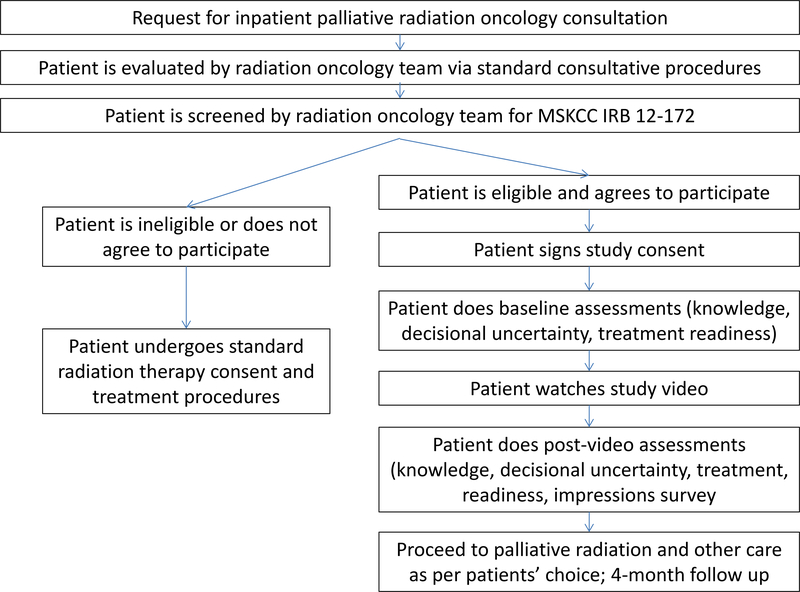
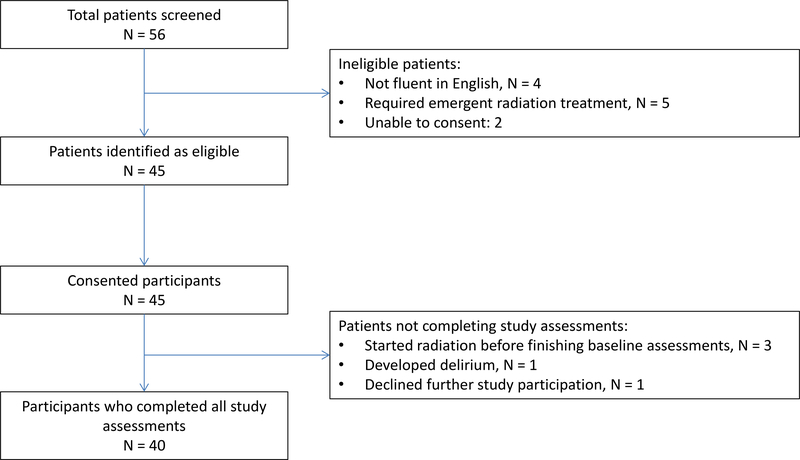
Methods: Forty patients with advanced cancer hospitalized at Memorial Sloan Kettering Cancer Center watched a video decision aid about PRT and palliative care. Patients' conceptual and logistical knowledge of PRT, decisional uncertainty, treatment readiness, and readiness for palliative care consultation were assessed before and after watching the video with a six-item knowledge survey, the decisional uncertainty subscale of the Decisional Conflict Scale, and Likert instruments to assess readiness to accept radiation treatment and/or palliative care consultation, respectively. A postvideo survey assessed the video's acceptability among patients.
Results: After watching the video, decisional uncertainty was reduced (28.3 vs. 21.7; P = 0.02), knowledge of PRT improved (60.4 vs. 88.3; P < 0.001), and PRT readiness increased (2.0 vs. 1.3; P = 0.04). Readiness for palliative care consultation was unchanged (P = 0.58). Patients felt very comfortable (70%) watching the video and would highly recommend it (75%) to others.
Conclusion: Among hospitalized patients with advanced cancer, a video decision aid reduced decisional uncertainty, improved knowledge of PRT, increased readiness for PRT, and was well received by patient viewers.
Keywords: Palliative radiation therapy; advanced cancer; decision aid; video tool.
Copyright © 2019 American Academy of Hospice and Palliative Medicine. Published by Elsevier Inc. All rights reserved.
Conflict of interest statement
Conflicts: None
Figures
References
-
- Timmermans LM, van der Maazen RW, Verhaak CM, van Roosmalen MS, van Daal WA, Kraaimaat FW. Patient participation in discussing palliative radiotherapy. Patient Educ Couns. 2005;57(1):53–61. - PubMed
-
- Lutz S, Korytko T, Nguyen J, Khan L, Chow E, Corn B. Palliative radiotherapy: when is it worth it and when is it not? Cancer J. 2010;16(5):473–482. - PubMed
-
- Woodhouse KD, Tremont K, Vachani A, et al. A Review of Shared Decision-Making and Patient Decision Aids in Radiation Oncology. J Cancer Educ. 2017;32(2):238–245. - PubMed
-
- Shakespeare TP, Lu JJ, Back MF, Liang S, Mukherjee RK, Wynne CJ. Patient preference for radiotherapy fractionation schedule in the palliation of painful bone metastases. J Clin Oncol. 2003;21(11):2156–2162. - PubMed
Publication types
MeSH terms
Grants and funding
LinkOut - more resources
Full Text Sources
Medical
