


Do we need a core curriculum for medical students? A scoping review
- PMID: 31473611
- PMCID: PMC6720253
- DOI: 10.1136/bmjopen-2018-027369
Do we need a core curriculum for medical students? A scoping review
Abstract
Objective: The General Medical Council (GMC) recommends medical schools to develop and implement curricula enabling students to achieve the required learning outcomes. UK medical schools follow the GMC's Outcomes for graduates, which are generic. GMC plans to introduce a national Medical Licensing Assessment (MLA) for the medical graduates wanting to practise medicine in the UK in 2022. With no standardised or unified undergraduate (UG) curriculum in UK, various specialties have expressed concerns about not being represented in medical schools and developed specialty-specific core curricula. The aim of this review was to identify learned bodies who have developed a core curriculum for UK medical schools and highlight the drivers, gaps and future approaches to curricular development and implementation.
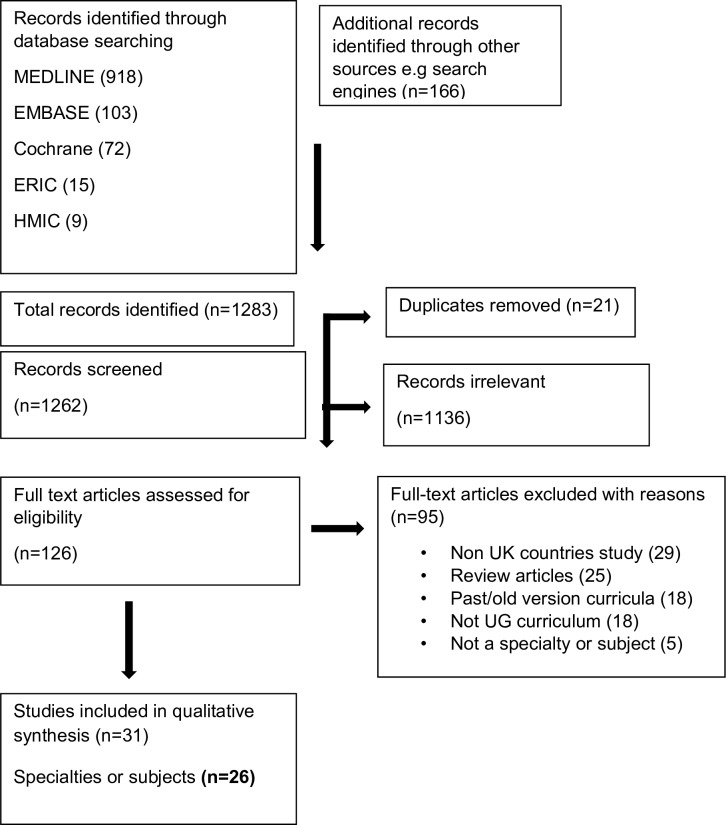
Methods: A literature search was conducted using online databases (EMBASE, MEDLINE, ERIC, HMIC, PubMed and CDSR), search engines and related websites (Google and Google Scholar, Department of Health, GMC and BMA) for relevant articles from 1996 to 5 March 2019 (~20 years). A methodological framework to map the key concepts of UG medical curriculum was followed. Any relevant body with a core curriculum for UK medical UGs was included.
Results: A total of 1283 articles were analysed with 31 articles included in the qualitative synthesis, comprising 26 specialties (clinical n=18, foundation subjects n=4 and professionalism related n=4). WHO, European and national (eg, Royal Colleges of UK) specialty bodies provided specific core learning outcomes for the medical graduates. Patient safety, disease burden, needs of society and inadequate preparedness of medical graduates were drivers for the development of these curricula.
Conclusions: This is the first comprehensive review of literature on UG core curricula recommending minimum standards on knowledge and skills, in alignment with GMC's Outcomes for graduates for all the UK medical students. Adopting and assessing unified standards would help reduce variability across UK medical schools for both generic and specialty-specific competencies.
Keywords: core; curriculum; medical education and training; undergraduate; united kingdom.
© Author(s) (or their employer(s)) 2019. Re-use permitted under CC BY. Published by BMJ.
Conflict of interest statement
Competing interests: None declared.
Figures
References
-
- Manchester Promoting excellence: standards for medical education and training, 2015. Available: https://www.gmc-uk.org/-/media/documents/Promoting_excellence_standards_... [Accessed 28 Sep 2018].
-
- Medical Licencing Assessment General medical Council, 2018. Available: https://www.gmc-uk.org/education/standards-guidance-and-curricula/projec... [Accessed 28 Sep 2018].
-
- Outcomes for graduates General medical Council, 2018. Available: https://www.gmc-uk.org/-/media/documents/dc11326-outcomes-for-graduates-... [Accessed 28 Sep 2018].
-
- Future Hospital: caring for medical patients , 2013. Available: https://www.rcplondon.ac.uk/projects/outputs/future-hospital-commission [Accessed 28 Sep 2018].
-
- Arksey H, O'Malley L. Scoping studies: towards a methodological framework. Int J Soc Res Methodol 2005;8:19–32. 10.1080/1364557032000119616 - DOI
Publication types
MeSH terms
LinkOut - more resources
Full Text Sources
