


Association of Cortisol Levels With Neuropsychiatric Functions: A Mendelian Randomization Analysis
- PMID: 31474942
- PMCID: PMC6706785
- DOI: 10.3389/fendo.2019.00564
Association of Cortisol Levels With Neuropsychiatric Functions: A Mendelian Randomization Analysis
Abstract
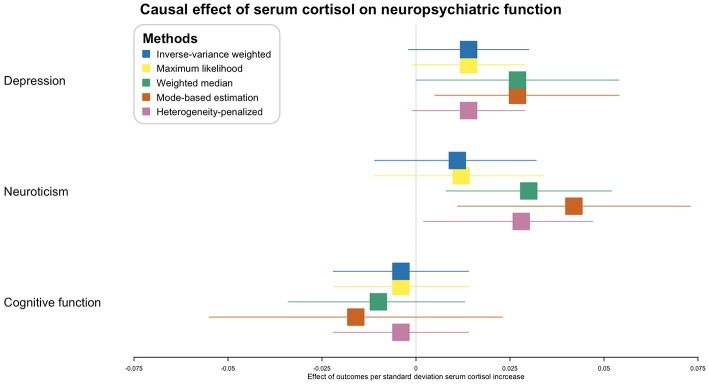
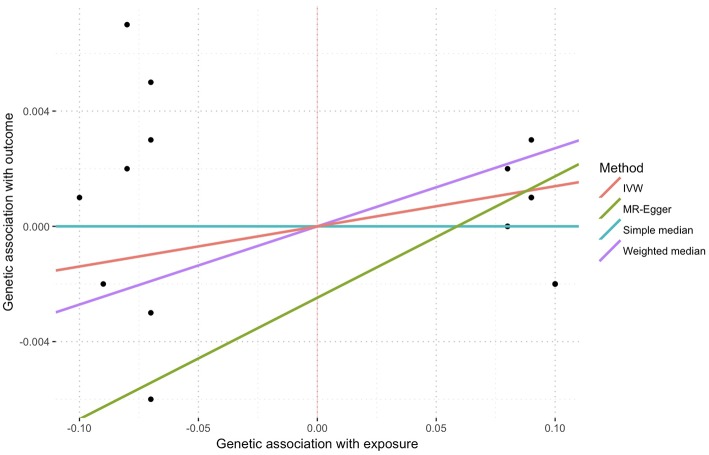
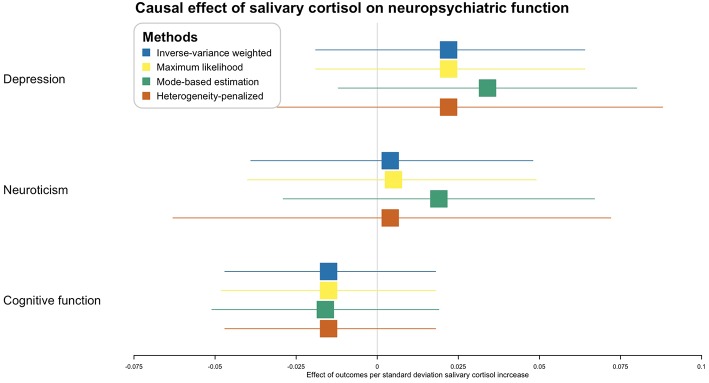
Aim: The conflicting evidence as to whether a real association exists between cortisol levels and depression lends support to adopting a Mendelian randomization approach to investigate whether cortisol levels have a causal effect with depression. Methods: Single nucleotide polymorphisms (SNPs) associated with serum morning plasma cortisol level and salivary cortisol level from CORNET consortium (12,597 participants) were proposed as instrumental variables. The primary outcome was depression, and the secondary outcomes were neuroticism and cognitive performance. Summary-level statistics were extracted from the Social Science Genetic Association Consortium including the United Kingdom Biobank cohort (105,739 subjects). Multiple analysis methods (inverse-variance weighted method, max likelihood method, weighted median estimator, model-based estimation, heterogeneity-penalized method, and MR-Egger regression) were applied to test the stability of the summary causal estimate. Results: Weighted median analysis estimated that the effect of serum morning cortisol on depression score was 0.027 per standard deviation increase of cortisol (95% CI, 0.000-0.054; p = 0.043). Other sensitivity analysis suggested similar results suggesting the result was robust. No evidence of pleiotropy (MR-Egger intercept, -0.002; p = 0.739) was observed. The effect of serum cortisol on neuroticism was 0.030 (95% CI, 0.008-0.052; p = 0.006) by weighted median estimator. None of the methods observed the effect of serum cortisol level on cognitive function. As for the effect of salivary cortisol level, no method obtained a p-value lower than 0.05 in any of the outcomes. Conclusion: Mendelian randomization analysis provided evidence that a genetic predisposition to higher serum morning cortisol level was associated with increased depression score.
Keywords: Cushing's syndrome; cortisol; depression; neuroendocrinology; single nucleotide polymorphisms.
Figures
References
-
- Dietrich A, Ormel J, Buitelaar JK, Verhulst FC, Hoekstra PJ, Hartman CA. Cortisol in the morning and dimensions of anxiety, depression, and aggression in children from a general population and clinic-referred cohort: an integrated analysis. The TRAILS study. Psychoneuroendocrinology. (2013) 38:1281–98. 10.1016/j.psyneuen.2012.11.013 - DOI - PubMed
-
- Caparros-Gonzalez RA, Romero-Gonzalez B, Strivens-Vilchez H, Gonzalez-Perez R, Martinez-Augustin O, Peralta-Ramirez MI. Hair cortisol levels, psychological stress and psychopathological symptoms as predictors of postpartum depression. PLoS ONE. (2017) 12:e0182817. 10.1371/journal.pone.0182817 - DOI - PMC - PubMed
LinkOut - more resources
Full Text Sources
Research Materials
