


Sarecycline: a narrow spectrum tetracycline for the treatment of moderate-to-severe acne vulgaris
- PMID: 31475868
- PMCID: PMC6802708
- DOI: 10.2217/fmb-2019-0199
Sarecycline: a narrow spectrum tetracycline for the treatment of moderate-to-severe acne vulgaris
Abstract
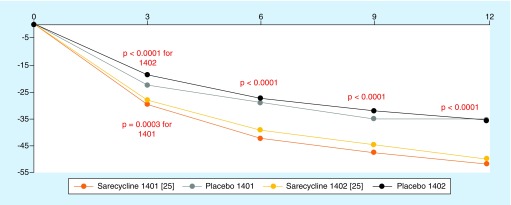
Sarecycline is a novel, narrow-spectrum, once-daily tetracycline-derived oral antibiotic that is FDA-approved in the US to be taken with or without food for moderate-to-severe acne vulgaris for ages 9 years of age and older. Sarecycline possesses anti-inflammatory properties and potent activity against Gram-positive bacteria, including activity against multiple strains of Cutibacterium acnes, while exhibiting minimal activity against enteric aerobic Gram-negative bacteria. Unlike many acne studies, sarecycline was investigated for chest and back acne. Significant reduction in inflammatory lesions was seen at week 12 at 1.5 mg/kg/day of sarecycline, with statistically significant improvement seen as early as week 3. No reports of phototoxicity, dizziness, pseudotumor cerebri or lupus but 1.2% nausea and 1.2% vaginal candidiasis was reported in the pivotal Phase III studies.
Keywords: acne; antibiotics; microbiota; narrow spectrum; sarecycline; tetracycline.
Conflict of interest statement
AY Moore has received funds as advisory board member (A), consultant (C), clinical study investigator (I), coordinating investigator (CI) and speaker (SP) for AbbVie (I, SP), Aclaris (I, SP), Allergan (C, I, CI, SP), Almirall (SP), Astellas (I), Biofrontera (C,I), Boehringer Ingelheim (I), Bristol-Myers Squibb (C,I), Cutanea (I), Dermavant (I), Dermira (I), Eli Lilly (I), Foamix (I), Galderma (I), Incyte (I), Janssen (A,I), Leo (A, SP), Mayne Pharma (C, I), Naked Biome (I), Novartis (I), Parexel (I), Pfizer (I,SP), Verrica (I). The authors have no other relevant affiliations or financial involvement with any organization or entity with a financial interest in or financial conflict with the subject matter or materials discussed in the manuscript apart from those disclosed.
No writing assistance was utilized in the production of this manuscript.
Figures
References
-
- Bhate K, Williams HC. Epidemiology of acne vulgaris. Br. J. Dermatol. 168(3), 474–485 (2013). - PubMed
-
- Goulden V, Stables GI, Cunliffe WJ. Prevalence of facial acne in adults. J. Am. Acad. Dermatol. 41(4), 577–580 (1999). - PubMed
-
- Ramos-E-Silva M, Carneiro SC. Acne vulgaris: review and guidelines. Dermatol. Nurs. 21(2), 63–68 (2009). - PubMed
-
- Holland DB, Jeremy AH, Roberts SG, Seukeran DC, Layton AM, Cunliffe WJ. Inflammation in acne scarring: a comparison of the responses in lesions from patients prone and not prone to scar. Br. J. Dermatol. 150(1), 72–81 (2004). - PubMed
-
- Jeremy AH, Holland DB, Roberts SG, Thomson KF, Cunliffe WJ. Inflammatory events are involved in acne lesion initiation. J. Invest. Dermatol. 121(1), 20–27 (2003). - PubMed
Publication types
MeSH terms
Substances
Supplementary concepts
LinkOut - more resources
Full Text Sources
Medical
