Meta-Analysis
. 2019 Sep 27;125(8):773-782.
doi: 10.1161/CIRCRESAHA.119.315380. Epub 2019 Sep 3.

Circulating Monocyte Chemoattractant Protein-1 and Risk of Stroke: Meta-Analysis of Population-Based Studies Involving 17 180 Individuals

Affiliations
Meta-Analysis

Circulating Monocyte Chemoattractant Protein-1 and Risk of Stroke: Meta-Analysis of Population-Based Studies Involving 17 180 Individuals

Marios K Georgakis et al. Circ Res. .

Erratum in

Abstract

Rationale: Proinflammatory cytokines have been identified as potential targets for lowering vascular risk. Experimental evidence and Mendelian randomization suggest a role of MCP-1 (monocyte chemoattractant protein-1) in atherosclerosis and stroke. However, data from large-scale observational studies are lacking. Objective: To determine whether circulating levels of MCP-1 are associated with risk of incident stroke in the general population. Methods and Results: We used previously unpublished data on 17 180 stroke-free individuals (mean age, 56.7±8.1 years; 48.8% men) from 6 population-based prospective cohort studies and explored associations between baseline circulating MCP-1 levels and risk of any stroke, ischemic stroke, and hemorrhagic stroke during a mean follow-up interval of 16.3 years (280 522 person-years at risk; 1435 incident stroke events). We applied Cox proportional-hazards models and pooled hazard ratios (HRs) using random-effects meta-analyses. After adjustments for age, sex, race, and vascular risk factors, higher MCP-1 levels were associated with increased risk of any stroke (HR per 1-SD increment in ln-transformed MCP-1, 1.07; 95% CI, 1.01-1.14). Focusing on stroke subtypes, we found a significant association between baseline MCP-1 levels and higher risk of ischemic stroke (HR, 1.11 [1.02-1.21]) but not hemorrhagic stroke (HR, 1.02 [0.82-1.29]). The results followed a dose-response pattern with a higher risk of ischemic stroke among individuals in the upper quartiles of MCP-1 levels as compared with the first quartile (HRs, second quartile: 1.19 [1.00-1.42]; third quartile: 1.35 [1.14-1.59]; fourth quartile: 1.38 [1.07-1.77]). There was no indication for heterogeneity across studies, and in a subsample of 4 studies (12 516 individuals), the risk estimates were stable after additional adjustments for circulating levels of IL (interleukin)-6 and high-sensitivity CRP (C-reactive protein). Conclusions: Higher circulating levels of MCP-1 are associated with increased long-term risk of stroke. Our findings along with genetic and experimental evidence suggest that MCP-1 signaling might represent a therapeutic target to lower stroke risk.Visual Overview: An online visual overview is available for this article.

Keywords: atherosclerosis; cerebrovascular disorders; chemokine CCL2; inflammation; stroke.


Figures
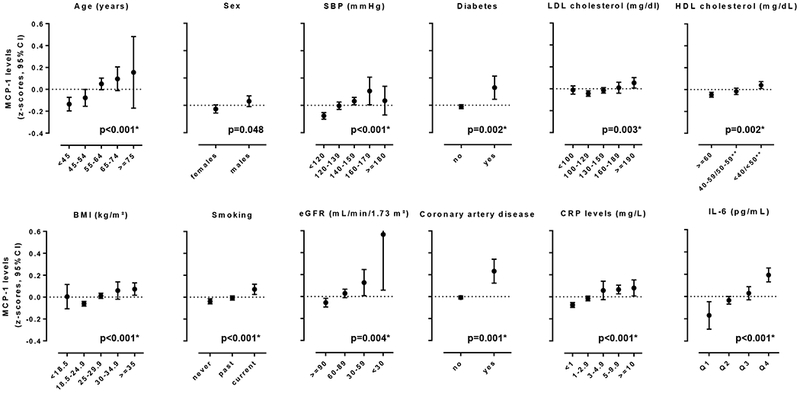
Figure 1.
Figure 1.
Cross-sectional associations between baseline circulating MCP-1 levels, demographic factors, conventional vascular risk factors, and inflammatory biomarkers. Shown are the results from the pooled sample consisting of six population-based studies. * statistically significant results (after correction for multiple comparisons statistical significance was set at p <0.05/12=0.004). ** <40 and 40-59 mg/dL for men, <50 and 50-59 mg/dL for women. Z-score for circulating MCP-1 levels correspond to differences from the mean value of each study. P-values are derived from meta-regression. Abbreviations: BMI, body mass index; HDL, high-density lipoprotein; hsCRP, high-sensitivity C-reactive protein; eGFR, estimated glomerular filtration rate; LDL, low-density lipoprotein; MCP-1, monocyte chemoattractant protein- 1; SBP, systolic blood pressure.
Figure 2.
Figure 2.
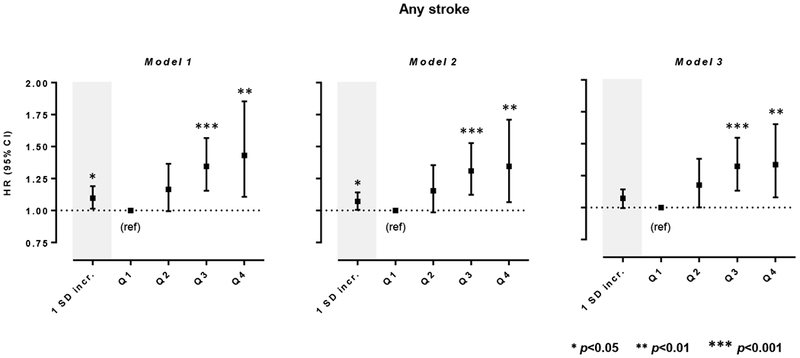
Associations between baseline circulating MCP-1 levels and risk of any stroke. Shown are the results from random-effects meta-analyses of the pooled sample consisting of six population-based studies.Model 1 is adjusted for age, sex, and race. Model 2 is adjusted for age, sex, race, and vascular risk factors including body mass index (1 kg/m2 increment), smoking (current vs. non-current), estimated glomerular filtration rate (1 mL/min/1.73 m2 increment), history of coronary artery disease, diabetes mellitus, hypercholesterolemia, hypertension, atrial fibrillation, and heart failure at baseline. Model 3 is additionally adjusted for circulating high-sensitivity C-reactive protein (hsCRP) levels. Analyses for 1 SD increment correspond to ln-transformed MCP-1 levels.
Figure 3.
Figure 3.
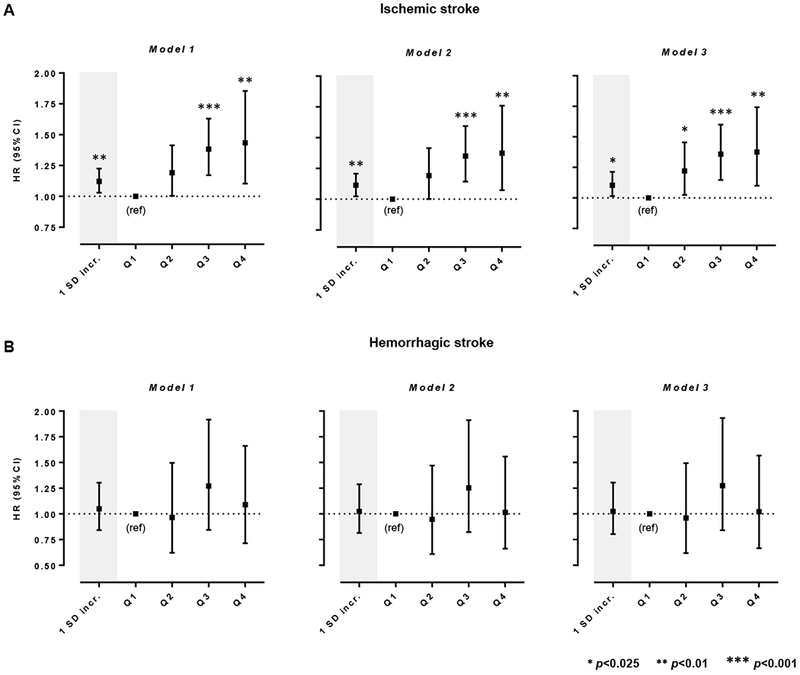
Associations between baseline circulating MCP-1 levels and risk of (A) ischemic stroke and (B) hemorrhagic stroke. Shown are the results from random-effects meta-analyses of the pooled sample consisting of six population-based studies. * Statistical significance threshold was set at p <0.05/2=0.025 after correction for multiple comparisons (two stroke subtypes). Model 1 is adjusted for age, sex, and race. Model 2 is adjusted for age, sex, race, and vascular risk factors including body mass index (1 kg/m2 increment), smoking (current vs. non-current), estimated glomerular filtration rate (1 mL/min/1.73 m2 increment), history of coronary artery disease, diabetes mellitus, hypercholesterolemia, hypertension, atrial fibrillation, and heart failure at baseline. Model 3 is additionally adjusted for circulating high-sensitivity C-reactive protein (hsCRP) levels. Analyses for 1 SD increment correspond to ln-transformed MCP-1 levels.

Similar articles

Cited by

References

    1. DALYs GBD, Collaborators H. Global, regional, and national disability-adjusted life-years (dalys) for 315 diseases and injuries and healthy life expectancy (hale), 1990-2015: A systematic analysis for the global burden of disease study 2015. Lancet. 2016;388:1603–1658 - PMC - PubMed
    1. Mortality GBD, Causes of Death C. Global, regional, and national life expectancy, all-cause mortality, and cause-specific mortality for 249 causes of death, 1980-2015: A systematic analysis for the global burden of disease study 2015. Lancet. 2016;388:1459–1544 - PMC - PubMed
    1. Esenwa CC, Elkind MS. Inflammatory risk factors, biomarkers and associated therapy in ischaemic stroke. Nat Rev Neurol. 2016;12:594–604 - PubMed
    1. Libby P, Ridker PM, Hansson GK, Leducq Transatlantic Network on A. Inflammation in atherosclerosis: From pathophysiology to practice. J Am Coll Cardiol. 2009;54:2129–2138 - PMC - PubMed
    1. Ridker PM, Everett BM, Thuren T, MacFadyen JG, Chang WH, Ballantyne C, Fonseca F, Nicolau J, Koenig W, Anker SD, Kastelein JJP, Cornel JH, Pais P, Pella D, Genest J, Cifkova R, Lorenzatti A, Forster T, Kobalava Z, Vida-Simiti L, Flather M, Shimokawa H, Ogawa H, Dellborg M, Rossi PRF, Troquay RPT, Libby P, Glynn RJ, Cantos Trial Group. Antiinflammatory therapy with canakinumab for atherosclerotic disease. N Engl J Med. 2017;377:1119–1131 - PubMed

Publication types

Grants and funding