


The association between alcohol, marijuana, illegal drug use and current use of E-cigarette among youth and young adults in Canada: results from Canadian Tobacco, Alcohol and Drugs Survey 2017
- PMID: 31477067
- PMCID: PMC6721192
- DOI: 10.1186/s12889-019-7546-y
The association between alcohol, marijuana, illegal drug use and current use of E-cigarette among youth and young adults in Canada: results from Canadian Tobacco, Alcohol and Drugs Survey 2017
Abstract
Background: E-cigarettes have grown in popularity around the world since 2003. Although marketed as a smoking cessation tool, e-cigarettes can lead to tobacco cigarette smoking in youth. In Canada, among all age groups, youth and young adults have the highest prevalence of e-cigarette use. The objective of this study was to assess the factors associated with e-cigarette use among youth and young adults in Canada, and to specifically examine the association between alcohol, marijuana and illicit drug use.
Methods: Data from the 2017 Canadian Tobacco, Alcohol and Drugs Survey were used. The sample was restricted to those aged 15-24 years (n = 10,322), and main outcome defined as 'E-cigarette use in the past 30-days'. Multivariable logistic regression was performed to assess the association between the main outcome and substance use variables (illicit drug, marijuana and alcohol use), tobacco exposure variables, and demographic and health-related factors.
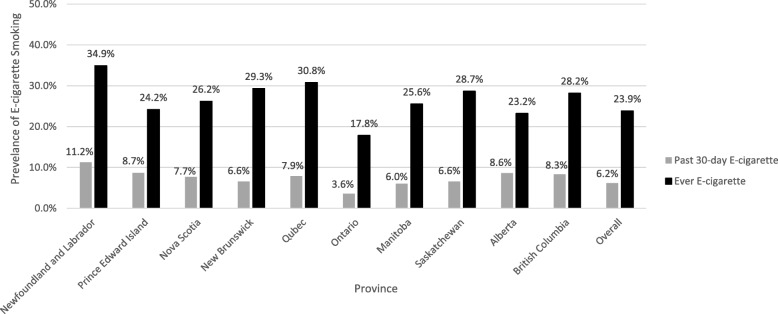
Results: 6.2% Canadians aged 15-24 reported using e-cigarettes in the past 30-days, while 23.9% reported having ever tried e-cigarettes. Twenty-three percent of the past 30-day users reported using e-cigarettes every day and 72.5% of the past 30-day users reported having nicotine in their last e-cigarette. Additionally, youth aged 15-17 were 4.95 times more likely to be e-cigarette users as compared to those aged 22-24 (OR: 4.95, 95% CI: 3.1-7.9). Moreover, e-cigarette use was significantly associated with marijuana use (OR:4.17, 95% CI: 2.6-6.7) and alcohol use (OR: 5.08, 95% CI: 2.9-9.0), and approached significance with illicit drug use (OR: 1.68, 95% CI: 1.0-2.9). Furthermore, being a current smoker (OR: 2.93, 95% CI: 1.8-4.7) and male (OR: 2.28, 95% CI: 1.5-3.4) was significantly associated with the outcome.
Conclusion: This study is nationally representative and provides insight into e-cigarette use among youth and young adults aged 15-24 years. Given that e-cigarettes can be used as illicit drug delivery systems, more studies are needed to understand how Canadian youth and young adults are using e-cigarettes. Stricter restrictions on public e-cigarette smoking, and awareness campaigns informing youth of risks of e-cigarette smoking should be implemented.
Keywords: Alcohol; Canada; Drugs; E-cigarette; Illicit drugs; Smoking; Vaping; Young adults; Youth.
Conflict of interest statement
The authors declare that they have no competing interests.
Figures
References
-
- Electronic Cigarette Market by Product Type, Flavor, and Distribution Channel: Global Opportunity Analysis and Industry Forecast, 2017-2023. Allied Market Research . 2018. https://www.alliedmarketresearch.com/electronic-cigarette-market. Accessed 23 Apr 2019.
MeSH terms
Substances
Grants and funding
LinkOut - more resources
Full Text Sources
Medical
Miscellaneous
