Review
. 2019 Oct;39(7):623-640.
doi: 10.1007/s10875-019-00684-7. Epub 2019 Sep 2.

Regulatory T Cells: the Many Faces of Foxp3

Affiliations
Review

Regulatory T Cells: the Many Faces of Foxp3

Peter Georgiev et al. J Clin Immunol. 2019 Oct.

Abstract

Regulatory T (Treg) cells expressing the transcription factor forkhead box P3 (Foxp3) play a requisite role in the maintenance of immunological homeostasis and prevention of peripheral self-tolerance breakdown. Although Foxp3 by itself is neither necessary nor sufficient to specify many aspects of the Treg cell phenotype, its sustained expression in Treg cells is indispensable for their phenotypic stability, metabolic fitness, and regulatory function. In this review, we summarize recent advances in Treg cell biology, with a particular emphasis on the role of Foxp3 as a transcriptional modulator and metabolic gatekeeper essential to an effective immune regulatory response. We discuss these findings in the context of human inborn errors of immune dysregulation, with a focus on FOXP3 mutations, leading to Treg cell deficiency. We also highlight emerging concepts of therapeutic Treg cell reprogramming to restore tolerance in the settings of immune dysregulatory disorders.

Keywords: Autoimmunity; Foxp3; IPEX; immune dysregulation; immune tolerance; immunometabolism; interleukin 2; rapamycin; regulatory T cell reprogramming; regulatory T cells.


Conflict of interest statement

Conflict of interest: Peter Georgiev is a current employee of Merck Sharp & Dohme Corp., a subsidiary of Merck & Co., Inc., Kenilworth, NJ, USA.

Figures

Figure 1.
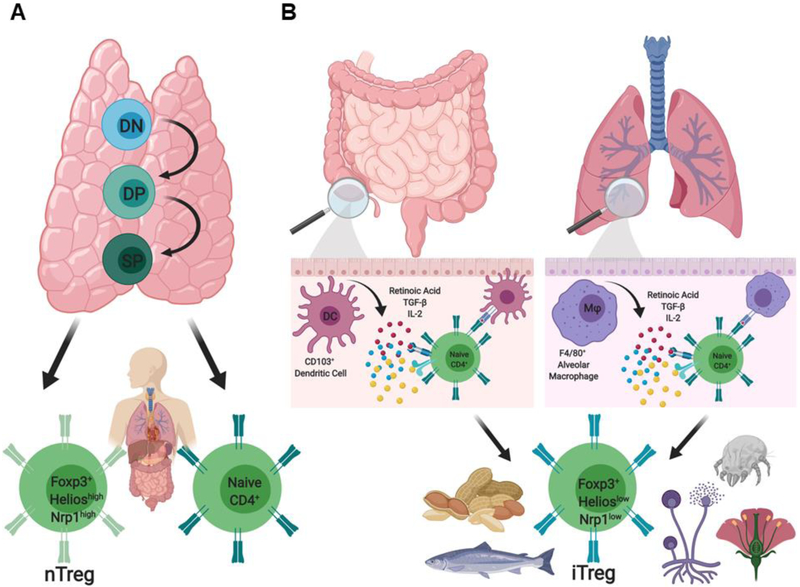
Figure 1.. Natural and induced Treg cell subsets.
The peripheral Treg cell pool is composed of 2 distinct populations, nTreg and iTreg cells, which express similar levels of the transcription factor Foxp3 but have non-overlapping TCR repertoires. (A) Foxp3+HelioshighNeuropilinhighnTreg cells differentiate in the thymus and play a critical role in enforcing tolerance to self-antigens. (B) Foxp3+HelioslowNeuropilinlow iTreg cells are generated de novo extrathymically in peripheral lymphoid tissue from naïve CD4+CD25 Tconv cells in the presence of retinoic acid, TGF-β, and IL-2 following TCR engagement by CD103+ dendritic cells or F4/80+ macrophages in the intestinal mucosa and alveola inerstitia, respectively. Unlike nTreg cells, iTreg cells are skewed in favor of recognizing non-self antigens, including the commensal flora and infectious agents, and innocuous antigens such as allergens and foods.
Figure 2.
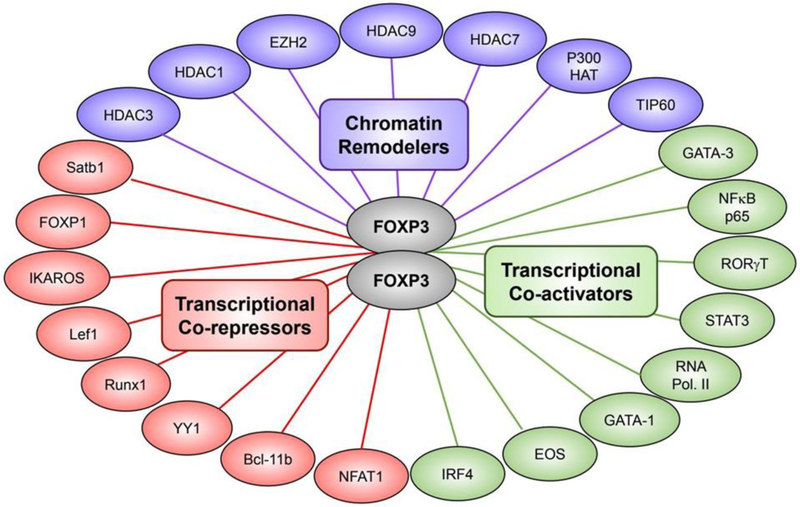
Figure 2.. The Foxp3 interactome.
Foxp3 can modulate the transcriptome of Treg cells by distinct mechanisms depending on its interaction with diverse binding partners. Foxp3 can modulate the accessibility of genes to several transcription factors through its interaction with chromatin remodelers including the histone acetyltransferases P300 and TIP60. Additionally, Foxp3 may interact with various transcriptional co-activators or co-repressors, leading to the upregulation or downregulation of gene expression, respectively.
Figure 3.
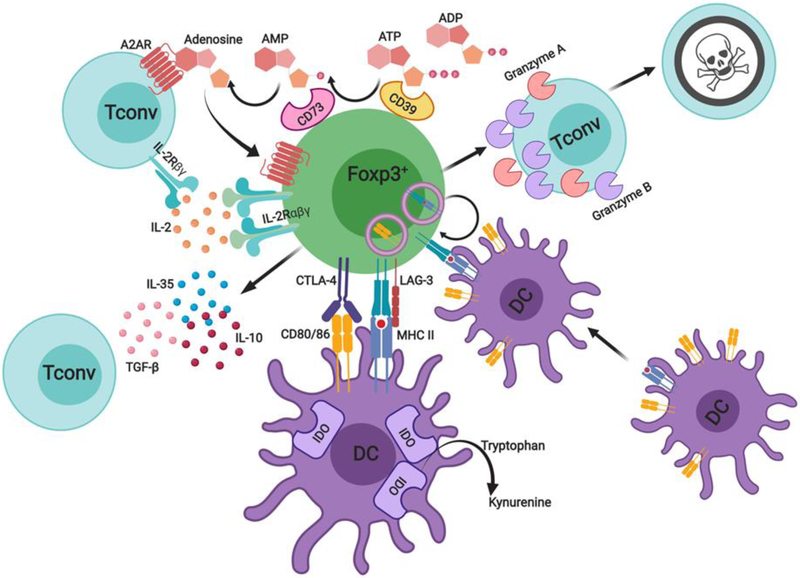
Figure 3.. The modular nature of Treg cell suppression.
Treg cells suppress innate and adaptive immune responses through multiple mechanisms in order to enforce immunological tolerance. These include inhibitory cytokines such as IL-10, TGF-β1 and IL-35, suppression of antigen presentation by professional antigen presenting cells (CTLA-4, LAG-3), granzyme and perforin dependent target cell cytolysis. Additional mechanisms include the generation of immunosuppressive adenosine by Treg cell ectoenzymes CD39 and CD73, and competition for endogenous IL-2 through expression of the high affinity IL-2 receptor alpha chain (CD25). Importantly, individual modules (e.g IL-10, TGF-β1) operate in a non-redundant manner to prevent peripheral tolerance breakdown, while mutations affecting the respective modules (e.g. CTLA-4, IL-2Rα and β subunits, TGF-β1 etc), give rise to distinct immune dysregulatory human diseases.
Figure 4.
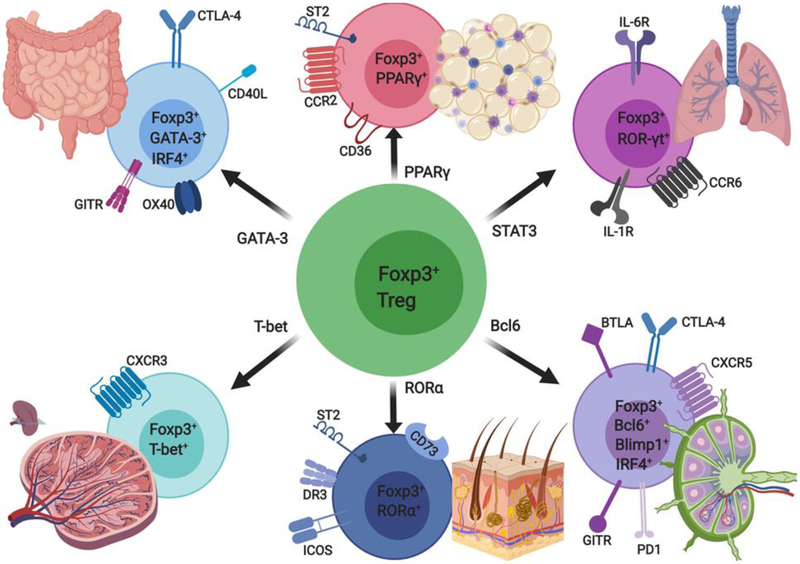
Figure 4.. Functional adaptation of Treg cells.
Treg cells regulate Tconv cell responses in an individually TH cell lineage dependent manner. To suppress TH1 responses Treg cells express the TH1 associated transcription factor T-bet and upregulate CXCR3 expression to transiently localize with expanded effector TH1 cells. Similarly, Treg cells partially acquire GATA-3 and ROR-γt transcriptional programs to enforce control of TH2 and TH17 cell responses respectively. Expression of RORα in skin resident Treg cells is critical for expression of death receptor 3 (DR3) which in turn promotes ILC2 activation and control of allergic skin inflammation. CXCR5+ follicular regulatory T (TFR) cells expressing the transcription factor Bcl6 control the germinal center reaction. In visceral adipose tissue (VAT), Treg cells express the peroxisome proliferator-activated receptor (PPAR)-γ, which plays an important role in restoration of insulin sensitivity and maintenance of VAT Treg cell function and phenotype.
Figure 5.
Figure 5.. Pathogenic Treg cell reprogramming.
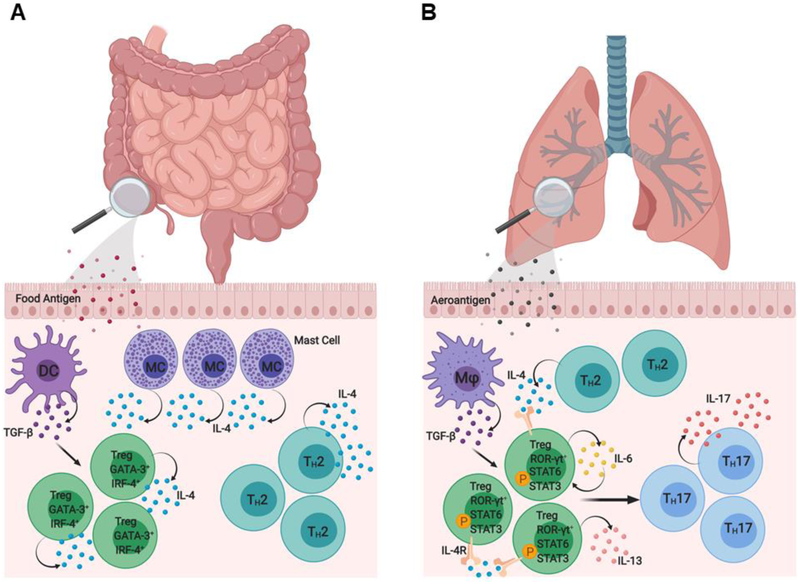
Two illustrative examples of pathogenic Treg cell reprogramming in human diseases. (A) In food allergy, allergen-specific Treg cells in the intestinal mucosa can acquire a pathogenic TH2 cell-like phenotype characterized by increased GATA-3 expression and enhanced IL-4 production. This pathological TH2 cell-like reprogramming results in the accumulation of dysfunctional antigen-specific Treg cells which fail to control effector TH2 and mast cell responses to promote allergic disease. (B) In asthma, a human IL-4Rα allele bearing a glutamine to arginine substitution at position 576 (IL-4Rα-Q576R) promotes asthma severity by driving mixed TH2-TH17 inflammation. In addition to activating STAT6, IL-4/IL-13 signaling via IL-4/IL-4R-R576 variant activates downstream MAPKs, which in turn drive an autocrine IL-6/ STAT3 activation loop. This activation results in a pathological TH17 cell-like reprogramming of nascent allergen-specific iTreg cells in the lung, characterized by increased ROR-γt expression and elevated IL-17 production.
Figure 6.
Figure 6.. Metabolic states of Treg cells in health and disease.
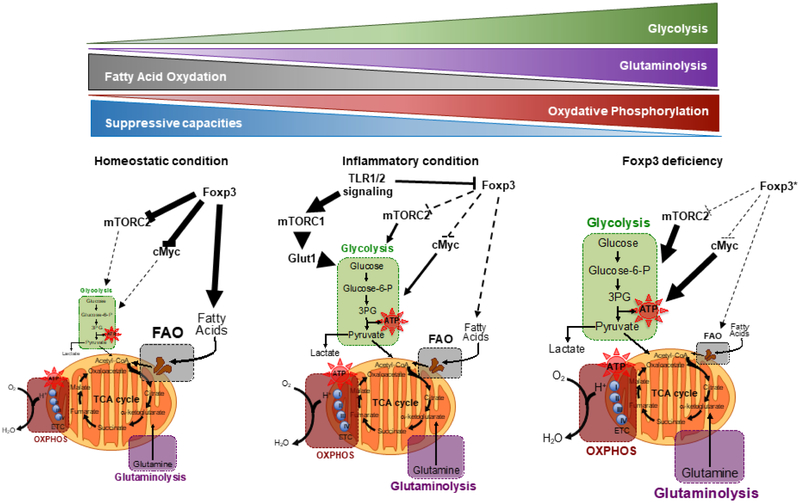
Under homeostatic condition, Foxp3 controls Treg cell metabolism by promoting fatty acid oxidation (FAO) and by limiting glycolysis through the inhibition of c-Myc and mTORC2 pathways. Under inflammatory condition, signals such as those via TLR1/2 promote glycolysis by inducing Glut1 expression in an mTORC1-dependent manner and by modulating Foxp3 expression in Treg cells. In IPEX patients and Foxp3-deficient mice, the Foxp3-deficient Treg cells undergo metabolic reprogramming characteristic of an effector memory cell-like phenotype, involving heightened aerobic glycolysis, tricarboxylic acid cycle (TCA cycle) and oxidative phosphorylation (OXPHOS), driven to large extent by mTORC2 dysregulation. Other changes include loss of fatty acid oxidation and increased glutaminolysis.
Figure 7.
Figure 7.. The spectrum of Human Foxp3 mutations.
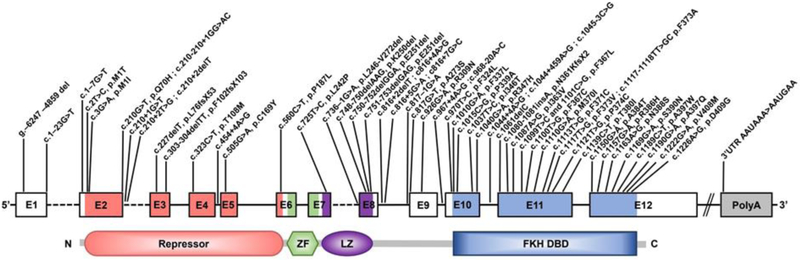
Schematic representation of FOXP3 illustrating the exons, the protein domains and mapped mutations of described IPEX patients. Amino acid changes are referred to by their single letter code. The N-terminal proline rich repressor domain (Repressor), zinc finger (ZF) motif, leucine zipper domain (LZ) and the forkhead DNA-binding domain (FKH DBD) are indicated.
Figure 8.
Figure 8.. Therapeutic manipulation of Foxp3+ Treg cells.
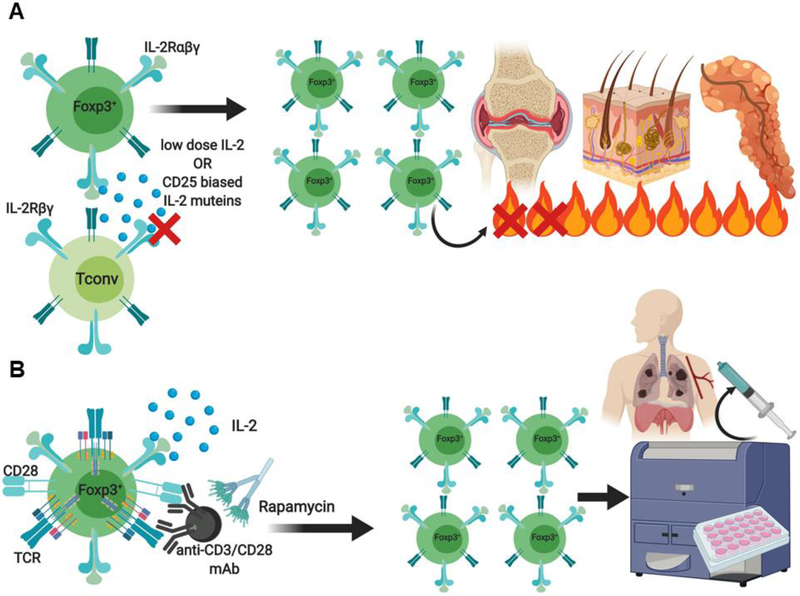
Examples of Treg cell-based therapy approaches. (A) Treg cells can be selectively expanded in-vivo with low dose IL-2 therapy or by IL-2 muteins engineered to preferentially interact with the high affinity IL-2 receptor alpha chain (CD25) expressed by Treg cells. (B) Alternatively, autologous CD4+CD25+CD127Treg cells can be massively expanded ex vivo following stimulation with anti-CD3/CD28 mAbs in the presence of IL-2, rapamycin, or Treg cell-biased IL-2 muteins to generate a clinical grade adoptive Treg cell transfer therapy product.

References

    1. Sakaguchi S, Takahashi T, Nishizuka Y. Study on cellular events in post-thymectomy autoimmune oophoritis in mice. II. Requirement of Lyt-1 cells in normal female mice for the prevention of oophoritis. J Exp Med. 1982;156(6):1577–86. - PMC - PubMed
    1. Sakaguchi S, Sakaguchi N, Asano M, Itoh M, Toda M. Immunologic self-tolerance maintained by activated T cells expressing IL-2 receptor alpha-chains (CD25). Breakdown of a single mechanism of self-tolerance causes various autoimmune diseases. J Immunol. 1995;155(3):1151–64. - PubMed
    1. Bonomo A, Kehn PJ, Payer E, Rizzo L, Cheever AW, Shevach EM. Pathogenesis of post-thymectomy autoimmunity. Role of syngeneic MLR-reactive T cells. J Immunol. 1995;154(12):6602–11. - PubMed
    1. Asano M, Toda M, Sakaguchi N, Sakaguchi S. Autoimmune disease as a consequence of developmental abnormality of a T cell subpopulation. J Exp Med. 1996;184(2):387–96. - PMC - PubMed
    1. Saoudi A, Seddon B, Fowell D, Mason D. The thymus contains a high frequency of cells that prevent autoimmune diabetes on transfer into prediabetic recipients. J Exp Med. 1996;184(6):2393–8. - PMC - PubMed

Publication types

MeSH terms

LinkOut - more resources