. 2019 Oct 16;10(10):4213-4220.
doi: 10.1021/acschemneuro.9b00309. Epub 2019 Sep 11.

Granulocyte-Colony Stimulating Factor Alters the Pharmacodynamic Properties of Cocaine in Female Mice

Affiliations

Granulocyte-Colony Stimulating Factor Alters the Pharmacodynamic Properties of Cocaine in Female Mice

Lillian J Brady et al. ACS Chem Neurosci. .

Abstract

Addiction to psychostimulants is a major public health crisis that leads to significant morbidity and mortality, for which there are currently no FDA-approved pharmacotherapies. Female subjects have increased propensity to develop pathological substance use disorders after initial use, suggesting the possibility of different pathophysiological mechanisms between males and females. Recently, we identified the neuroactive cytokine granulocyte-colony stimulating factor (G-CSF) as a key mediator of neuronal and behavioral plasticity in response to cocaine in male mice. Here, we found that G-CSF potentiated the rewarding effects of cocaine in female mice as well; however, the dopaminergic mechanism linked to these effects was highly dependent on the ovarian hormone cycle. G-CSF treatment enhanced the ability of cocaine to inhibit dopamine clearance; however, this effect was observed specifically during pro/estrus, when circulating ovarian hormone levels were high. These findings demonstrate important sex differences in the synaptic effects of this translationally relevant neuroimmune modulator.

Keywords: Cytokine; cocaine; dopamine; hormone cycle; reward; voltammetry.


Conflict of interest statement

The authors declare no competing financial interest.

Figures
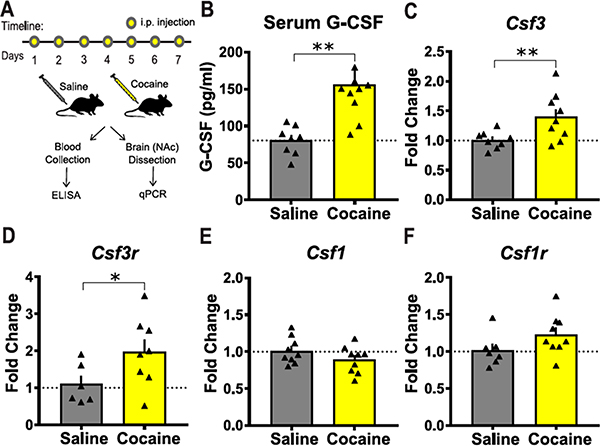
Figure 1.
Figure 1.
Cocaine injected female mice display elevated levels of G-CSF and G-CSF receptor. (A) Timeline of cocaine or saline injections followed by tissue collection and molecular analysis. (B) Cocaine treatment increased serum levels of G-CSF in female mice (saline, n = 8; cocaine, n = 10). (C,D) Cocaine treatment increased transcript levels of G-CSF (Csf 3: saline, n = 8; cocaine, n = 9) and receptor (Csf 3r: saline, n = 6; cocaine: n = 8) in the NAc. (E,F) Transcript levels of M-CSF (Csf1: saline, n = 9; cocaine, n = 9) and receptor (Csf1r: saline, n = 7; cocaine, n = 9) are unaffected by cocaine in the NAc. *p < 0.05, **p ≤ 0.01. All data are presented as mean ± SEM.
Figure 2.
Figure 2.
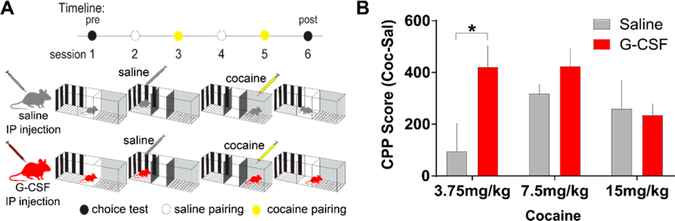
G-CSF treated female mice exhibit enhanced conditioned place preference (CPP). (A) Timeline of cocaine CPP experiments in saline and G-CSF treated female mice. (B) G-CSF treatment shifted the CPP dose response curve to the left in female mice (saline, n = 5; G-CSF, n = 6). *p < 0.05 for Holm-Sidak post hoc test. All data presented as mean ± SEM.
Figure 3.
Figure 3.
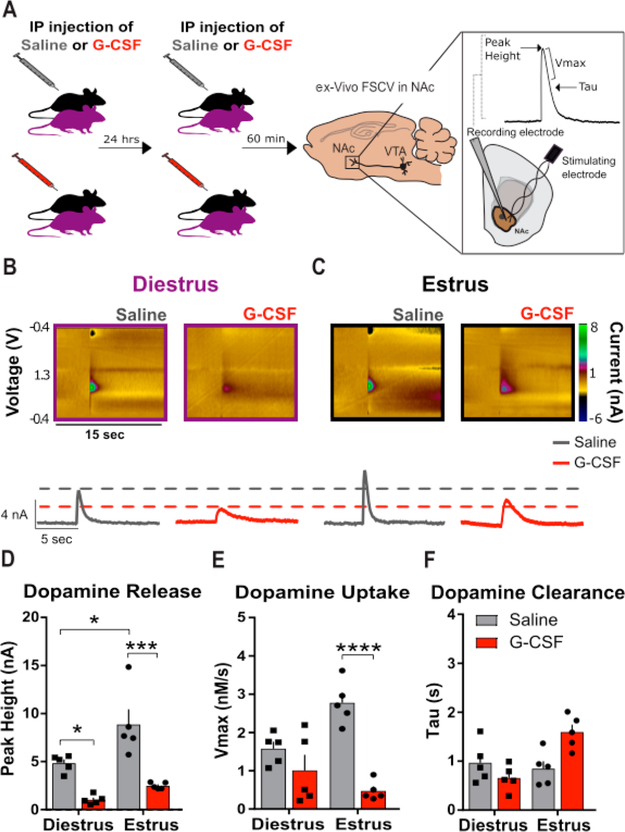
G-CSF decreases presynaptic dopamine release in the nucleus accumbens of female mice. (A) Timeline of G-CSF injections. Animals were injected with either saline or G-CSF 24 h and then 60 min before ex vivo voltammetry (left; n = 5 per group) to ensure that G-CSF blood levels were elevated for a comparable time as compared to the CPP experiments. FSCV was used to record dopamine release and uptake in the NAc (right). (Inset) Peak height, Vmax, and tau measurements were used to assess the signal. (B,C) Color plots (top) and current versus time plots (bottom) showing the presence of dopamine after electrical stimulation in diestrus (B) and estrus (C) animals. (D) Group data showing enhanced dopamine release in the saline treated animals in estrus compared to diestrus, and decreased dopamine release in the G-CSF treated animals in diestrus and estrus. (E) G-CSF treatment decreased maximal rates of dopamine uptake (Vmax) only in estrus. (F) There was no difference in dopamine clearance as measured by tau. *p < 0.05, **p < 0.01, ***p < 0.0001. Data presented as mean ± SEM.
Figure 4.
Figure 4.
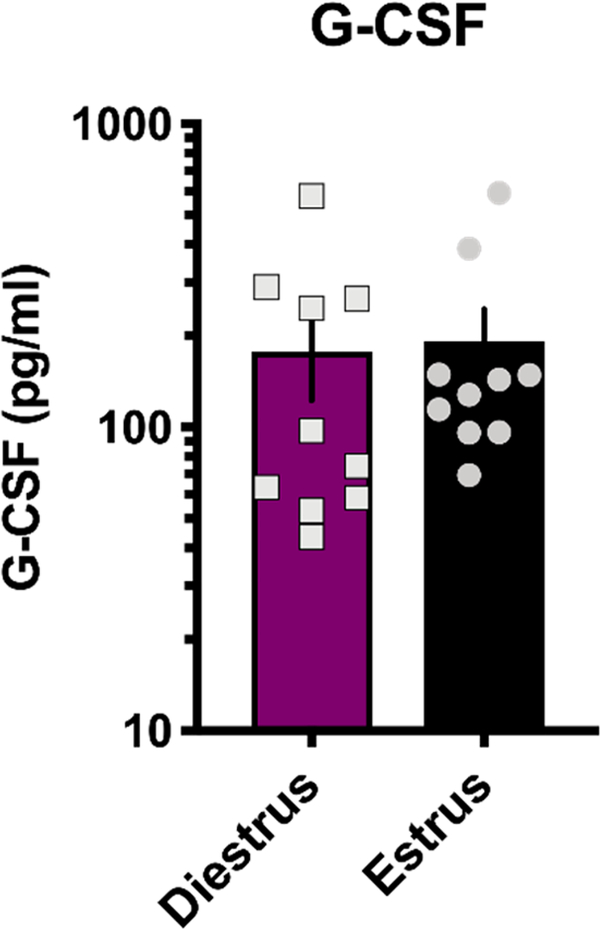
Circulating G-CSF levels are not affected by estrous cycle stage. ELISA analysis of serum from animals in diestrus and estrus reveals no significant fluctuations in levels of G-CSF at different stages of the estrous cycle. Data are mean ± SEM.
Figure 5.
Figure 5.
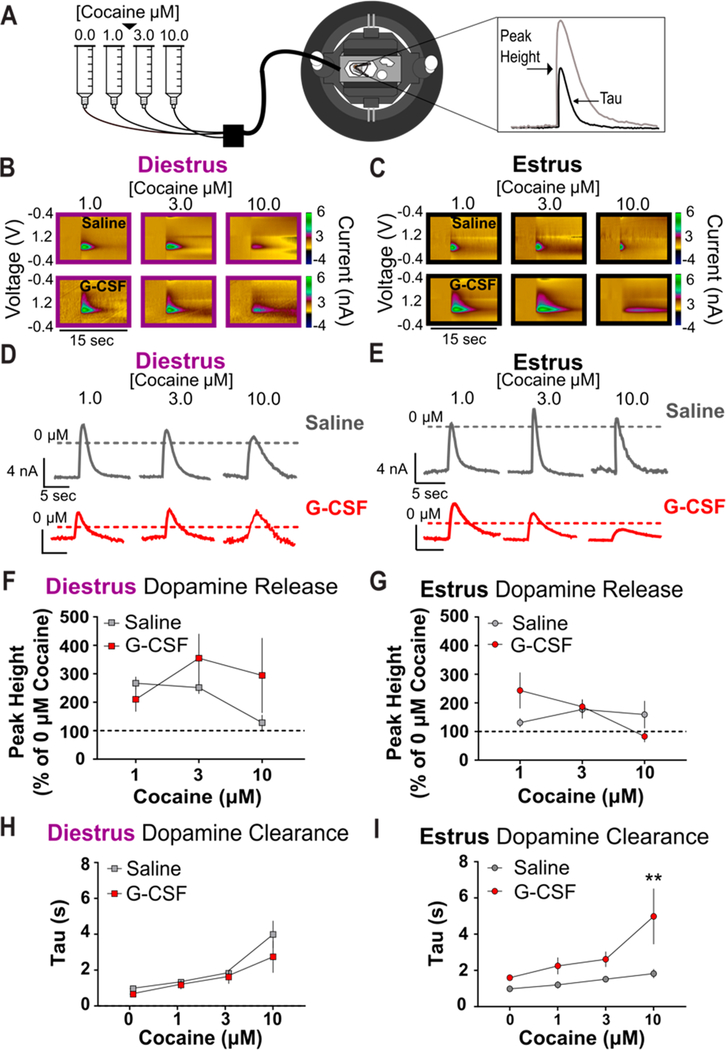
G-CSF treatment alters cocaine effects in a cycle-dependent fashion. (A) Schematic of experiment. (B) Diestrus and (C) estrus color plots showing the presence of dopamine after electrical stimulation and bath application of 1, 3, and 10 μM cocaine (n = 5 per group) in animals treated with saline (top) and G-CSF (bottom). (D) Diestrus and (E) estrus current versus time plots showing cocaine effects on electrically evoked dopamine release in animals treated with saline (top) or G-CSF (bottom). (F) Group data showing electrically evoked dopamine release was not changed by G-CSF treatment in animals in diestrus and (G) estrus. (H) There was no difference in dopamine clearance (tau) between diestrus animals treated with saline or G-CSF. I, G-CSF treatment in estrus females enhances the effects of cocaine on dopamine clearance. **p < 0.01 from saline treated. All data are presented as mean ± SEM.

References

    1. McLean CP, Asnaani A, Litz BT, and Hofmann SG (2011) Gender differences in anxiety disorders: prevalence, course of illness, comorbidity and burden of illness. J. Psychiatr. Res. 45 (8), 1027–35. - PMC - PubMed
    1. Altemus M, Sarvaiya N, and Epperson CN (2014) Sex differences in anxiety and depression clinical perspectives. Front. Neuroendocrinol. 35 (3), 320–330. - PMC - PubMed
    1. Becker JB, and Hu M (2008) Sex Differences in Drug Abuse. Front. Neuroendocrinol. 29 (1), 36–47. - PMC - PubMed
    1. NIDA, Substance Use in Women. National Institute on Drug Abuse website, August 10, 2018.
    1. Lambert C, Silva SD, Ceniti AK, Rizvi SJ, Foussias G, and Kennedy SH (2018) Anhedonia in depression and schizophrenia: A transdiagnostic challenge. CNS Neurosci. Ther. 24, 615–623. - PMC - PubMed

Publication types

MeSH terms

Substances