. 2020 Jun 1;146(11):3087-3097.
doi: 10.1002/ijc.32661. Epub 2019 Oct 1.

Relationship between protein biomarkers of chemotherapy response and microsatellite status, tumor mutational burden and PD-L1 expression in cancer patients

Affiliations

Relationship between protein biomarkers of chemotherapy response and microsatellite status, tumor mutational burden and PD-L1 expression in cancer patients

Mina Nikanjam et al. Int J Cancer. .

Abstract

Chemotherapy and checkpoint inhibitor immunotherapies are increasingly used in combinations. We determined associations between the presence of anti-PD-1/PD-L1 therapeutic biomarkers and protein markers of potential chemotherapy response. Data were extracted from a clinical-grade testing database (Caris Life Sciences; February 2015 through November 2017): immunotherapy response markers (microsatellite instability-high [MSI-H], tumor mutational burden-high [TMB-H], and PD-L1 protein expression) and protein chemotherapy response markers (excision repair complementation group 1 [ERCC1], topoisomerase 1 [TOPO1], topoisomerase 2 [TOP2A], thymidylate synthase [TS], tubulin beta 3 [TUBB3], ribonucleotide reductase regulatory subunit M1 [RRM1] and O-6-methyl guanine DNA methyltransferase [MGMT]). Relationships were determined by the Mantel-Haenszel chi-squared test or Fischer's exact tests. Overall, 28,034 patients representing a total of 40 tumor types were assessed. MSI-H was found in 3.3% of patients (73% were also TMB-H), TMB-H, 8.4% (28.3% were also MSI-H) and PD-L1 expression in 11.0% of patients (5.1% were also MSI-H; 16.4% were also TMB-H). Based on concurrent biomarker expression, combinations of immunotherapy with platinum (ERCC1 negativity) or with doxorubicin, epirubicin or etoposide (TOP2A positivity) have a higher probability of response, whereas combinations with irinotecan or topotecan (TOPO1 positivity), with gemcitabine (RRM1 negativity), and fluorouracil, pemetrexed or capecitabine (TS negativity) may be of less benefit. The potential for immunotherapy and taxane (TUBB3 negativity) combinations is present for MSI-H but not TMB-H or PD-L1-expressing tumors; for temozolomide and dacarbazine (MGMT negative), PD-L1 is frequently coexpressed, but MSI-H and TMB-H are not associated. Protein markers of potential chemotherapy response along with next-generation sequencing for immunotherapy response markers can help support rational combinations as part of an individualized, precision oncology approach.

Keywords: MSI; PD-L1; TMB; cytotoxic chemotherapy; immunotherapy.


Figures

Figure 1
Figure 1
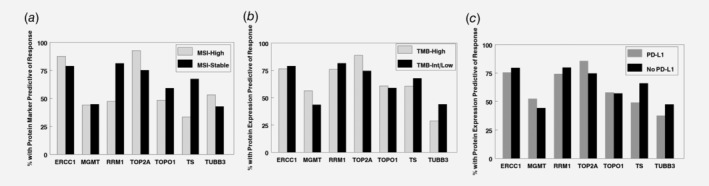
Protein markers predictive of response to chemotherapy compared with immunotherapy response makers. (a) MSI‐H (predictive of checkpoint inhibitor response) versus MSI‐stable. Eighty‐eight percent of MSI‐H also have ERCC1 negativity (predictive of platinum response); 44% of MSI‐H also have MGMT negativity (predictive of dacarbazine and temozolomide response); 47% of MSI‐H also have RRM1 negative (predictive of gemcitabine response); 93% of MSI‐H patients have TOP2A positivity (predictive of with doxorubicin, epirubicin, etoposide response), 48% of MSI‐H patients have TOPO1 positivity (predictive of irinotecan or topotecan response), 33% of MSI‐H patients have TS negativity (predictive of fluorouracil/pemetrexed/capecitabine response) and 53% of MSI‐H patients have TUBB3 negativity (predictive of taxane response). (b) TMB‐H (predictive of checkpoint inhibitor response) versus TMB‐intermediate/‐low. Seventy‐six percentage of TMB‐H also have ERCC1 negativity (predictive of platinum response); 56% of TMB‐H also have MGMT negativity (predictive of dacarbazine and temozolomide response); 76% of TMB‐H also have RRM1 negative (predictive of gemcitabine response); 89% of TMB‐H patients have TOP2A positivity (predictive of with doxorubicin, epirubicin and etoposide response), 61% of TMB‐H patients have TOPO1 positivity (predictive of or irinotecan or topotecan response), 61% of TMB‐H patients have TS negativity (predictive of fluorouracil/pemetrexed/capecitabine response) and 29% of TMB‐H patients have TUBB3 negativity (predictive of better response to taxanes). (c) PD‐L1 positive (predictive of checkpoint inhibitor response) versus PD‐L1 negative. Seventy‐five percentage of PD‐L1 positive also have ERCC1 negativity (predictive of platinum response); 52% of PD‐L1 positive also have MGMT negativity (predictive of dacarbazine and temozolomide response); 74% of PD‐L1 positive also have RRM1 negative (predictive of gemcitabine response); 86% of PD‐L1 positive patients have TOP2A positivity (predictive of with doxorubicin, epirubicin, etoposide response), 58% of PD‐L1 positive patients have TOPO1 positivity (predictive of irinotecan or topotecan response), 49% of PD‐L1 positive patients have TS negativity (predictive of fluorouracil/pemetrexed/capecitabine response) and 38% of PD‐L1 positive patients have TUBB3 negativity (predictive of better response to taxanes). See Table 2 for additional data.

References

    1. Morrissey KM, Yuraszeck TM, Li CC, et al. Immunotherapy and novel combinations in oncology: current landscape, challenges, and opportunities. Clin Transl Sci 2016;9:89–104. - PMC - PubMed
    1. Harris SJ, Brown J, Lopez J, et al. Immuno‐oncology combinations: raising the tail of the survival curve. Cancer Biol Med 2016;13:171–93. - PMC - PubMed
    1. Nikanjam M, Patel H, Kurzrock R. Dosing immunotherapy combinations: analysis of 3,526 patients for toxicity and response patterns. Oncoimmunology 2017;6:e1338997. - PMC - PubMed
    1. Ott PA, Hodi FS, Kaufman HL, et al. Combination immunotherapy: a road map. J Immunother Cancer 2017;5:16. - PMC - PubMed
    1. Lesterhuis WJ, Punt CJ, Hato SV, et al. Platinum‐based drugs disrupt STAT6‐mediated suppression of immune responses against cancer in humans and mice. J Clin Invest 2011;121:3100–8. - PMC - PubMed

Publication types

MeSH terms