


Diagnostic colonoscopy completion after abnormal fecal immunochemical testing and quality of tests used at 8 Federally Qualified Health Centers in Southern California: Opportunities for improving screening outcomes
- PMID: 31479529
- PMCID: PMC7008958
- DOI: 10.1002/cncr.32440
Diagnostic colonoscopy completion after abnormal fecal immunochemical testing and quality of tests used at 8 Federally Qualified Health Centers in Southern California: Opportunities for improving screening outcomes
Abstract
Background: The effectiveness of colorectal cancer screening with fecal immunochemical tests (FITs) of stool blood depends on high rates of colonoscopy follow-up for abnormal FITs and the use of high-quality tests. This study characterized colonoscopy referral and completion among patients with abnormal FITs and the types of FITs implemented in a sample of Southern California Federally Qualified Health Centers (FQHCs).
Methods: FQHCs in San Diego, Imperial, and Los Angeles Counties were invited to define a cohort of ≥150 consecutive patients with abnormal FITs in 2015-2016 and to provide data on sex, insurance status, diagnostic colonoscopy referrals and completion within 6 months of abnormal FITs, and the types (brands) of FITs implemented. The primary outcomes were the proportions with colonoscopy referrals and completion for all patients at each FQHC and in aggregate.
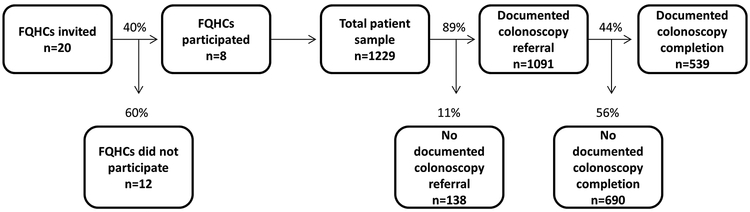
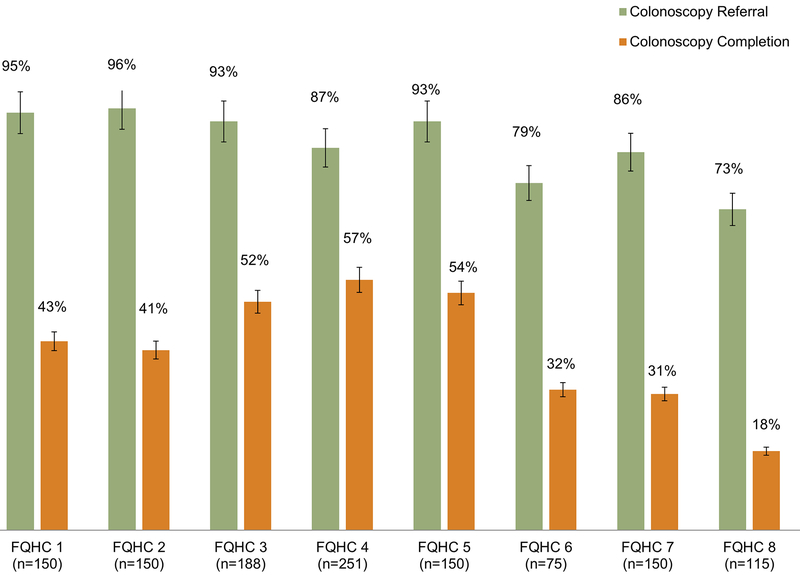
Results: Eight FQHCs provided data for 1229 patients with abnormal FITs; 46% were male, and 20% were uninsured. Among patients with abnormal FITs, 89% (1091 of 1229; 95% confidence interval [CI], 0.87-0.91) had a colonoscopy referral, and 44% (539 of 1229; 95% CI, 0.41-0.47) had colonoscopy completion. Across FQHCs, the range for colonoscopy referral was 73% to 96%, and the range for completion was 18% to 57%. Six of the 8 FQHCs (75%) reported FIT brands with limited data to support their effectiveness.
Conclusions: In a sample of Southern California FQHCs, diagnostic colonoscopy completion after abnormal FITs was substantially below the nationally recommended benchmark to achieve 80% completion, and the use of FIT brands with limited data to support their effectiveness was high. These findings suggest a need for policies and multilevel interventions to promote diagnostic colonoscopy among individuals with abnormal FITs and the use of higher quality FITs.
Keywords: Federally Qualified Health Center; Hispanic; abnormal fecal immunochemical test (FIT); colorectal cancer; screening.
© 2019 American Cancer Society.
Conflict of interest statement
Conflict of Interest Statement
The Authors have no relevant conflicts of interest to disclose.
Figures
Comment in
-
Low rates of diagnostic colonoscopy in Federally Qualified Health Centers: A persistent problem that must be addressed to achieve the promise of colorectal cancer screening.Cancer. 2019 Dec 1;125(23):4134-4135. doi: 10.1002/cncr.32438. Epub 2019 Sep 3. Cancer. 2019. PMID: 31479509 No abstract available.
References
-
- Force USPST, Bibbins-Domingo K, Grossman DC, Curry SJ, Davidson KW, Epling JW Jr., et al. Screening for Colorectal Cancer: US Preventive Services Task Force Recommendation Statement. JAMA. 2016;315(23):2564–75. - PubMed
-
- Kim Andrews; Rick Alteri; Afsaneh Barzi ea. Colorectal Cancer Facts & Figures. American Cancer Society 2017.
-
- Robertson DJ, Lee JK, Boland CR, Dominitz JA, Giardiello FM, Johnson DA, et al. Recommendations on Fecal Immunochemical Testing to Screen for Colorectal Neoplasia: A Consensus Statement by the US Multi-Society Task Force on Colorectal Cancer. Gastroenterology. 2017;152(5):1217–37 e3. - PubMed
Publication types
MeSH terms
Grants and funding
- U54 CA132384/CA/NCI NIH HHS/United States
- U54CA132384/National Institute of Health (NIH)/International
- CA023100-32/Specialized Cancer Center Support Grant to the UC San Diego Moores Cancer Center/International
- U58 DP003862/DP/NCCDPHP CDC HHS/United States
- U54CA132379/National Institute of Health (NIH)/International
- U54CA143931/Charles Drew University-University of California Los Angeles/International
- CC/CDC HHS/United States
- CA023100-32/University of California San Diego Moores Cancer Center/International
- U54CA143931/Charles Drew Univeristy (CDU)-UCLA Partnership to Eliminate Cancer Disparities Grant/International
- U54CA132384/National Institute of Health/International
- U54CA132379/National Institute of Health/International
- P30 CA023100/CA/NCI NIH HHS/United States
- U54 CA132379/CA/NCI NIH HHS/United States
- U54 CA143931/CA/NCI NIH HHS/United States
