


Afferent-efferent connectivity between auditory brainstem and cortex accounts for poorer speech-in-noise comprehension in older adults
- PMID: 31479953
- PMCID: PMC6778515
- DOI: 10.1016/j.heares.2019.107795
Afferent-efferent connectivity between auditory brainstem and cortex accounts for poorer speech-in-noise comprehension in older adults
Abstract
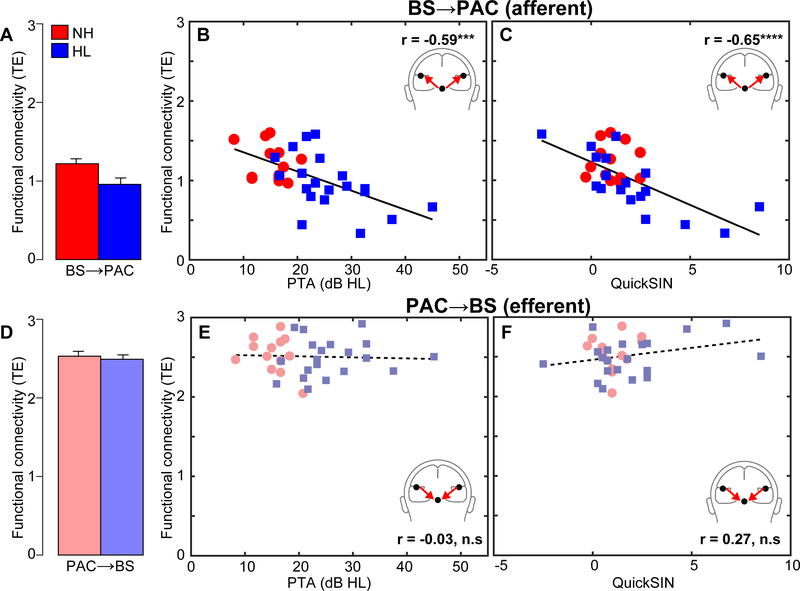
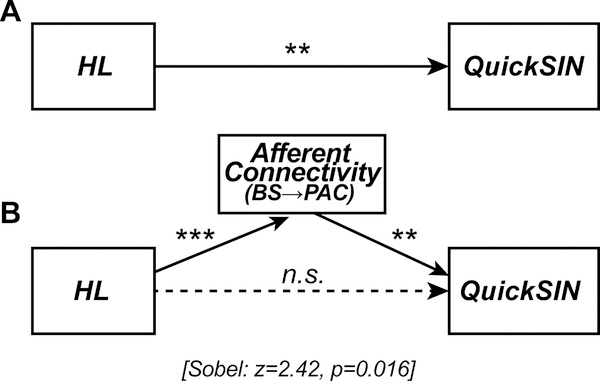
Speech-in-noise (SIN) comprehension deficits in older adults have been linked to changes in both subcortical and cortical auditory evoked responses. However, older adults' difficulty understanding SIN may also be related to an imbalance in signal transmission (i.e., functional connectivity) between brainstem and auditory cortices. By modeling high-density scalp recordings of speech-evoked responses with sources in brainstem (BS) and bilateral primary auditory cortices (PAC), we show that beyond attenuating neural activity, hearing loss in older adults compromises the transmission of speech information between subcortical and early cortical hubs of the speech network. We found that the strength of afferent BS→PAC neural signaling (but not the reverse efferent flow; PAC→BS) varied with mild declines in hearing acuity and this "bottom-up" functional connectivity robustly predicted older adults' performance in a SIN identification task. Connectivity was also a better predictor of SIN processing than unitary subcortical or cortical responses alone. Our neuroimaging findings suggest that in older adults (i) mild hearing loss differentially reduces neural output at several stages of auditory processing (PAC > BS), (ii) subcortical-cortical connectivity is more sensitive to peripheral hearing loss than top-down (cortical-subcortical) control, and (iii) reduced functional connectivity in afferent auditory pathways plays a significant role in SIN comprehension problems.
Keywords: Aging; Auditory cortex; Auditory evoked potentials; Frequency-following response (FFR); Functional connectivity; Neural speech processing; Source waveform analysis.
Copyright © 2019 Elsevier B.V. All rights reserved.
Conflict of interest statement
Figures
References
-
- Aiken SJ, Picton TW 2008. Envelope and spectral frequency-following responses to vowel sounds. Hear. Res 245, 35–47. - PubMed
-
- Aitkin LM, Dickhaus H, Schult W, Zimmermann M 1978. External nucleus of inferior colliculus: auditory and spinal somatosensory afferents and their interactions. J. Neurophysiol 41, 837–47. - PubMed
-
- Alain C, McDonald K, Van Roon P 2012. Effects of age and background noise on processing a mistuned harmonic in an otherwise periodic complex sound. Hear. Res 283, 126–135. - PubMed
-
- Alain C, Snyder JS, He Y, Reinke KS 2007. Changes in auditory cortex parallel rapid perceptual learning. Cereb. Cortex 17, 1074–84. - PubMed
Publication types
MeSH terms
Grants and funding
LinkOut - more resources
Full Text Sources
Medical
