


Review on Smart Gas Sensing Technology
- PMID: 31480359
- PMCID: PMC6749323
- DOI: 10.3390/s19173760
Review on Smart Gas Sensing Technology
Abstract
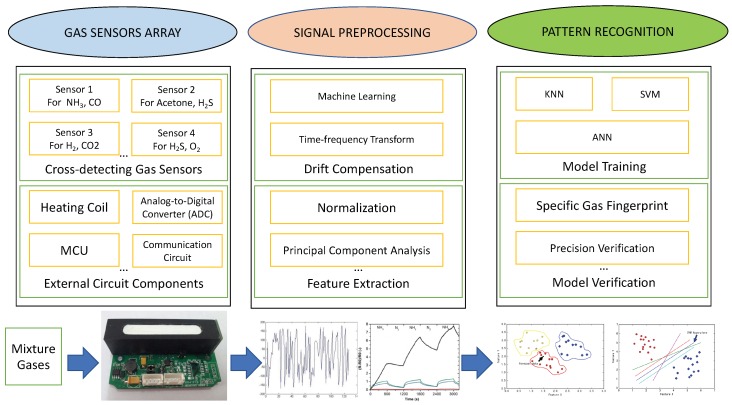
With the development of the Internet-of-Things (IoT) technology, the applications of gas sensors in the fields of smart homes, wearable devices, and smart mobile terminals have developed by leaps and bounds. In such complex sensing scenarios, the gas sensor shows the defects of cross sensitivity and low selectivity. Therefore, smart gas sensing methods have been proposed to address these issues by adding sensor arrays, signal processing, and machine learning techniques to traditional gas sensing technologies. This review introduces the reader to the overall framework of smart gas sensing technology, including three key points; gas sensor arrays made of different materials, signal processing for drift compensation and feature extraction, and gas pattern recognition including Support Vector Machine (SVM), Artificial Neural Network (ANN), and other techniques. The implementation, evaluation, and comparison of the proposed solutions in each step have been summarized covering most of the relevant recently published studies. This review also highlights the challenges facing smart gas sensing technology represented by repeatability and reusability, circuit integration and miniaturization, and real-time sensing. Besides, the proposed solutions, which show the future directions of smart gas sensing, are explored. Finally, the recommendations for smart gas sensing based on brain-like sensing are provided in this paper.
Keywords: gas sensor; machine learning; selectivity; sensitive; sensor arrays; smart gas sensing.
Conflict of interest statement
The authors declare no conflict of interest.
Figures

References
-
- Liu L., Li X., Li Z., Shi Y. Application of Electronic Nose in Detection of Fresh Vegetables Freezing Time Considering Odor Identification Technology. Chem. Eng. Trans. 2018;68:265–270.
-
- Manzoli A., Steffens C., Paschoalin R.T., Graboski A.M., Brandão H.D.M., de Carvalho B.C., Bellini J.L., de Paula Herrmann P.S., Jr. Volatile compounds monitoring as indicative of female cattle fertile period using electronic nose. Sens. Actuators Chem. 2019;282:609–616. doi: 10.1016/j.snb.2018.11.109. - DOI
-
- Chen L.Y., Wong D.M., Fang C.Y., Chiu C.I., Chou T.I., Wu C.C., Chiu S.W., Tang K.T. Development of an electronic-nose system for fruit maturity and quality monitoring; Proceedings of the IEEE International Conference on Applied System Invention (ICASI); Chiba, Japan. 13–17 April 2018; pp. 1129–1130.
-
- Harrou F., Dairi A., Sun Y., Kadri F. Detecting Abnormal Ozone Measurements With a Deep Learning-Based Strategy. IEEE Sens. J. 2018;18:7222–7232. doi: 10.1109/JSEN.2018.2852001. - DOI
Publication types
Grants and funding
LinkOut - more resources
Full Text Sources
Other Literature Sources
