


Blood Pressure Non-Dipping and Obstructive Sleep Apnea Syndrome: A Meta-Analysis
- PMID: 31480717
- PMCID: PMC6780266
- DOI: 10.3390/jcm8091367
Blood Pressure Non-Dipping and Obstructive Sleep Apnea Syndrome: A Meta-Analysis
Abstract
Aim: We examined the reduced blood pressure (BP) nocturnal fall in patients with obstructive sleep apnea (OSA) by a meta-analysis including studies that provided data on prevalence rates of non-dipping (ND) pattern during 24-h ambulatory blood pressure monitoring (ABPM).
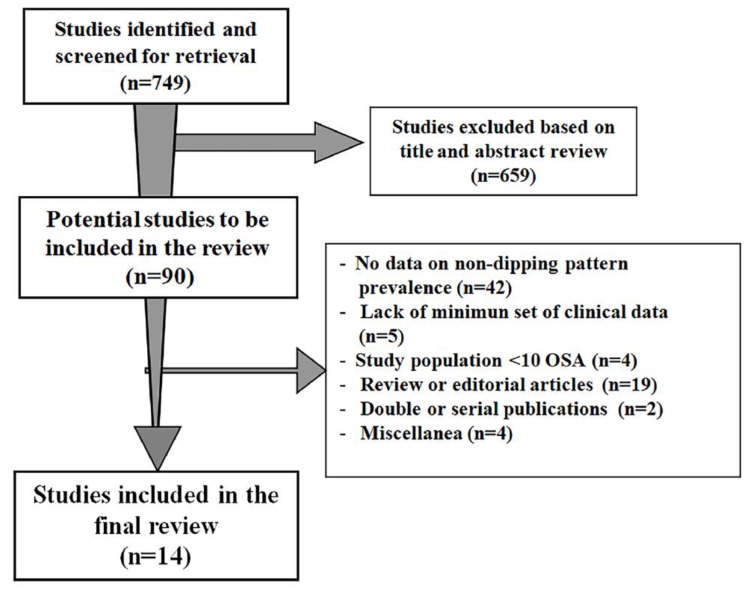
Design: The PubMed, OVID-MEDLINE, and Cochrane CENTRAL literature databases were searched for appropriate articles without temporal restriction up to April 2019 through focused and sensitive search methods. Studies were identified by crossing the search terms as follows: "obstructive sleep apnea", "sleep quality", "non dipping", "reduced nocturnal BP fall", "circadian BP variation", "night-time BP", and "ambulatory blood pressure monitoring".
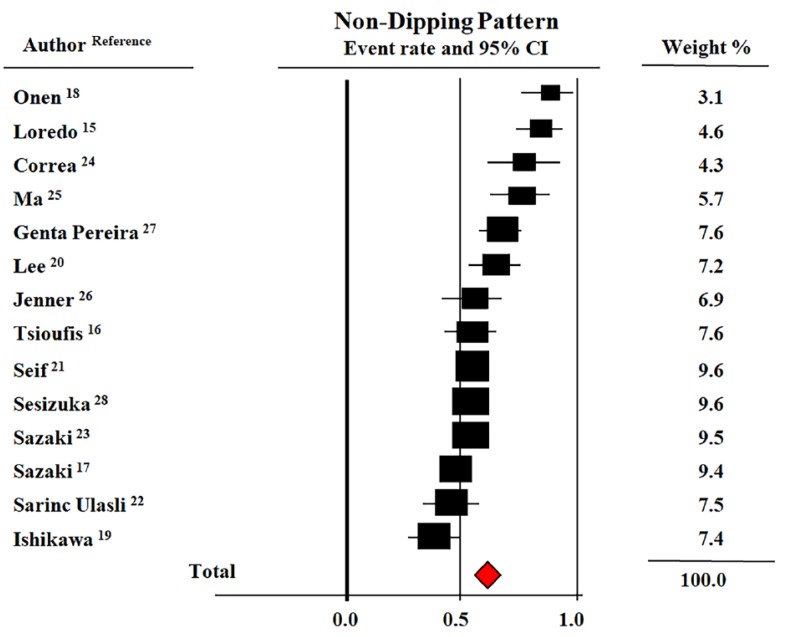
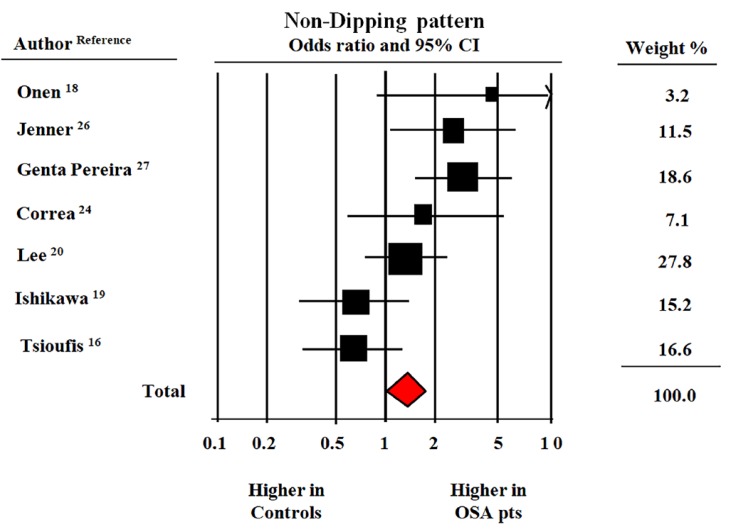
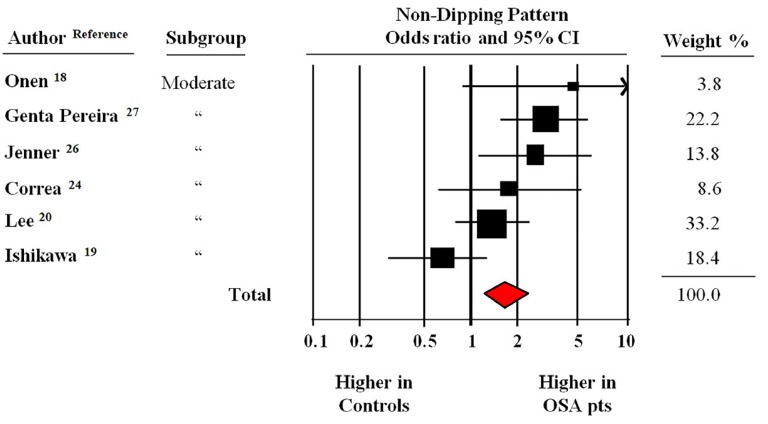
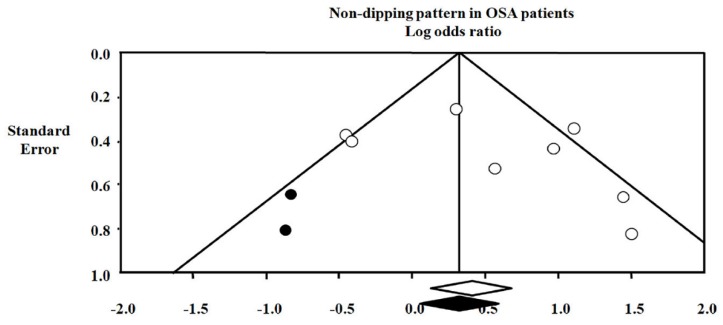
Results: Meta-analysis included 1562 patients with OSA from different clinical settings and 957 non-OSA controls from 14 studies. ND pattern prevalence in patients with OSA widely varied among studies (36.0-90.0%). This was also the case for non-OSA controls (33.0% to 69.0%). Overall, the ND pattern, assessed as an event rate in the pooled OSA population, was 59.1% (confidence interval (CI): 52.0-65.0%). Meta-analysis of the seven studies comparing the prevalence of ND pattern in participants with OSA and controls showed that OSA entails a significantly increased risk of ND (Odds ratio (OR) = 1.47, CI: 1.07-1.89, p < 0.01). After the exclusion of patients with mild OSA, OR increased to 1.67 (CI: 1.21-2.28, p < 0.001).
Conclusions: The present meta-analysis, extending previous information on the relationship between OSA and impaired BP dipping, based on single studies, suggests that this condition increases by approximately 1.5 times the likelihood of ND, which is a pattern associated with a greater cardiovascular risk than normal BP dipping.
Keywords: meta-analysis; non-dipping pattern; obstructive sleep apnea.
Conflict of interest statement
The authors report no conflicts of interest.
Figures
References
-
- Zullig L.L., Diamantidis C.J., Bosworth H.B., Bhapkar M.V., Barnhart H., Oakes M.M., Pendergast J.F., Miller J.J., Patel U.D. Racial differences in nocturnal dipping status in diabetic kidney disease: Results from the STOP-DKD (Simultaneous Risk Factor Control Using Telehealth to Slow Progression of Diabetic Kidney Disease) study. J. Clin. Hypertens. (Greenwich) 2017;19:1327–1335. doi: 10.1111/jch.13088. - DOI - PMC - PubMed
LinkOut - more resources
Full Text Sources
Medical
Miscellaneous
