


Intracellular crowding by age-dependent neuromelanin accumulation disrupts neuronal proteostasis and triggers Parkinson disease pathology
- PMID: 31480882
- PMCID: PMC6844506
- DOI: 10.1080/15548627.2019.1659621
Intracellular crowding by age-dependent neuromelanin accumulation disrupts neuronal proteostasis and triggers Parkinson disease pathology
Abstract
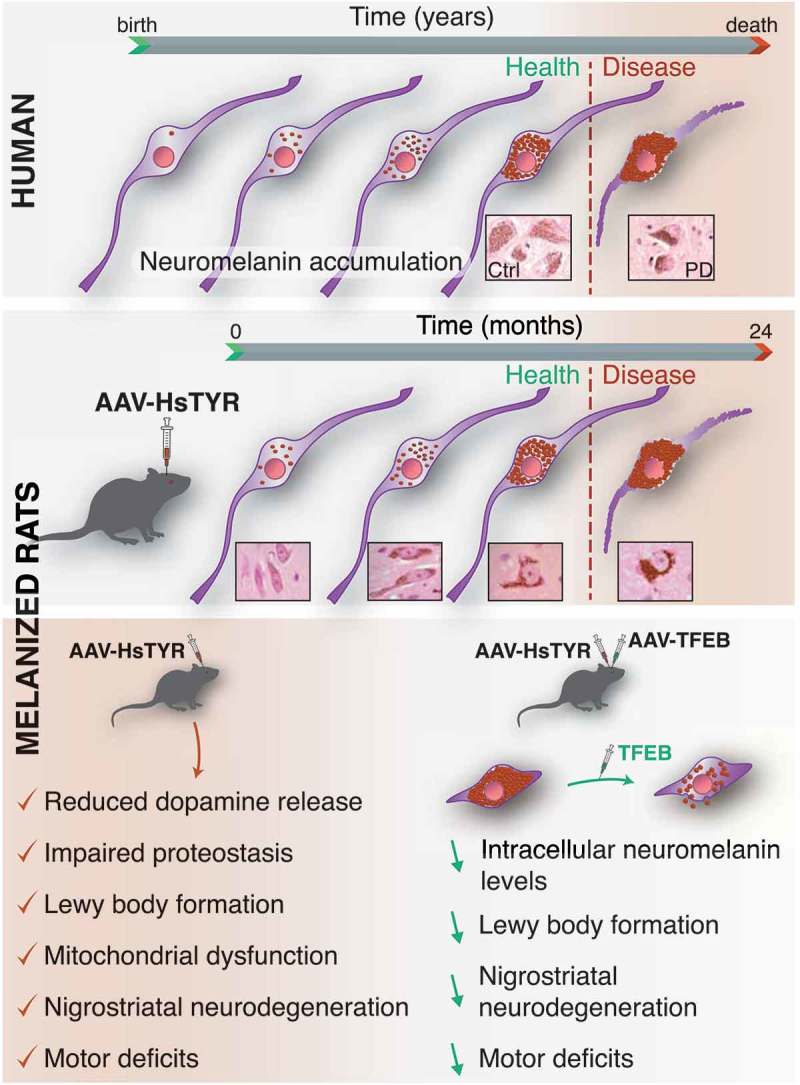
In Parkinson disease (PD), there is a preferential degeneration of neurons that contain the dark-brown cytoplasmic pigment neuromelanin, in particular dopaminergic neurons of the substantia nigra (SN), the loss of which leads to the typical motor symptoms of the disease and constitutes the cardinal pathological diagnostic criterion for PD. Neuromelanin is generally considered a byproduct of dopamine oxidative metabolism and, in humans, it is first detected in early childhood and accumulates progressively with age until occupying most of the neuronal cytoplasm, as neurons apparently lack the means to degrade or eliminate this pigment. Aging is the main risk factor for developing PD, but the molecular substrate underlying this link remains unknown. Despite the close and long-established association between neuromelanin and PD, the potential contribution of neuromelanin to PD pathogenesis has remained elusive because, in contrast to humans, common laboratory animal species, such as rodents, lack neuromelanin. To overcome this major limitation, we have recently generated the first experimental in vivo rodent model exhibiting age-dependent production and accumulation of human-like neuromelanin within PD-vulnerable dopaminergic nigral neurons, at levels up to those reached in elderly humans.
Keywords: Alpha-synuclein; Lewy bodies; Parkinson’s disease; autophagy; cellular trafficking; dopamine; neurodegeneration; neuromelanin.
Figures
Comment on
-
Brain tyrosinase overexpression implicates age-dependent neuromelanin production in Parkinson's disease pathogenesis.Nat Commun. 2019 Mar 7;10(1):973. doi: 10.1038/s41467-019-08858-y. Nat Commun. 2019. PMID: 30846695 Free PMC article.
References
Publication types
MeSH terms
Substances
LinkOut - more resources
Full Text Sources
Medical
