


Malaria around large dams in Africa: effect of environmental and transmission endemicity factors
- PMID: 31481092
- PMCID: PMC6720395
- DOI: 10.1186/s12936-019-2933-5
Malaria around large dams in Africa: effect of environmental and transmission endemicity factors
Abstract
Background: The impact of large dams on malaria has received widespread attention. However, understanding how dam topography and transmission endemicity influence malaria incidences is limited.
Methods: Data from the European Commission's Joint Research Center and Shuttle Radar Topography Mission were used to determine reservoir perimeters and shoreline slope of African dams. Georeferenced data from the Malaria Atlas Project (MAP) were used to estimate malaria incidence rates in communities near reservoir shorelines. Population data from the WorldPop database were used to estimate the population at risk of malaria around dams in stable and unstable areas.
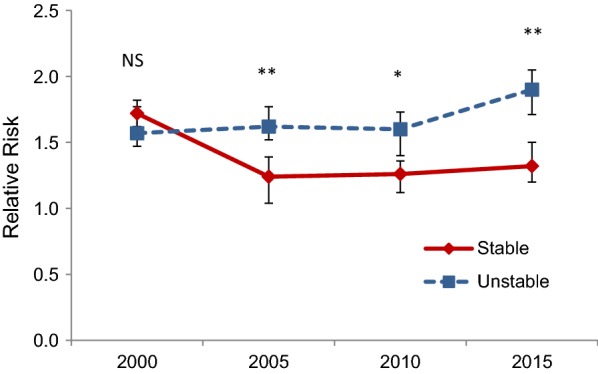
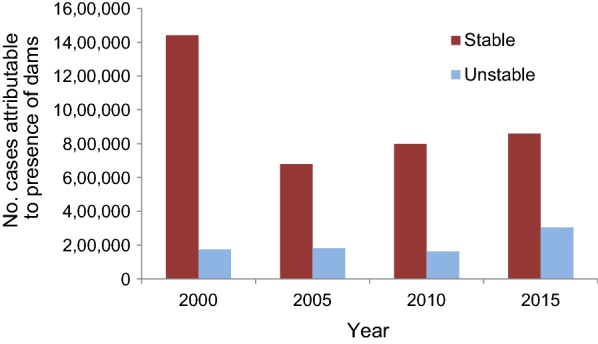
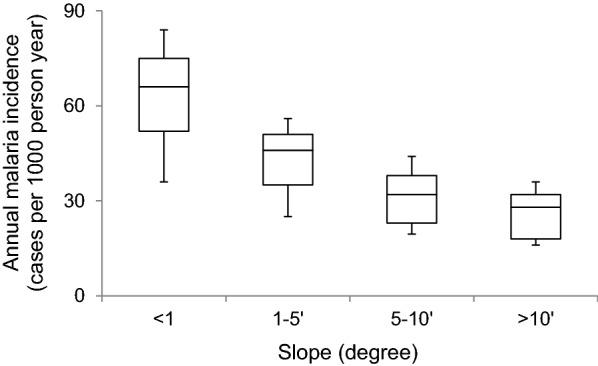
Results: The data showed that people living near (< 5 km) large dams in sub-Saharan Africa grew from 14.4 million in 2000 to 18.7 million in 2015. Overall, across sub-Saharan Africa between 0.7 and 1.6 million malaria cases per year are attributable to large dams. Whilst annual malaria incidence declined markedly in both stable and unstable areas between 2000 and 2015, the malaria impact of dams appeared to increase in unstable areas, but decreased in stable areas. Shoreline slope was found to be the most important malaria risk factor in dam-affected geographies, explaining 41-82% (P < 0.001) of the variation in malaria incidence around reservoirs.
Conclusion: Gentler, more gradual shoreline slopes were associated with much greater malaria risk. Dam-related environmental variables such as dam topography and shoreline slopes are an important factor that should be considered in efforts to predict and control malaria around dams.
Keywords: Africa; Dams; Malaria; Reservoir shoreline; Slope; Topography.
Conflict of interest statement
The authors declare that they have no competing interests.
Figures
References
-
- Thornton PK, Jones PG, Owiyo T, Kruska RL, Herrero M, Kristjanson P et al. Mapping climate vulnerability and poverty in Africa. 2006. http://www.dfid.gov.uk/research/mapping-climate.pdf. Accessed 15 Sept 2017.
-
- Sadoff CW, Hall JW, Grey D, Aerts JCJH, Ait-Kadi M, Brown C, et al. Securing water, sustaining growth: report of the GWP/OECD task force on water security and sustainable growth. UK: University of Oxford; 2015.
-
- Union African. Programme for infrastructure development in Africa. Addis Ababa: African Union; 2015.
-
- White WR. World water: resources, usage, and the role of man-made reservoirs. 2010. http://www.fwr.org/wwtrstrg.pdf. Accessed 15 Aug 2019.
-
- International Rivers. 2015. The World Bank and Dams. https://www.internationalrivers.org/sites/default/files/attached-files/w.... Accessed 15 Feb 2019.
