


Low-dose post-transplant cyclophosphamide and anti-thymocyte globulin as an effective strategy for GVHD prevention in haploidentical patients
- PMID: 31481121
- PMCID: PMC6724335
- DOI: 10.1186/s13045-019-0781-y
Low-dose post-transplant cyclophosphamide and anti-thymocyte globulin as an effective strategy for GVHD prevention in haploidentical patients
Abstract
Background: Low-dose post-transplant cyclophosphamide (PTCy) in conjunction with anti-thymocyte globulin (ATG) appears as a potentially effective graft-versus-host disease (GVHD) prevention strategy in haploidentical hematopoietic cell transplant (haplo-HCT). Our study aims to assess the efficacy of this regimen.
Methods: We extended our prospective study in patients treated with low-dose PTCy (14.5 mg/kg on days 3 and 4) in ATG/granulocyte colony-stimulating factor (G-CSF)-based regimen and compared the results to the contemporary cohort of patients without low-dose PTCy (ATG cohort). Both study cohort and control are transplanted from maternal donor or collateral relatives.
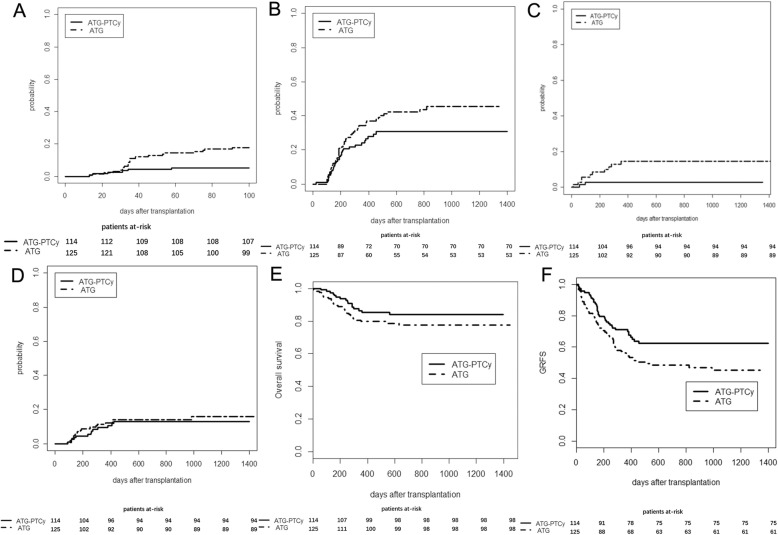
Results: We identified 239 consecutive patients (ATG-PTCy cohort = 114; ATG cohort = 125). All patients but one in ATG cohort achieved myeloid engraftment by day 30 post-HCT. We found that both the cumulative incidence of 100-day grade III-IV aGvHD and non-relapse-mortality (NRM) in the ATG-PTCy cohort was significantly reduced than that in the ATG group (5% vs 18%; P = 0.003; and 6% vs 15%; P= 0.045); the 2-year cumulative incidences of relapse and overall survival were comparable between the two cohorts (13% vs 14%; P = 0.62; and 83% vs 77%; P = 0.18, respectively). Furthermore, GVHD-free, relapse-free survival (GRFS) was significantly improved in the ATG-PTCy arm (63% vs 48%; P = 0.039). In multivariate analysis, the joint treatment resulted in lower grade II-IV acute GVHD (HR 0.58; P = 0.036), grade III-IV aGvHD (HR 0.28; P = 0.006), chronic GVHD (HR 0.60; P = 0.047), NRM (HR 0.26; P = 0.014), and higher GRFS (HR 0.59; P = 0.021) but slower myeloid and platelet recovery (HR 0.29 and 0.30; both P < 0.001).
Conclusions: These results suggested that ATG/PTCy (low-dose) can reduce both acute and chronic GVHD as compared with standard ATG-based prophylaxis using maternal donor or collateral relatives at particular high GVHD risk.
Trial registration: ClinicalTrials.gov NCT02412423.
Keywords: Anti-thymocyte globulin; Graft-versus-host disease; Haploidentical; Low-dose; Post-transplant cyclophosphamide.
Conflict of interest statement
The authors declare that they have no competing interests.
Figures
References
-
- Rubio MT, Savani BN, Labopin M, Piemontese S, Polge E, Ciceri F, et al. Impact of conditioning intensity in T-replete haplo-identical stem cell transplantation for acute leukemia: a report from the acute leukemia working party of the EBMT. J Hematol Oncol. 2016;9:25. doi: 10.1186/s13045-016-0248-3. - DOI - PMC - PubMed
-
- Wang Y, Liu QF, Xu LP, Liu KY, Zhang XH, Ma X, et al. Haploidentical versus matched-sibling transplant in adults with Philadelphia-negative high-risk acute lymphoblastic leukemia: a biologically phase III randomized study. Clin Cancer Res. 2016;22:3467–3476. doi: 10.1158/1078-0432.CCR-15-2335. - DOI - PubMed
Publication types
MeSH terms
Substances
Associated data
LinkOut - more resources
Full Text Sources
Medical
