


Assessing the Training Costs and Work of Diagnostic Radiology Residents Using Key Performance Indicators - An Observational Study
- PMID: 31481346
- PMCID: PMC7048663
- DOI: 10.1016/j.acra.2019.08.004
Assessing the Training Costs and Work of Diagnostic Radiology Residents Using Key Performance Indicators - An Observational Study
Abstract
Rationale and objectives: To quantify the costs and work of diagnostic radiology (DR) residents using the radiology key performance indicator turn-around time (TAT) as the outcome measure.
Materials and methods: In an Institutional Review Board-approved study, the annual cost of a DR resident was determined using salary, benefits, and a cost allocation of faculty effort. The volume of cases reported in the 2015-16 academic year and median and interquartile range (IQR) TAT for a trainee preliminary (Complete to Prelim, C-P) or an attending final (Complete to Final, C-F) radiology report were measured and stratified by time of day and patient location. Wilcoxon rank-sum tests were used (significance, p values < 0.05).
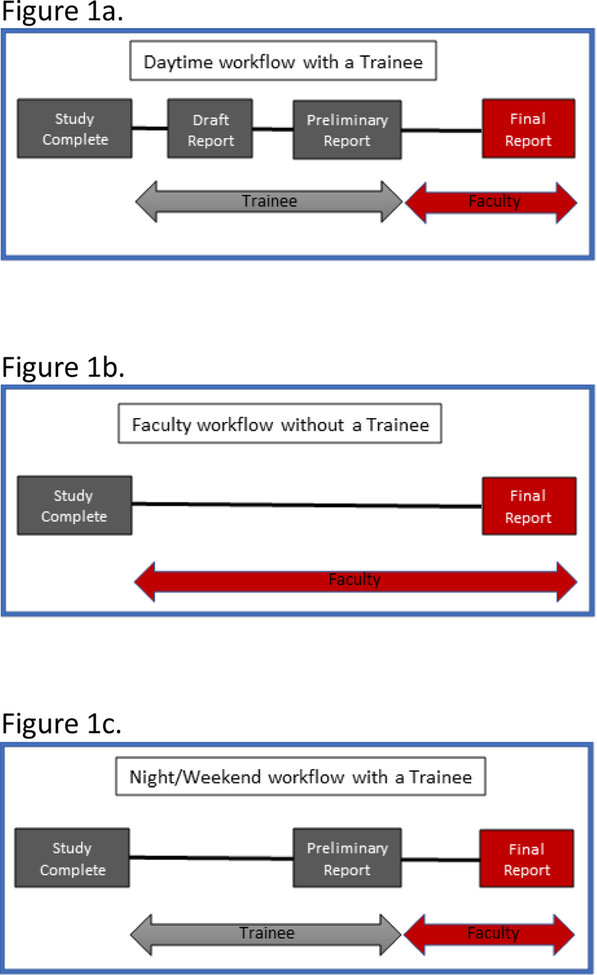
Results: The annual cost of a DR resident was $99,109, 34% greater than direct salary/benefits and 27% of the direct salary/benefits cost of an attending. The total per minute cost of rendering care was $4.36 with both trainee ($0.70/minute) and faculty ($3.66/minute). Residents participated in 139,084/235,417 (59%) imaging studies. The C-P TAT was 74 (IQR, 27-180) minutes compared to 51 (IQR, 18-129) minutes C-F TAT of faculty working alone and C-F TAT of 213 (IQR, 71-469) minutes with a resident (p < 0.001). The C-P TAT vs C-F TAT between 4 pm-9 am and weekends with residents is 44 (IQR, 18-119) minutes vs 60 (IQR, 18-179) minutes without.
Conclusion: The cost of training DR residents exceeds the salary and benefits allocated to their training. Residents increase the absolute professional labor cost of caring for a patient. Overall TAT is slower with residents but the care delivered by residents after-hours is faster.
Keywords: Academic medicine; Cost; Diagnostic radiology; Graduate medical education; Turn-around-time.
Copyright © 2019 The Association of University Radiologists. Published by Elsevier Inc. All rights reserved.
Figures
Comment in
-
The Profitability of Graduate Medical Education in Diagnostic Radiology.Acad Radiol. 2021 Feb;28(2):294. doi: 10.1016/j.acra.2020.09.029. Epub 2020 Nov 24. Acad Radiol. 2021. PMID: 33246788 No abstract available.
-
Authors Response to: "The Profitability of Graduate Medical Education in Radiology".Acad Radiol. 2021 Feb;28(2):295. doi: 10.1016/j.acra.2020.11.003. Epub 2020 Dec 16. Acad Radiol. 2021. PMID: 33339729 No abstract available.
References
-
- Eden J, Berwick D, Wilensky G. IOM (Institute of Medicine): Graduate Medical Education That Meets the Nation’s Health Needs. Washington, D.C.: The Institute of Medicine, Education CotGaFoGM; 2014. - PubMed
-
- Saultz J The cost of residency education. Fam Med. 2011;43(8):541–2. - PubMed
-
- Newhouse JP, Wilensky GR. Paying for graduate medical education: the debate goes on. Health Aff (Millwood). 2001;20(2):136–47. - PubMed
-
- Regenstein M, Snyder JE, Jewers MM, Nocella K, Mullan F. Comprehensive Revenue and Expense Data Collection Methodology for Teaching Health Centers: A Model for Accountable Graduate Medical Education Financing. J Grad Med Educ. 2018;10(2):157–64. Epub 2018/04/25. doi: 10.4300/JGME-D-17-00542.1. - DOI - PMC - PubMed
Publication types
MeSH terms
Grants and funding
LinkOut - more resources
Full Text Sources
Miscellaneous
