Review
. 2019 Sep 1;33(17-18):1098-1116.
doi: 10.1101/gad.327312.119.

Host-transposon interactions: conflict, cooperation, and cooption

Affiliations
Review

Host-transposon interactions: conflict, cooperation, and cooption

Rachel L Cosby et al. Genes Dev. .

Abstract

Transposable elements (TEs) are mobile DNA sequences that colonize genomes and threaten genome integrity. As a result, several mechanisms appear to have emerged during eukaryotic evolution to suppress TE activity. However, TEs are ubiquitous and account for a prominent fraction of most eukaryotic genomes. We argue that the evolutionary success of TEs cannot be explained solely by evasion from host control mechanisms. Rather, some TEs have evolved commensal and even mutualistic strategies that mitigate the cost of their propagation. These coevolutionary processes promote the emergence of complex cellular activities, which in turn pave the way for cooption of TE sequences for organismal function.

Keywords: KRAB zinc finger; fetrotransposons; gene regulation; genomics; piRNA; transposable elements.


Figures

Figure 1.
Figure 1.
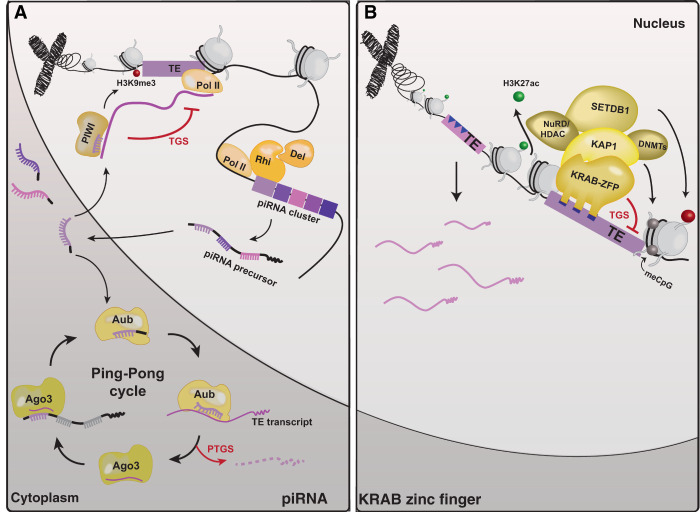
piRNA and KRAB-ZFPs: two host systems that recognize and silence TEs. (A) The piRNA pathway in D. melanogaster. Mature piRNAs re-enter the nucleus to perform transcriptional gene silencing (TGS) or participate in the ping-pong cycle to perform posttranscriptional gene silencing (PTGS) of TEs. (Rhi) Rhino; (Del) Deadlock; (Aub) Aubergine; (Ago3) Argonaute 3. (B) The KRAB-ZFP pathway in tetrapods (see the text). (NURD) Nucleosome remodeling deacetylase; (HDAC) histone deacetylase; (DNMTs) DNA methyltransferases.
Figure 2.
Figure 2.
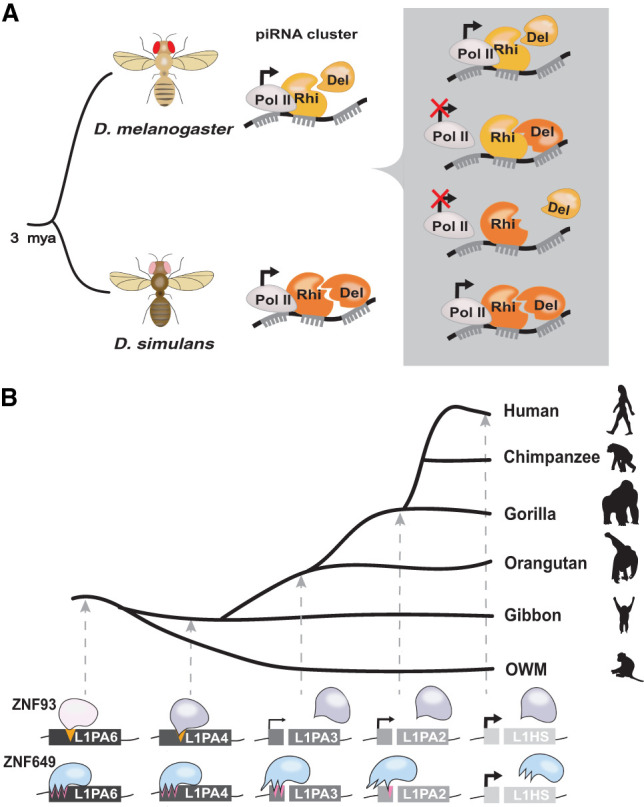
Evidence of host–TE arms races. (A) D. melanogaster–D. simulans Rhino–Deadlock incompatibility. (Rhi) Rhino; (Del) Deadlock; (Pol II) RNA polymerase II. D. melanogasterD. simulans Rhino/Deadlock proteins cannot complement to transcribe piRNA clusters (see the text). (B) ZNF93- and ZNF649-mediated silencing of primate L1 elements. Older L1 primate families are silenced by ZNF93 and ZNF649, but younger L1 families lack ZNF93- and ZNF649-binding sites and are not silenced.
Figure 3.
Figure 3.
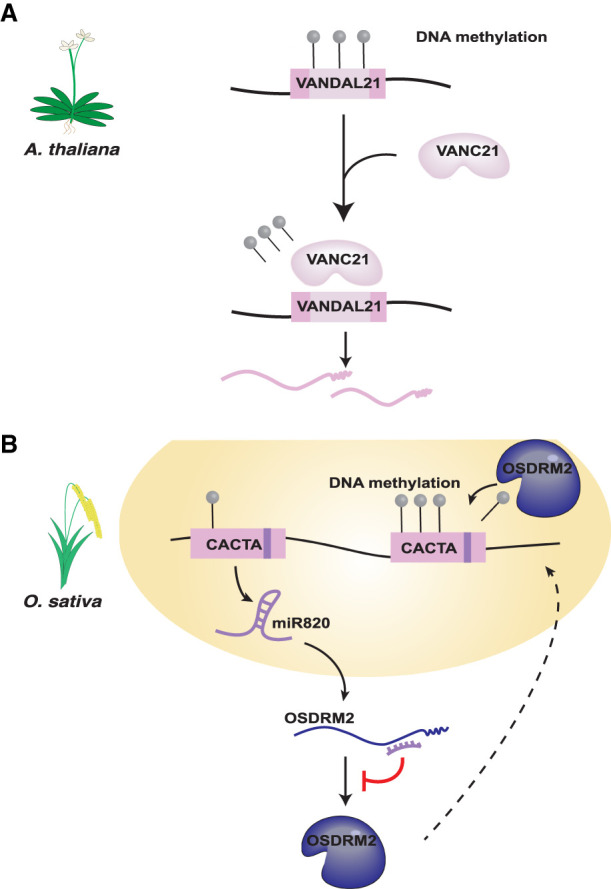
Evidence of TE counterdefense (A) VANDAL21 elements in Arabidopsis thaliana encode VANC21, which inhibits host DNA methylation (gray circles) of VANDAL21 elements. (B) Some CACTA DNA transposons in O. sativa encode a miRNA, mir820, which basepairs with OsDRM2 mRNA and reduces translation of OsDRM2, a DNA methyltransferase.
Figure 4.
Figure 4.
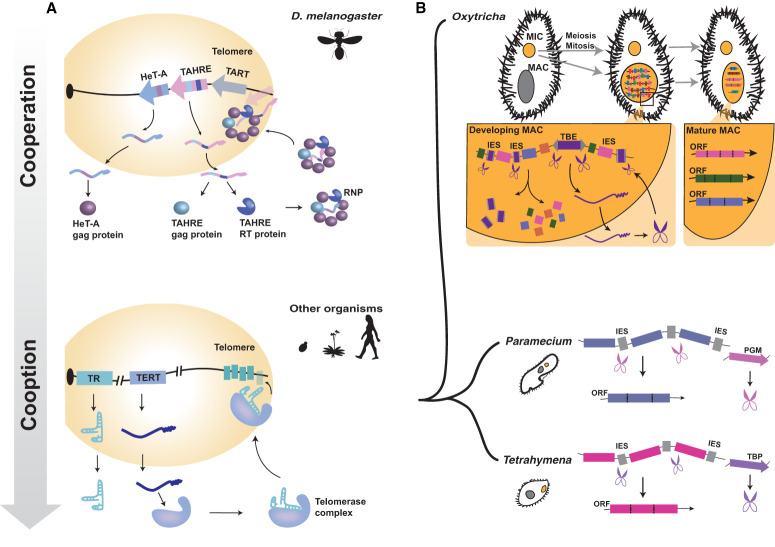
Cooperation paves the way for cooption. (A) Drosophila telomeric transposons as a potential model for telomerase evolution. In D. melanogaster, three non-LTR transposons families maintain telomeres. Telomeric elements form a head-to-tail array in the telomere. Gag and reverse transcriptase (RT) proteins from HeT-A, TAHRE, and TART complex with their cognate mRNAs, forming a RNP complex capable of telomere elongation. In other organisms, telomerase reverse transcriptase (TERT) and telomerase RNA (TR) form the telomerase complex, which maintains telomeres. (B) Transposase proteins necessary for germline internal eliminated sequence (IES) elimination in Tetrahymena and Paramecium may have evolved from a mechanism analogous to TBE excision in Oxytricha (see the text). In the developing Oxytricha somatic macronucleus (MAC), TBE transposases excise IESs. Subsequent steps stitch together exons into single-gene chromosomes, which are amplified to thousands of copies in the mature MAC. In Paramecium and Tetrahymena, PiggyBac-derived proteins are domesticated for IES recognition and excision. (Pgm) PiggyMac and interactors; (TBP) Tetrahymena piggyBac-like. Scissors represent transposase proteins, and arrows represent genes.
Figure 5.
Figure 5.
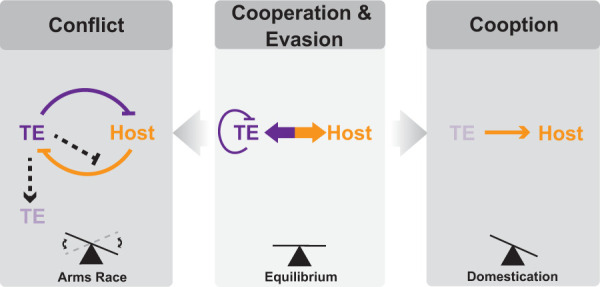
Model for host–TE interactions. Conflict: TEs (purple) harm the host (orange), leading to host silencing of TEs. TEs occasionally evolve direct antisilencing mechanisms (dashed line). Most host–TE conflict leads to TE death. Cooperation and evasion: TEs evolve self-regulatory mechanisms to mitigate impacts on host fitness. Hosts and TEs can also evolve a mutualistic relationship. Cooperation can lead to both conflict and cooption. Cooption: Host repurposes all or part of a TE for novel host function at the expense of the TE.

References

    1. Ade C, Roy-Engel AM, Deininger PL. 2013. Alu elements: an intrinsic source of human genome instability. Curr Opin Virol 3: 639–645. 10.1016/j.coviro.2013.09.002 - DOI - PMC - PubMed
    1. Arensburger P, Megy K, Waterhouse RM, Abrudan J, Amedeo P, Antelo B, Bartholomay L, Bidwell S, Caler E, Camara F, et al. 2010. Sequencing of Culex quinquefasciatus establishes a platform for mosquito comparative genomics. Science 330: 86–88. 10.1126/science.1191864 - DOI - PMC - PubMed
    1. Augé-Gouillou C, Hamelin MH, Demattei MV, Periquet M, Bigot Y. 2001. The wild-type conformation of the Mos-1 Inverted terminal repeats is suboptimal for transposition in bacteria. Mol Gen Genomics 265: 51–57. 10.1007/s004380000385 - DOI - PubMed
    1. Bagijn MP, Goldstein LD, Sapetschnig A, Weick E-M, Bouasker S, Lehrbach NJ, Simard MJ, Miska EA. 2012. Function, targets, and evolution of Caenorhabditis elegans piRNAs. Science 337: 574–578. 10.1126/science.1220952 - DOI - PMC - PubMed
    1. Batista PJ, Ruby JG, Claycomb JM, Chiang R, Fahlgren N, Kasschau KD, Chaves DA, Gu W, Vasale JJ, Duan S, et al. 2008. PRG-1 and 21U-RNAs interact to form the piRNA complex required for fertility in C. elegans. Mol Cell 31: 67–78. 10.1016/j.molcel.2008.06.002 - DOI - PMC - PubMed

Publication types

Substances