


The pathohistological subtype strongly predicts survival in patients with ampullary carcinoma
- PMID: 31481741
- PMCID: PMC6722235
- DOI: 10.1038/s41598-019-49179-w
The pathohistological subtype strongly predicts survival in patients with ampullary carcinoma
Abstract
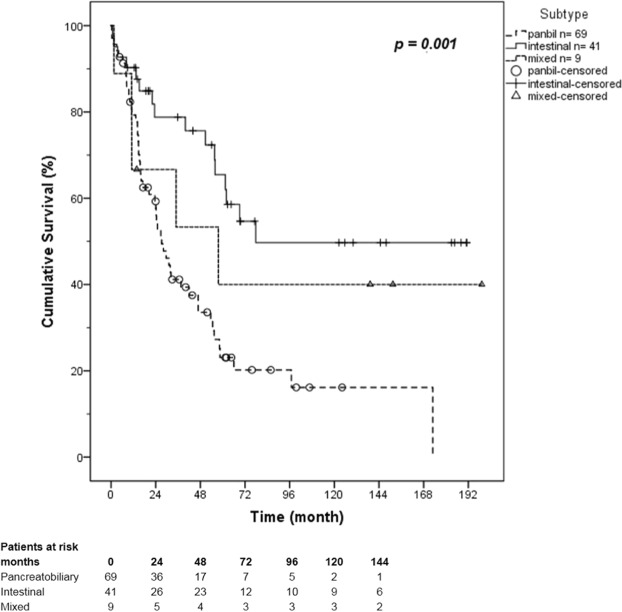
Ampullary cancer represents approximately 6% of the malignant periampullary tumors. An early occurrence of symptoms leads to a 5-year survival rate after curative surgery of 30 to 67%. In addition to the tumor stage, the immunohistological subtypes appear to be important for postoperative prognosis. The aim of this study was to analyze the different subtypes regarding their prognostic relevance. A total of 170 patients with ampullary cancer were retrospectively analyzed between 1999 until 2016 after pancreatic resection. Patients were grouped according to their pathohistological subtype of ampullary cancer (pancreatobiliary, intestinal, mixed). Characteristics among the groups were analyzed using univariate and multivariate models. Survival probability was analyzed by the Kaplan-Meier method. An exact subtyping was possible in 119 patients. A pancreatobiliary subtype was diagnosed in 69 patients (58%), intestinal in 41 patients (34.5%), and a mixed subtype in 9 patients (7.6%). Survival analysis showed a significantly worse 5-year survival rate for the pancreatobiliary subtype compared with the intestinal subtype (27.5% versus 61%, p < 0.001). The mean overall survival of patients with pancreatobiliary, intestinal, and mixed subtype was 52.5, 115 and 94.7 months, respectively (p < 0.001). The pathohistological subtypes of ampullary cancer allows a prediction of the postoperative prognosis.
Conflict of interest statement
The authors declare no competing interests.
Figures
References
MeSH terms
Substances
LinkOut - more resources
Full Text Sources
