. 2019 Nov;12(6):1327-1335.
doi: 10.1038/s41385-019-0200-2. Epub 2019 Sep 3.

Intestinal proteomic analysis of a novel non-human primate model of experimental colitis reveals signatures of mitochondrial and metabolic dysfunction

Affiliations

Intestinal proteomic analysis of a novel non-human primate model of experimental colitis reveals signatures of mitochondrial and metabolic dysfunction

Peter McQueen et al. Mucosal Immunol. 2019 Nov.

Abstract

Animal models recapitulating features of chronic colitis, such as ulcerative colitis, Crohn's disease, or HIV infection, are critical to study disease pathogenesis and test novel therapeutics. In this study, we used a proteomics approach to explore the molecular intestinal response in two rhesus macaque (RM) animal models of experimentally induced colitis using dextran sulfate sodium (DSS) and simian immunodeficiency virus (SIV) infection. Proteomic analysis detected more than 2500 proteins in colonic tissue collected from 30 RMs. Differential protein expression analysis revealed a protein expression pattern in DSS-treated RMs resembling the proteome of human ulcerative colitis. In a group of 12 DSS-treated RMs compared to 6 with no treatment, decrease in expression of proteins related to mitochondrial energy metabolism, including fatty acid metabolism was noted, while innate immune activation pathways, including complement and coagulation proteins were upregulated. SIV infection of RMs resulted in increased innate immune responses related to viral defense. Proteomic signatures of barrier damage were apparent in both DSS treatment or SIV infection. These results demonstrate that DSS treatment in a non-human primate model resembles features of human ulcerative colitis, making this a promising tool to study important immunological mechanisms in inflammatory bowel disease.


Conflict of interest statement

Competing interests: The authors declare no competing interests.

Figures

Fig. 1
Fig. 1
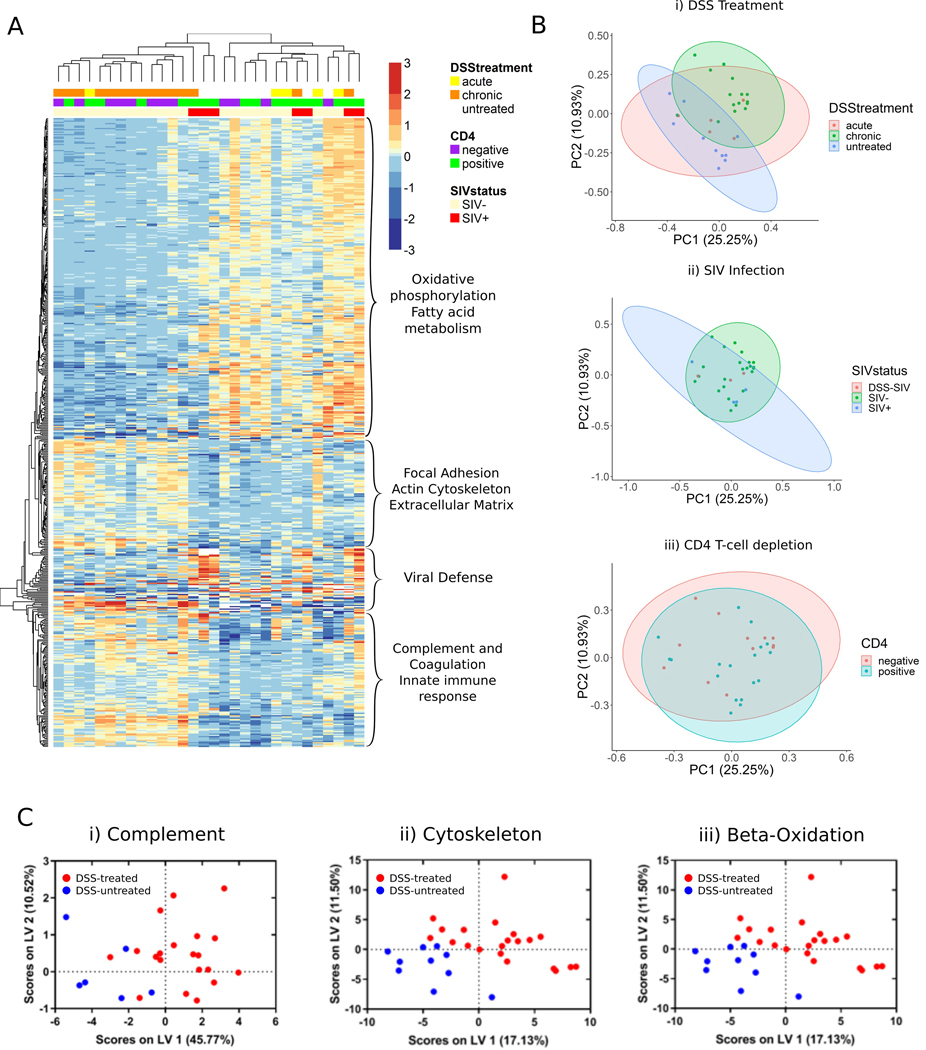
Overview of colon protein expression in a chemically induced and SIV rhesus macaque model of ulcerative colitis. a Subject PCA plots demonstrating the effect of (i) DSS treatment and (ii) SIV infection on protein expression. PCA plots show two separate clusters for untreated and DSS-treated RMs. RMs with acute DSS treatment are distributed between untreated and treated clusters. SIV+ RMs tended to cluster with RMs not treated with DSS. RMs treated with both SIV and DSS tended to cluster with RMs without DSS treatment. b (i) Heatmap of 425 differentially expressed proteins between DSS-untreated (n = 6), and DSS chronic RMs (n = 12, adjusted p value<0.05, BH correction). Protein expression is also shown for RMs with acute DSS treatments (n = 5). Main functions based on DAVID analysis (adjusted p value <0.05, BH correction) are listed to the right of each cluster. Major downregulated pathways included oxidative phosphorylation, fatty acid metabolism, and butanoate metabolism. Upregulated pathways included complement and coagulation cascades, ribosomal pathways, and regulation of the actin cytoskeleton. (ii) Heatmap of 37 upregulated proteins in SIV+ RMs against DSS-untreated RMs. DAVID analysis of two clusters (adjusted p value <0.05, BH correction) revealed upregulation of defense response to virus and proteasome complex proteins. (c) Biological pathways were analyzed for their ability to classify DSS-untreated RMs (DSS untreated, SIV+ RMs, n = 10) from DSS-treated RMs (DSS acute, DSS chronic, DSS SIV+ n = 20). (i) Thirteen complement components were detected in the dataset and were able to classify DSS-treated RMs (red) from non-treated RMs (blue) with 90.2% calibration (Cal) accuracy and 67.4% cross-validation (CV) accuracy. (ii) One hundred and twenty eight proteins involved in cytoskeletal processes showed a 97.2% Cal accuracy and 76.9% CV accuracy. (iii) Seventeen proteins involved in β-oxidization of fatty acids were also able to distinguish DSS-treated RMs with 80.7% Cal accuracy and 60.3% CV accuracy
Fig. 2
Fig. 2
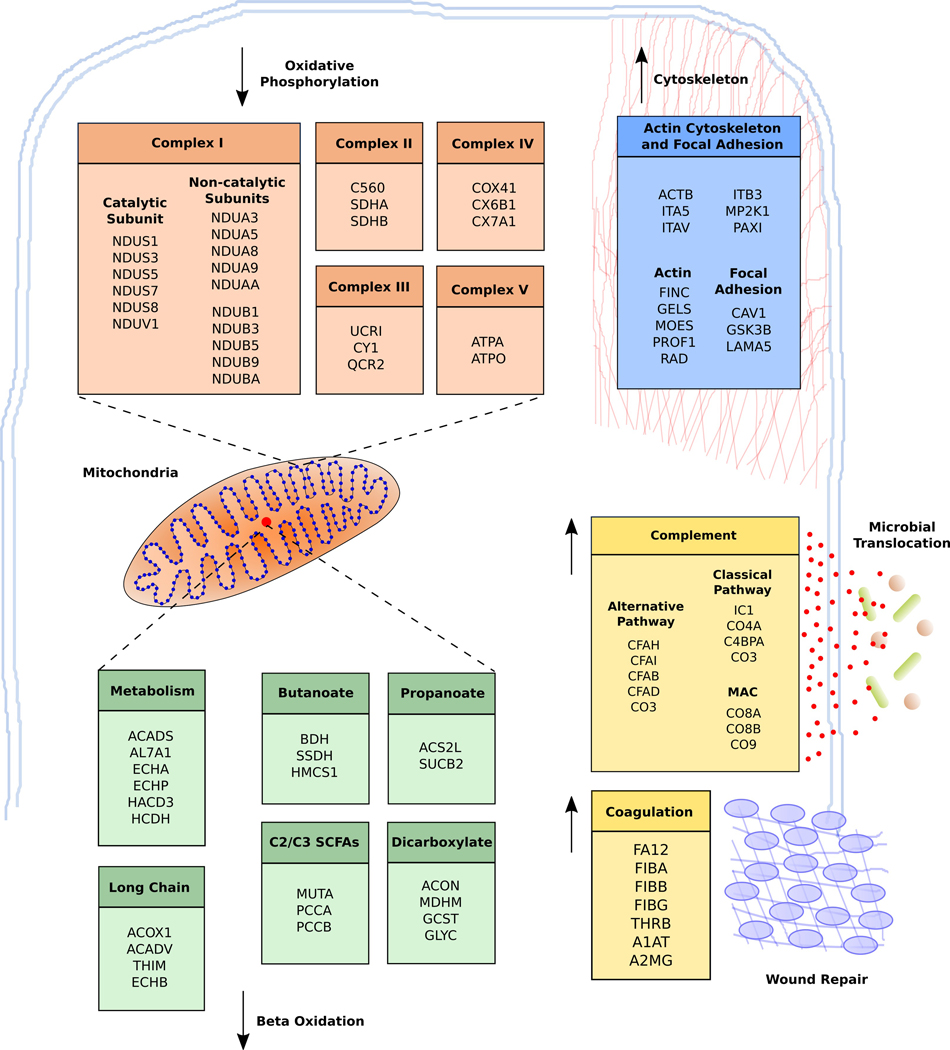
Outline of the effects of DSS treatment on the colon tissue proteome of rhesus macaques. List of significantly regulated proteins (adjusted p value <0.05, BH correction) between DSS chronic and DSS-untreated RMs. Multiple components belonging to each of the five complexes important in oxidative phosphorylation were downregulated. Enzymes involved in short- and long-chain fatty acid metabolism inside the mitochondria were also downregulated. Upregulated components include proteins involved in the actin cytoskeleton and focal adhesion. There was also significant upregulation of complement components related to innate immune activation and coagulation. All pathways were determined to be significantly upregulated in DSS chronic RMs as per DAVID analysis (adjusted p value <0.05, BH correction)
Fig. 3
Fig. 3
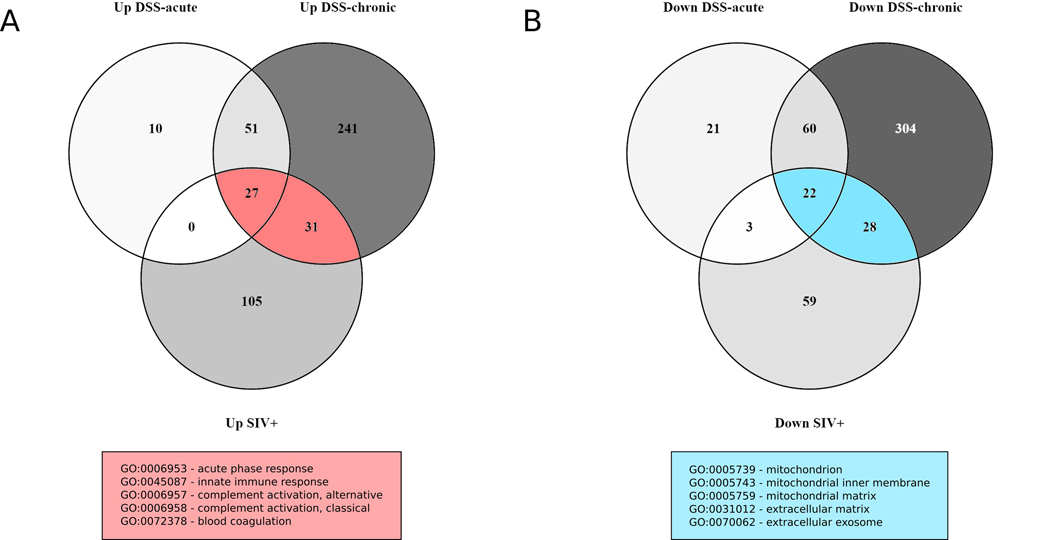
Venn diagrams showing overlap in differential protein expression in DSS-treated and SIV-infected RMs for upregulated (a) and downregulated (b) proteins (non-adjusted p value <0.05). Representative up- or downregulated biological processes are shown for overlapping proteins in DSS-treated and SIV+ RMs (DAVID analysis, BH-adjusted p value <0.05). The majority of proteins up- and downregulated in the DSS acute treatment groups overlapped with those upregulated in the DSS chronic group. There was a total of 58 and 53 up- and downregulated proteins, respectively, detected in both DSS-treated and SIV+ RMs demonstrating overlap between response to DSS treatment and SIV infection

References

    1. Molodecky NA et al. Increasing incidence and prevalence of the inflammatory bowel diseases with time, based on systematic review. Gastroenterology 142, 46–54 e42 (2012). quiz e30. - PubMed
    1. de Souza HS & Fiocchi C Immunopathogenesis of IBD: current state of the art.Nat. Rev. Gastroenterol. Hepatol 13, 13–27 (2016). - PubMed
    1. Baumgart DC & Sandborn WJ Inflammatory bowel disease: clinical aspects and established and evolving therapies. Lancet 369, 1641–1657 (2007). - PubMed
    1. Kozuch PL & Hanauer SB Treatment of inflammatory bowel disease: a review of medical therapy. World J. Gastroenterol. 14, 354–377 (2008). - PMC - PubMed
    1. DeVoss J & Diehl L Murine models of inflammatory bowel disease (IBD): challenges of modeling human disease. Toxicol. Pathol. 42, 99–110 (2014). - PubMed

Publication types

MeSH terms

Substances