


Outcomes and Predictors of Mortality in Hospitalized Frail Patients Undergoing Percutaneous Coronary Intervention
- PMID: 31482044
- PMCID: PMC6701902
- DOI: 10.7759/cureus.5399
Outcomes and Predictors of Mortality in Hospitalized Frail Patients Undergoing Percutaneous Coronary Intervention
Abstract
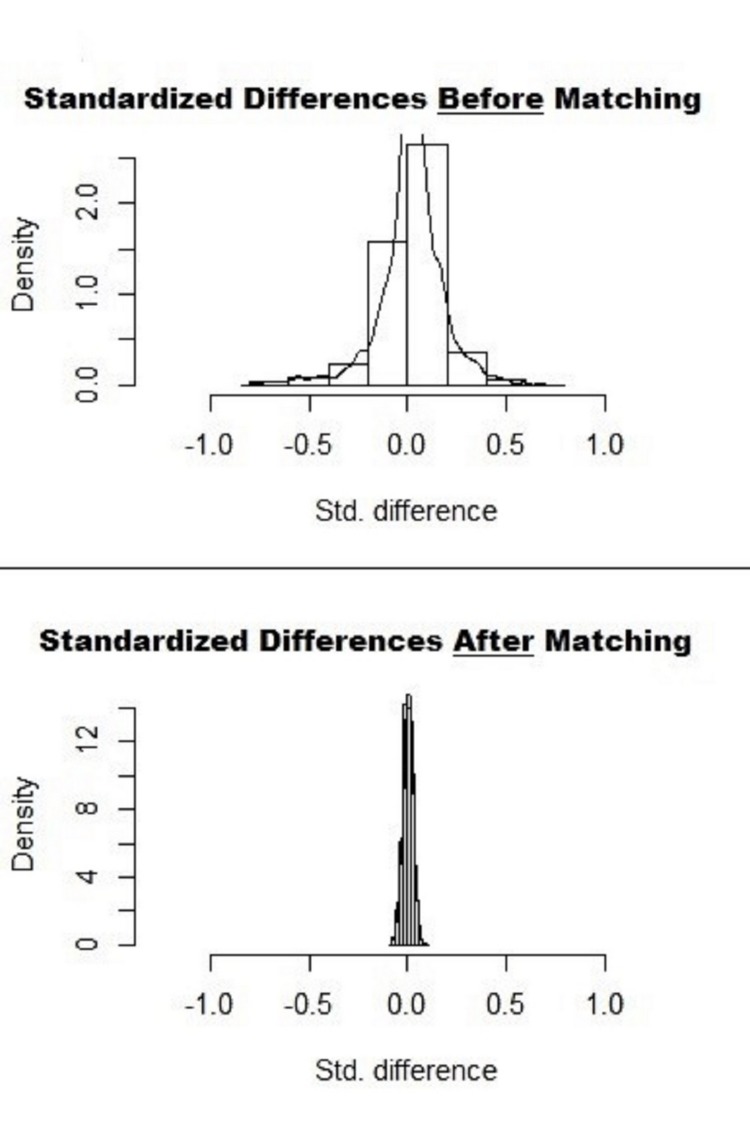
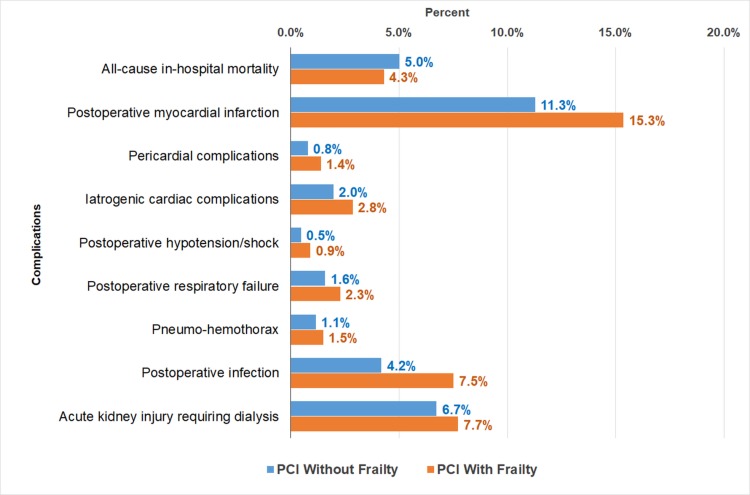
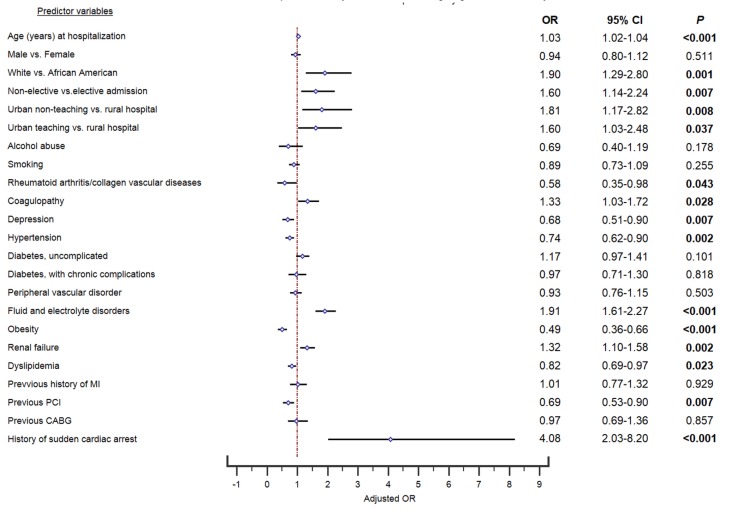
Objective To study the impact of frailty on inpatient outcomes among patients undergoing percutaneous coronary intervention (PCI). Methods The National Inpatient Sample data of all PCI-related hospitalizations throughout the United States (US) from 2010 through 2014 was utilized. Patients were divided into two groups: frailty and no-frailty. International Classification of Diseases, Ninth Revision, Clinical Modification (ICD-9-CM) codes were used to stratify groups and outcomes. In order to address the substantial difference in the total number of valid observations between the two groups, a propensity-matched analysis was performed at a 1:1 ratio and caliper width of 0.01. Results A total of 2,612,661 PCI-related hospitalizations throughout the US from 2010 through 2014 were identified, out of which 16,517 admissions (0.6%) had coexisting frailty. Only 1:1 propensity-matched data was utilized for the study. Propensity-matched frailty group (n=14,717) as compared to no-frailty (n=14,755) was frequently older, white, and Medicare enrollee (p<0.05). The frailty group had significantly higher rates of comorbidities and complications (p<0.05). All-cause in-hospital mortality was higher in the no-frailty group (p<0.05). Age, white race, non-elective admission, urban hospitals, and comorbidities predicted in-hospital mortality in frailty group (p<0.05). Rheumatoid arthritis, depression, hypertension, obesity, dyslipidemia, and history of previous PCI decreased odds of in-hospital mortality in frailty group (p<0.05). Frailty group had prolonged hospital stay and higher hospital charges (p<0.05). Conclusions Frailty has a significant effect on PCI-related outcomes. We present a previously unknown protective effect of cardiovascular disease risk factors and other health risk factors on frail patients undergoing PCI. Frailty's inclusion in risk stratification will help in predicting the post-procedure complications and improve resource utilization.
Keywords: all-cause mortality; cardiovascular outcomes; frailty.
Conflict of interest statement
The authors have declared that no competing interests exist.
Figures
References
-
- Frailty in older adults: evidence for a phenotype. Fried LP, Tangen CM, Walston J, et al. J Gerontol A Biol Sci Med Sci. 2001;56:146–156. - PubMed
-
- Association between gait speed as a measure of frailty and risk of cardiovascular events after myocardial infarction. Matsuzawa Y, Konishi M, Akiyama E, et al. J Am Coll Cardiol. 2013;61:1964–1972. - PubMed
-
- 2015 ACC/AHA/SCAI focused update on primary percutaneous coronary intervention for patients with ST-elevation myocardial infarction: an update of the 2011 ACCF/AHA/SCAI guideline for percutaneous coronary intervention and the 2013 ACCF/AHA guideline for the management of ST-elevation myocardial infarction: a report of the American College of Cardiology/American Heart Association Task Force on Clinical Practice Guidelines and the Society for Cardiovascular Angiography and Interventions. Endorsed by the Latin American Society of Interventional Cardiology, PCI Writing Committee, Levine GN, et al. Catheter Cardiovasc Interv. 2016;87:1001–1019. - PubMed
-
- The immune system in atherosclerosis. Hansson GK, Hermansson A. Nat Immunol. 2011;12:204–212. - PubMed
LinkOut - more resources
Full Text Sources
Miscellaneous