Clinical Trial
. 2019 Sep;68(9):1547-1559.
doi: 10.1007/s00262-019-02383-z. Epub 2019 Sep 3.

A phase II study of the L19IL2 immunocytokine in combination with dacarbazine in advanced metastatic melanoma patients

Affiliations
Clinical Trial

A phase II study of the L19IL2 immunocytokine in combination with dacarbazine in advanced metastatic melanoma patients

Benjamin Weide et al. Cancer Immunol Immunother. 2019 Sep.

Abstract

Engineered cytokine products represent promising agents for the treatment of immunogenic tumors, such as malignant melanoma, in addition to immune checkpoint inhibitors. Here we describe the results of a controlled, randomized phase II clinical trial, aimed at assessing the therapeutic potential of L19IL2, a fully human fusion protein consisting of the L19 antibody specific to the alternatively spliced extra-domain B of fibronectin, fused to human interleukin-2 in advanced metastatic melanoma. In one arm, patients received dacarbazine (DTIC; 1000 mg/m2 of body surface on day 1 of 21-day cycles) as single agent, while in two other arms L19IL2 (22.5 million international units of IL2 equivalents) was added, based on two different schedules of administration. In total, 69 patients with stage IV melanoma were enrolled (24 in the dacarbazine arm, 23 and 22 in the other combination arms, respectively) and 67 received treatment. Analyses of efficacy results show a statistically significant benefit in terms of overall response rate and median progression-free survival for patients receiving L19IL2 in combination with DTIC, compared to DTIC as single agent. In light of these results, further clinical investigations with L19IL2 (alone or in combination with other agents) are warranted.

Keywords: Dacarbazine; Immunocytokine; L19IL2; Phase II study; Stage IV melanoma.


Conflict of interest statement

Benjamin Weide has received speaker or advisory board honoraria from Amgen, CureVac, Philogen, Novartis as well as research funding from Bristol-Myers Squibb (BMS), Merck, Sharp & Dohme (MSD) and Philogen. Paolo Ascierto reports grants and personal fees from BMS, grants and personal fees from Roche-Genentech, personal fees from MSD, grants and personal fees from Array, personal fees from Novartis, personal fees from Merck Serono, personal fees from Pierre Fabre, personal fees from Incyte, personal fees from Genmab, personal fees from NewLink Genetics, personal fees from Medimmune, personal fees from AstraZeneca, personal fees from Syndax, personal fees from Sun Pharma, personal fees from Sanofi, personal fees from Idera, personal fees from Ultimovacs, personal fees from Sandoz, personal fees from Immunocore, personal fees from 4SC, outside the submitted work; Jürgen C. Becker has received speaker honoraria from Amgen, Merck Serono, and Pfizer, advisory board honoraria from Amgen, CureVac, eTheRNA, Lytix, Merck Serono, Novartis, Rigontec, and Takeda as well as research funding from Alcedis, Boehringer Ingelheim, BMS and Merck Serono; he also received travel support from 4SC and Incyte; Axel Hauschild received clinical trial support, speaker´s honoraria, or consultancy fees from the following companies: Amgen, BMS, Merck Serono, MSD, Novartis, Philogen, Pierre Fabre, Provectus, Regeneron, Roche, OncoSec, Sanofi-Genzyme, and Sun Pharma; Reinhard Dummer reports intermittent, project focused consulting and/or advisory relationships with Novartis, MSD, BMS, Roche, Amgen, Takeda, Pierre Fabre, Sun Pharma, Sanofi, Catalym, Second Genome outside the submitted work; Giuliano Elia is an employee of Philochem AG, a company of the Philogen group; Dario Neri is shareholder and Board Member of Philogen S.p.A.; Claus Garbe reports personal fees from Philogen, during the conduct of the study; personal fees from Amgen, personal fees from MSD, grants and personal fees from Novartis, personal fees from NeraCare, grants and personal fees from BMS, personal fees from Philogen, grants and personal fees from Roche, grants and personal fees from Sanofi, outside the submitted work. All other authors declare no conflict of interest.

Figures
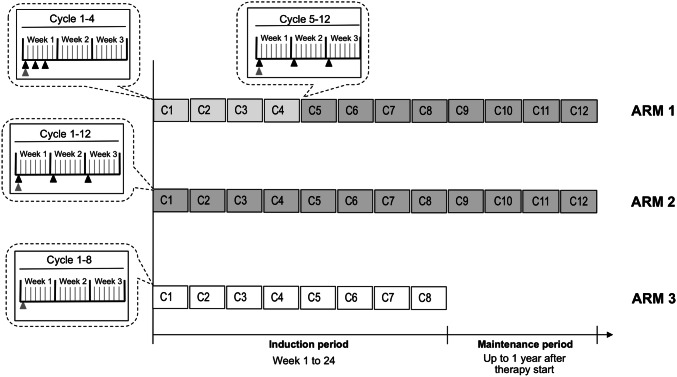
Fig. 1
Fig. 1
Administration Schedule of L19IL2 and DTIC in the three arms of the study. Schematic representation of the administration schedule of L19IL2 and DTIC in the three arms of the randomized Phase II study. A detailed view of one single cycle is shown in the callouts on the left hand side and on top. Black triangle L19IL2; grey triangle DTIC. Arm 1 used the previously tested schedule (L19IL2 administrations on days 1, 3 and 5 of each 21-day cycle; light grey squares) during the first four cycles, followed by weekly administrations of L19IL2 (dark grey squares). Patients in Arm 2 received directly weekly administration of the immunocytokine (dark squares). DTIC was administered once on day 1 of each cycle (all Arms). In Arm 3 (empty squares), although the protocol foresaw a maximum of eight cycles of DTIC treatment, responders would be allowed to continue with the same treatment until progression
Fig. 2
Fig. 2
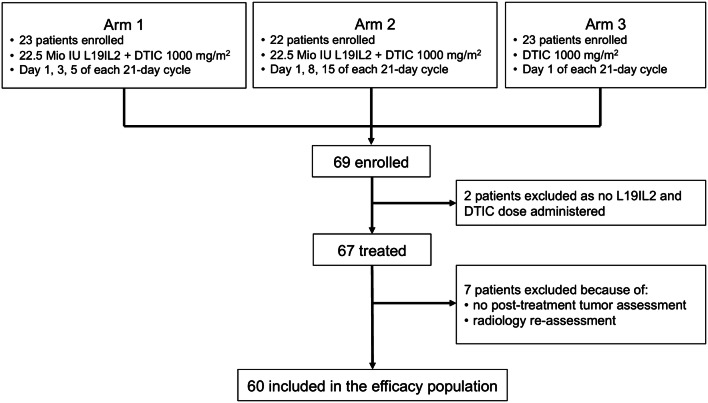
Flowchart of trial profile and patient allocation to each treatment arm
Fig. 3
Fig. 3
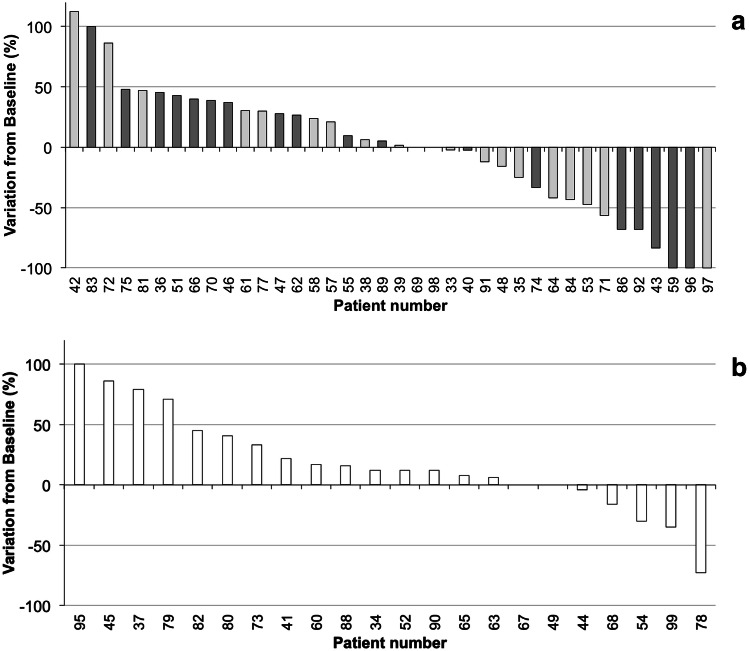
Waterfall plot of best objective response for target lesions. Waterfall plot of the best response recorded for each patient evaluable for efficacy in the randomized phase II study. a Waterfall plot of the best response for patients who received L19IL2/DTIC; light gray bars = Arm 1 patients, dark gray bars = Arm 2 patients. b Waterfall plot of the best response for patients who received DTIC alone (Arm 3)
Fig. 4
Fig. 4
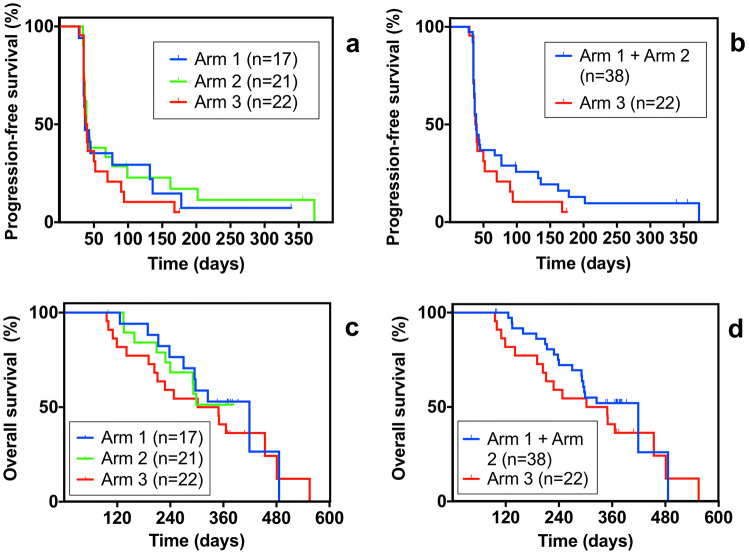
Kaplan–Meier curves for the progression-free survival and overall survival. a Kaplan–Meier curves showing progression-free survival (PFS) recorded in all efficacy-evaluable patients treated in the randomized phase II study (Arm 1 = blue line; Arm 2 = green line; Arm 3 = red line). b Kaplan–Meier curves of PFS for the 38 patients treated with L19IL2/DTIC (Arm 1 + Arm 2; blue line) and for patients treated with DTIC alone (Arm 3; red line). c Kaplan–Meier curves showing overall survival (OS) for patients of Arm 1 (blue line), Arm 2 (green line) and Arm 3 (red line), recorded in the randomized phase II study. d Kaplan–Meier curves showing OS recorded in all 38 efficacy-evaluable patients treated with L19IL2/DTIC in the phase II study (Arm 1 + Arm 2; blue line) and in the 22 efficacy-evaluable patients treated with DTIC alone (Arm 3; red line)
Fig. 5
Fig. 5
Examples of responses in patients of the controlled phase II. a CT images of four different pulmonary coin lesions (I–IV) of patient No. 43. The patient was randomized to Arm 2 of the study and presented at baseline with four pulmonary coin lesions (RECIST score 35.3). Already at week 6, the patient enjoyed a partial response (decrease of 41% in RECIST score), which improved over time reaching an 82% reduction of RECIST score (5.8) on week 24. This partial response was still continuing when the patient was dismissed at the end of study (week 52; not shown). Lesions are indicated by green arrows. b CT images of a paratracheal lymph node of patient No. 97 (best response 100%). The patient was randomized to Arm 1 of the study and presented at baseline with a paratracheal and a pre-carinal (not shown) lymph node metastasis (RECIST score 35.0). Also in this case, already at week 6 both lymph nodes returned to a size of < 1.0 cm (complete response) and remained of normal size until the patient was withdrawn from the study on investigator’s decision on week 36. The complete response, however, was still ongoing at week 52 from the beginning of treatment (not shown). A green arrow indicates the paratracheal lesion

References

    1. Korn EL, Liu PY, Lee SJ, et al. Meta-analysis of phase II cooperative group trials in metastatic stage IV melanoma to determine progression-free and overall survival benchmarks for future phase II trials. J Clin Oncol. 2008;26(4):527–534. doi: 10.1200/JCO.2007.12.7837. - DOI - PubMed
    1. Garbe C, Peris K, Hauschild A, et al. Diagnosis and treatment of melanoma: European consensus-based interdisciplinary guideline. Eur J Cancer. 2010;46(2):270–283. doi: 10.1016/j.ejca.2009.10.032. - DOI - PubMed
    1. Hodi FS, O’Day SJ, McDermott DF, et al. Improved survival with ipilimumab in patients with metastatic melanoma. N Engl J Med. 2010;363(8):711–723. doi: 10.1056/NEJMoa1003466. - DOI - PMC - PubMed
    1. Robert C, Ribas A, Wolchok JD, et al. Anti-programmed-death-receptor-1 treatment with pembrolizumab in ipilimumab-refractory advanced melanoma: a randomised dose-comparison cohort of a phase 1 trial. Lancet. 2014;384(9948):1109–1117. doi: 10.1016/S0140-6736(14)60958-2. - DOI - PubMed
    1. Robert C, Thomas L, Bondarenko I, et al. Ipilimumab plus dacarbazine for previously untreated metastatic melanoma. N Engl J Med. 2011;364(26):2517–2526. doi: 10.1056/NEJMoa1104621. - DOI - PubMed

Publication types