Therapeutic Positive Airway Pressure Level Predicts Response to Hypoglossal Nerve Stimulation for Obstructive Sleep Apnea
- PMID: 31482839
- PMCID: PMC6707043
- DOI: 10.5664/jcsm.7814
Therapeutic Positive Airway Pressure Level Predicts Response to Hypoglossal Nerve Stimulation for Obstructive Sleep Apnea
Abstract
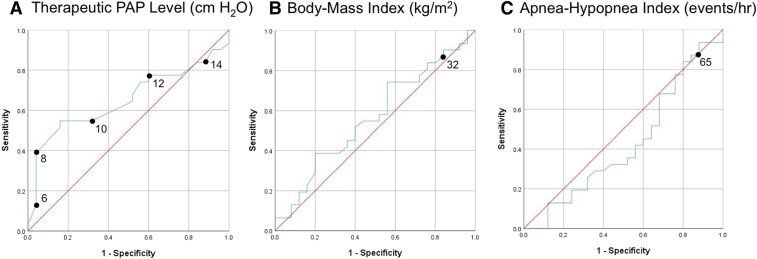
Study objectives: To determine whether therapeutic positive airway pressure (PAP) level predicts response to hypoglossal nerve stimulation (HGNS) for obstructive sleep apnea using the coprimary outcomes of apnea-hypopnea index (AHI) and 4% oxygen desaturation index.
Methods: Combined cohort study from two US sleep otolaryngology training programs. Subjects were adults with AHI > 15 events/h who underwent HGNS. Eligible subjects had diagnostic preoperative sleep studies, full-night efficacy postoperative studies and therapeutic PAP levels available for analysis. Low and high PAP groups were compared using the t test for continuous variables and chi-square test for categorical variables.
Results: Fifty-six patients met all inclusion criteria. On average, patients were male, Caucasian, middle-aged, and overweight. Thirteen patients were in the low PAP group (< 8 cm H₂O) and 43 patients in the high PAP group (≥ 8 cm H₂O). Although both groups experienced improvement of polysomnographic measures with HGNS, the low PAP group achieved a significantly larger mean AHI reduction (36.7 ± 22.7 versus 18.4 ± 23.4, P = .02). Additionally, the low PAP group had a greater response rate (defined as AHI < 20 events/h and > 50% reduction of AHI) than the high PAP group (92% versus 44%, P < .01).
Conclusions: Therapeutic PAP level may aid in the discernment of candidacy for HGNS, with a strong positive predictive value for PAP levels < 8 cm H₂O. A larger prospective study is needed to confirm these findings.
Citation: Lee CH, Seay EG, Walters BK, Scalzitti NJ, Dedhia RC. Therapeutic positive airway pressure level predicts response to hypoglossal nerve stimulation for obstructive sleep apnea. J Clin Sleep Med. 2019;15(8):1165-1172.
Keywords: hypoglossal nerve stimulation; obstructive sleep apnea; positive airway pressure; sleep surgery.
© 2019 American Academy of Sleep Medicine.
Figures
Comment in
-
A New Metric for Precision Medicine: PAP and Hypoglossal Neurostimulation.J Clin Sleep Med. 2019 Aug 15;15(8):1079-1080. doi: 10.5664/jcsm.7862. J Clin Sleep Med. 2019. PMID: 31482828 Free PMC article.
References
-
- Bradley TD, Floras JS. Obstructive sleep apnoea and its cardiovascular consequences. Lancet. 2009;373(9657):82–93. - PubMed
-
- Lal C, Strange C, Bachman D. Neurocognitive impairment in obstructive sleep apnea. Chest. 2012;141(6):1601–1610. - PubMed
-
- Marin JM, Carrizo SJ, Vicente E, Agusti AG. Long-term cardiovascular outcomes in men with obstructive sleep apnoea-hypopnoea with or without treatment with continuous positive airway pressure: an observational study. Lancet. 2005;365(9464):1046–1053. - PubMed
MeSH terms
Grants and funding
LinkOut - more resources
Full Text Sources
Research Materials
Miscellaneous