


Sociodemographic and health-related determinants for making repeated calls to a medical helpline: a prospective cohort study
- PMID: 31482858
- PMCID: PMC6720138
- DOI: 10.1136/bmjopen-2019-030173
Sociodemographic and health-related determinants for making repeated calls to a medical helpline: a prospective cohort study
Abstract
Objectives: To identify sociodemographic and health-related characteristics of callers' making repeated calls within 48 hours to a medical helpline, compared with those who only call once.
Setting: In the Capital Region of Denmark people with acute, non-life-threatening illnesses or injuries are triaged through a single-tier medical helpline for acute, healthcare services.
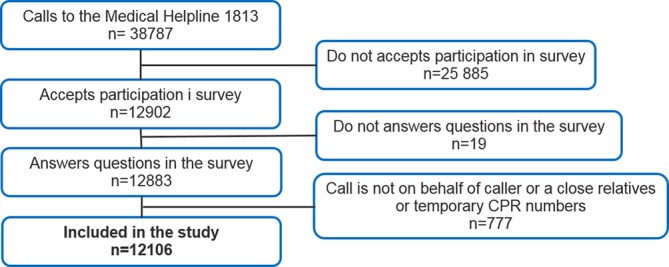
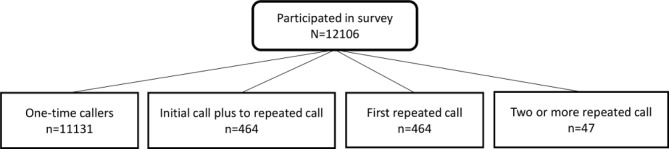
Participants: People who called the medical helpline between 18 January and 9 February 2017 were invited to participate in the survey. During the period, 38 787 calls were handled and 12 902 agreed to participate. Calls were excluded because of the temporary civil registration number (n=78), the call was not made by the patient or a close relative (n=699), or survey responses were incomplete (n=19). Hence, the analysis included 12 106 calls, representing 11.131 callers' making single calls and 464 callers' making two or more calls within 48 hours. Callers' data (age, sex and caller identification) were collected from the medical helpline's electronic records. Data were enriched using the callers' self-rated health, self-evaluated degree of worry, and registry data on income, ethnicity and comorbidities. The OR for making repeated calls was calculated in a crude, sex-adjusted and age-adjusted analysis and in a mutually adjusted analysis.
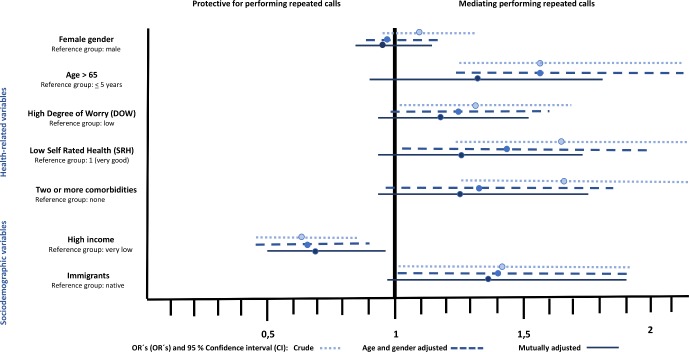
Results: The crude logistic regression analysis showed that age, self-rated health, self-evaluated degree of worry, income, ethnicity and comorbidities were significantly associated with making repeated calls. In the mutually adjusted analysis associations decreased, however, odds ratios remained significantly decreased for callers with a household income in the middle (OR=0.71;95% CI 0.54 to 0.92) or highest (OR=0.68;95% CI 0.48 to 0.96) quartiles, whereas immigrants had borderline significantly increased OR (OR=1.34;95% CI 0.96 to 1.86) for making repeated calls.
Conclusions: Findings suggest that income and ethnicity are potential determinants of callers' need to make additional calls within 48 hours to a medical helpline with triage function.
Keywords: organisation of health services; quality In health care.
© Author(s) (or their employer(s)) 2019. Re-use permitted under CC BY-NC. No commercial re-use. See rights and permissions. Published by BMJ.
Conflict of interest statement
Competing interests: None declared.
Figures
References
-
- Wadmann SKJ. Evaluering af enstrenget og visiteret akutsystem i Region Hovedstaden. Sammenfatning. Det nationale institut for komuners og regioners analyse og forskning 2015.
MeSH terms
LinkOut - more resources
Full Text Sources
Medical
Miscellaneous
