Opioid Prescribing After Surgery in the United States, Canada, and Sweden
- PMID: 31483475
- PMCID: PMC6727684
- DOI: 10.1001/jamanetworkopen.2019.10734
Opioid Prescribing After Surgery in the United States, Canada, and Sweden
Abstract
Importance: Small studies and anecdotal evidence suggest marked differences in the use of opioids after surgery internationally; however, this has not been evaluated systematically across populations receiving similar procedures in different countries.
Objective: To determine whether there are differences in the frequency, amount, and type of opioids dispensed after surgery among the United States, Canada, and Sweden.
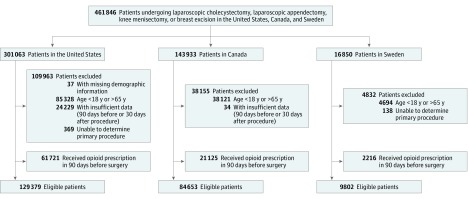
Design, setting, and participants: This cohort study included patients without previous opioid prescriptions aged 16 to 64 years who underwent 4 low-risk surgical procedures (ie, laparoscopic cholecystectomy, laparoscopic appendectomy, arthroscopic knee meniscectomy, and breast excision) between January 2013 and December 2015 in the United States, between July 2013 and March 2016 in Canada, and between January 2013 and December 2014 in Sweden. Data analysis was conducted in all 3 countries from July 2018 to October 2018.
Main outcomes and measures: The main outcome was postoperative opioid prescriptions filled within 7 days after discharge; the percentage of patients who filled a prescription, the total morphine milligram equivalent (MME) dose, and type of opioid dispensed were compared.
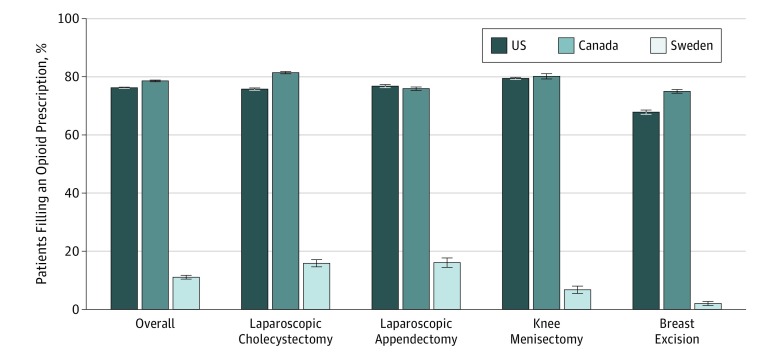
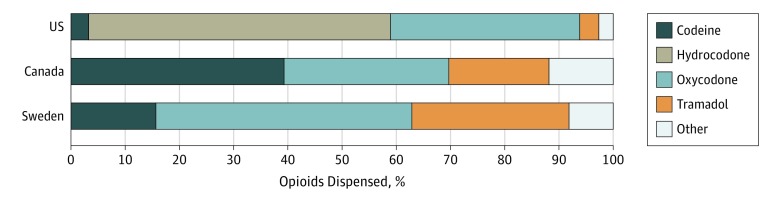
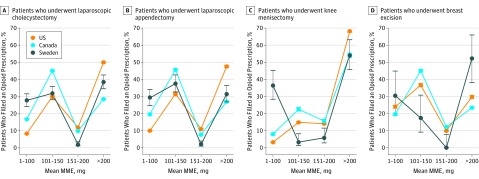
Results: The study sample consisted of 129 379 patients in the United States, 84 653 in Canada, and 9802 in Sweden. Overall, 52 427 patients (40.5%) in the United States were men, with a mean (SD) age of 45.1 (12.7) years; in Canada, 25 074 patients (29.6%) were men, with a mean (SD) age of 43.5 (13.0) years; and in Sweden, 3314 (33.8%) were men, with a mean (SD) age of 42.5 (13.0). The proportion of patients in Sweden who filled an opioid prescription within the first 7 days after discharge for any procedure was lower than patients treated in the United States and Canada (Sweden, 1086 [11.1%]; United States, 98 594 [76.2%]; Canada, 66 544 [78.6%]; P < .001). For patients who filled a prescription, the mean (SD) MME dispensed within 7 days of discharge was highest in United States (247 [145] MME vs 169 [93] MME in Canada and 197 [191] MME in Sweden). Codeine and tramadol were more commonly dispensed in Canada (codeine, 26 136 patients [39.3%]; tramadol, 12 285 patients [18.5%]) and Sweden (codeine, 170 patients [15.7%]; tramadol, 315 patients [29.0%]) than in the United States (codeine, 3210 patients [3.3%]; tramadol, 3425 patients [3.5%]).
Conclusions and relevance: The findings indicate that the United States and Canada have a 7-fold higher rate of opioid prescriptions filled in the immediate postoperative period compared with Sweden. Of the 3 countries examined, the mean dose of opioids for most surgical procedures was highest in the United States.
Conflict of interest statement
Figures
Comment in
-
Opioid Prescribing After Surgery-Cause for Concern?JAMA Netw Open. 2019 Sep 4;2(9):e1910721. doi: 10.1001/jamanetworkopen.2019.10721. JAMA Netw Open. 2019. PMID: 31483466 No abstract available.
References
Publication types
MeSH terms
Substances
Grants and funding
LinkOut - more resources
Full Text Sources
Other Literature Sources
Medical
Miscellaneous